
Review · GAUDI HOUSE TOURS
Barcelona: La Pedrera-Casa Milà Ticket & Audio Guide Option
Gaudí’s strangest house rewards a slow look. Casa Milà, better known as La Pedrera, gives you two things I especially like: fast access inside and the freedom to explore at your own pace with an audio guide. The rooftop chimneys are the star, while the Espai Gaudí exhibition helps explain how the architect turned natural forms into bold structural ideas.
The main drawback is price. At about $33 per person, this is not a casual pop-in, especially if you are already paying to see several Barcelona sights. Rain can also close the roof terrace, with no full or partial ticket refund, so weather matters.
In This Review
- Key points before you book
- Why Casa Milà deserves a place on your Barcelona list
- Entering from Passeig de Gràcia
- The inner courtyards and unusual circulation
- Apartment interiors and everyday Barcelona life
- The rooftop chimneys and Barcelona views
- Espai Gaudí in the attic
- How long should you allow?
- Is the $33 ticket good value?
- Who will enjoy Casa Milà most?
- My verdict on the La Pedrera audio visit
- FAQ
- Where does the Casa Milà experience start?
- What is included with the ticket?
- Is a live guide included?
- Which languages are available for the audio guide?
- How long is the ticket valid?
- How much time should I allow for the visit?
- Can I visit the rooftop in the rain?
- Can I cancel for a full refund?
- Do I have to pay when I book?
Key points before you book
- The rooftop is the main event: Curving walls, unusual stairways, and whimsical chimneys create one of Barcelona’s most memorable viewpoints.
- The audio guide adds real value: It explains Gaudí’s choices in a clear, self-paced format and is available in 14 languages.
- You can take your time: There is no live guide pushing you from room to room, and you can revisit areas as you wish.
- Espai Gaudí goes beyond Casa Milà: Scale models, plans, old photographs, and videos place the building beside Gaudí’s wider work.
- Original interiors add depth: Historic furniture and apartment details help turn an abstract architectural visit into a look at daily life.
- Plan around the weather: The roof closes for safety in rain, and that closure does not qualify for a refund.
Why Casa Milà deserves a place on your Barcelona list
Passeig de Gràcia is lined with grand buildings, smart shops, and plenty of people taking photographs. Casa Milà catches your eye because it does not behave like a normal apartment block. Its stone front rolls and dips instead of forming a neat, flat wall. Iron balconies twist like vines. The whole building feels less designed with a ruler and more shaped by wind, water, and rock.
Antoni Gaudí completed Casa Milà at the height of his career. You are not simply looking at a pretty façade. You are seeing an architect test new ideas about structure, light, ventilation, decoration, and the way people move through a building.
That is what makes the visit worthwhile. The exterior is easy to photograph from the street, but the ticket takes you into the parts that explain the building’s character. You see the roof, attic, interior spaces, and an exhibition devoted to Gaudí’s work. Each area answers a different question: What does the building feel like? How was it made? What inspired it?
I like that this is a self-guided visit, not a fixed group tour. You can stop for photographs, replay an audio section, or spend extra time on the rooftop. If you prefer a guide telling stories in person, this will feel less personal. If you like setting your own pace, it is a strong format.
More Gaudi house tours:
- Barcelona: Casa Batlló Entry with Self-Audioguide Tour
★ 4.7 · 25,359 reviews - Barcelona: La Pedrera Night Experience
★ 4.4 · 4,633 reviews - Barcelona: Gaudi’s Casa Vicens Skip-the-Line Entrance Ticket
★ 4.7 · 3,449 reviews
Entering from Passeig de Gràcia
The activity starts at La Pedrera, on Passeig de Gràcia. The meeting point is easy to find, and the ticket includes skip-the-line entry. That does not mean the building will be empty. Casa Milà is one of Barcelona’s major sights, and the entrance area can feel busy, but bypassing the ticket line saves useful time.
There can still be some confusion about where to wait outside, particularly when several people are arriving at once. Read the entry instructions before you reach the building and keep your ticket ready. Once inside, the visit becomes calmer and less compressed than the street scene suggests.
The building’s name gives you a clue to its rough, stone-like appearance. La Pedrera means the stone quarry. Its official name, Casa Milà, comes from the family who commissioned it. You do not need to know every detail before arriving, but having those names in mind makes the place easier to follow.
There is no live guide included. Instead, you collect or access the audio guide and move through the building independently. The guide is offered in Basque, Catalan, Chinese, English, French, Galician, German, Italian, Japanese, Korean, Portuguese, Russian, and Spanish.
The inner courtyards and unusual circulation
One of the first useful lessons here is that Casa Milà is not built around a conventional central corridor. Its internal courtyards help bring daylight and air into the apartments, while the stairs and lifts organize movement through the structure.
The courtyards are worth more than a quick glance. Look up and notice how the walls curve around the open space. The shapes are practical, but they are also theatrical. Gaudí did not treat ventilation and light as dull engineering problems. He made them part of the building’s visual experience.
The staircases are particularly memorable. They twist upward with the same restless energy found on the façade and roof. You may find some areas narrow or crowded at busy times, but the independent format means you are not required to keep up with a group.
An elevator is available, which is useful if stairs are difficult for you. The information provided does not specify every access detail, so anyone with particular mobility needs should confirm current arrangements before booking. The building does allow you to move at your own speed, and that is a real advantage for visitors who need pauses.
Apartment interiors and everyday Barcelona life
The apartment rooms help balance the more dramatic parts of the building. Casa Milà is famous for its abstract exterior and rooftop, but the interiors show how people actually used the spaces.
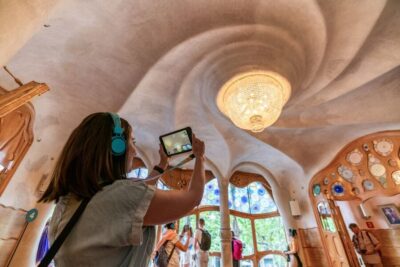
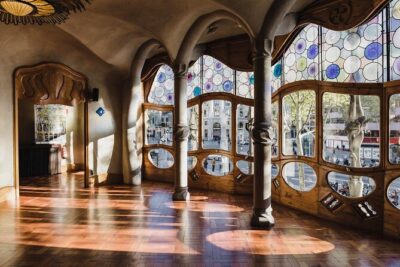
Historic furniture and authentic period elements give the rooms a lived-in feel. They help you picture the building as an apartment house rather than a sculpture that happens to have doors. Pay attention to the details around windows, handles, ceilings, and storage. Gaudí’s ideas are often easiest to understand when you look at small, practical features.
The audio guide is useful here because it connects the design to the architect’s intentions. You can listen while examining the rooms instead of trying to absorb everything from a wall label. The commentary is also a help if you do not already know much about Gaudí.
I would not expect a full biography of Gaudí from the audio guide. It gives background on his architecture and explains the building well, but some visitors want more about the man himself. The attic exhibition fills in part of that gap.
More self-guided tours:
- Barcelona: Sagrada Familia Entry Ticket with Audio Guide
★ 4.6 · 105,312 reviews - Barcelona: Palau de la Música Self-Guided Tour
★ 4.6 · 3,603 reviews - Casa Batllo Admission Ticket with Intelligent Audio Guide
★ 4.5 · 3,168 reviews - Barcelona: Mies van der Rohe Pavilion Ticket and Audio Guide
★ 4.6 · 380 reviews
The rooftop chimneys and Barcelona views
Allow plenty of time for the roof. This is where Casa Milà shifts from interesting to unforgettable.
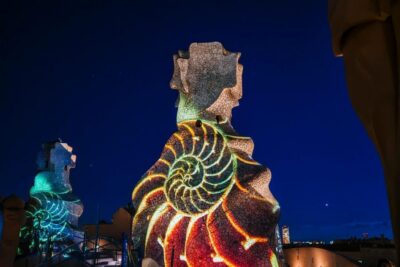
The rooftop is a series of sinuous surfaces, steps, walls, and openings. The chimneys are shaped like strange helmets or masked figures. They are practical objects, but Gaudí turned them into sculpture. Up close, they look even more surprising than they do in photographs.
The roof also gives you views across Barcelona. On a clear day, the city opens around you, and the unusual forms of Casa Milà frame the view in every direction. Sunset can be especially attractive because the changing light brings out the curves and textures of the building.
You should not rush this section. Walk slowly, look back at the shapes from different angles, and leave time for photographs. A bright, sunny day makes the views stronger, but it can also bring more people and harder light for pictures. An early visit may feel calmer, while a late visit offers warmer light. A special first-light option has also been praised for the soft morning illumination inside and outside the building, but availability depends on the date you choose.
There is one firm weather warning: rain closes the roof terrace for safety. This is not treated as grounds for a full or partial refund. If the rooftop is your main reason for booking, check the forecast and consider choosing a flexible date.
Espai Gaudí in the attic
After the roof, head to the attic for Espai Gaudí. This is the only exhibition specifically devoted to Gaudí’s life and work, and it gives the visit needed context.
The displays include scale models, building plans, historic photographs, and videos. These materials help you see how Gaudí moved from an idea to a finished building. A model can make a complicated roof or structural system much easier to understand than a long explanation.
The exhibition also looks beyond Casa Milà. You learn about other projects, including the Sagrada Família, and see how Gaudí reused certain ideas while adapting them to different buildings. This is a good place to pause if you want more than a quick architectural photo stop.
Audio and video displays add variety, although the exhibition can take time if you read and watch everything. The visit is more satisfying when you treat Espai Gaudí as a central part of the experience, not an optional extra on the way out.
Some visitors find that the audio guide could provide more personal history about Gaudí. I agree that the exhibition carries more of that burden. If your main interest is the architect’s life, spend extra time with the photographs and explanatory displays.
How long should you allow?
The ticket is valid for one day, with entry times depending on availability. The visit is not described as a fixed-duration tour, and you are free to move through the house at your own pace.
I would allow at least two hours if you want to see the roof, apartment areas, and Espai Gaudí without hurrying. You could move faster, but that would reduce the value of the ticket. The roof alone deserves time for views and photographs, while the attic exhibition rewards careful attention.
The flexible format is helpful when you are building a full Barcelona day. You can enter at your booked time, stay as long as you need, and avoid the pressure of a group departure. Keep in mind that the entry time is not necessarily flexible once you arrive. There have been occasions when people could not enter earlier even though the building did not look full, so choose a time you can meet.
The ground-floor café is another practical feature. It offers a place to pause, and the food has been well received. There are also gift shops, though some of the merchandise is expensive and easy to skip if you are watching your budget.
Is the $33 ticket good value?
At $33, Casa Milà costs more than a simple church or neighborhood museum visit. The question is not just whether the building is attractive. It is whether you will use the full visit.
The price makes better sense when you:
- Spend at least two hours inside
- Use the audio guide rather than treating it as background noise
- Visit the rooftop in good weather
- Explore Espai Gaudí carefully
- Take time with the apartment rooms and period details
The audio guide is included, which improves the value. A building this unusual can be difficult to understand from photographs alone. The commentary explains why the spaces look and feel so different, and it lets you pause without losing the thread.
You may find the ticket expensive if you only want a quick rooftop photograph. In that case, Casa Milà competes with many other paid attractions in Barcelona. But if Gaudí interests you, the combination of original interiors, roof, exhibition, and city views gives you several distinct experiences in one visit.
The high overall rating, 4.7 from more than 15,000 ratings, fits the strengths of the attraction: the roof is memorable, the audio guide is easy to use, and the building offers more than a façade photo. Still, strong demand and the price mean you should plan rather than wander in on a whim.
Who will enjoy Casa Milà most?
I would recommend this experience to anyone with a serious interest in Gaudí, architecture, design, or Barcelona’s early twentieth-century buildings. It also works well for first-time visitors who want one major Gaudí site but do not want a live group tour.
Families can use the unusual shapes and chimneys to keep younger visitors interested, though the amount of exhibition material may suit older children better. Photographers will enjoy the rooftop forms, courtyards, staircases, and views.
It is also a good choice for visitors who need control over their pace. You can pause, return to a room, or spend extra time with a display. The available elevator is helpful for anyone who finds stairs challenging, though specific accessibility needs should be checked ahead of time.
I would be more cautious if rain is forecast, if your schedule allows only a short visit, or if you are already tired of paid architectural sights. You can see the façade from outside, but the interior visit is where the ticket earns its keep.
My verdict on the La Pedrera audio visit
Book it if you want to understand Casa Milà rather than simply photograph it. The rooftop is the clear highlight, but the visit works because the apartment interiors and Espai Gaudí exhibition give meaning to those fantastic shapes.
Choose a time that matches your schedule, check the weather, and allow two hours or more. Use the audio guide, take your time on the roof, and do not skip the attic. At $33, it is not Barcelona’s cheapest attraction, but for a self-paced look at one of Gaudí’s most inventive buildings, it offers solid value.
FAQ
Where does the Casa Milà experience start?
It starts at La Pedrera, also called Casa Milà, on Passeig de Gràcia in Barcelona.
What is included with the ticket?
The ticket includes skip-the-line entrance to Casa Milà and an audio guide.
Is a live guide included?
No. A live guide is not included. The visit is self-guided with the included audio guide.
Which languages are available for the audio guide?
The audio guide is available in Basque, Catalan, Chinese, English, French, Galician, German, Italian, Japanese, Korean, Portuguese, Russian, and Spanish.
How long is the ticket valid?
The activity is valid for one day. You need to check availability for the available starting times.
How much time should I allow for the visit?
Allow at least two hours if you want time for the rooftop, apartment spaces, and Espai Gaudí exhibition.
Can I visit the rooftop in the rain?
No. The roof terrace closes when it rains for safety reasons. This closure does not qualify for a full or partial refund.
Can I cancel for a full refund?
Yes. You can cancel up to 24 hours in advance for a full refund.
Do I have to pay when I book?
You can reserve now and pay later, so no payment is required at the time of booking under that option.
More Audio Tours
- Barcelona: Montjuïc Cable Car Ticket with Audio Guide
★ 3.9 · 270 reviews - Granada: Alhambra Entry Ticket with Audio Guide
★ 4.1 · 5,950 reviews - Madrid: Las Ventas Bullring Tour with Audio Guide
★ 4.6 · 3,154 reviews - Cordoba: Mosque-Cathedral E-Ticket with Audio Guide
★ 4.1 · 2,124 reviews
Recently added around Barcelona
- Intro Segway Tour Barcelona 1h★ 4.9 · 166 reviews
- Barcelona: Bike or eBike Tour, Top Sights & Local Insights★ 4.9 · 166 reviews
- Instagram Photoshoot Tour in Barcelona★ 5.0 · 167 reviews
- Artisan Ceramic Making Experience★ 5.0 · 168 reviews
- Barcelona: Big Fun Museum Ticket★ 4.2 · 169 reviews
- Sagrada Familia Evening Private Tour with Expert Guide★ 4.5 · 170 reviews
- Gaudi’s Crypt in Colonia Güell with Audioguide★ 4.4 · 170 reviews
- Las Golondrinas Barcelona 60-min Boat Tour★ 4.0 · 170 reviews
Gaudi House Tours, compared.
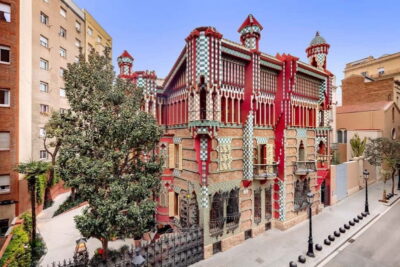
Gaudi’s Casa Vicens Skip-the-Line Entrance Ticket
Read our review →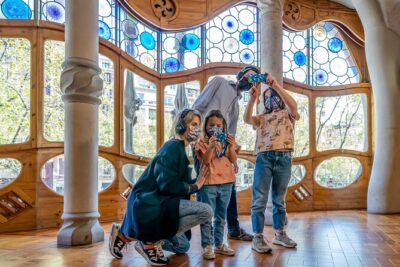
Casa Batllo Admission Ticket with Intelligent Audio Guide
Read our review →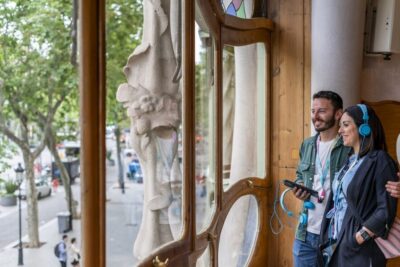
Complete Gaudi Tour: Casa Batllo, Park Guell & Sagrada Familia
Read our review →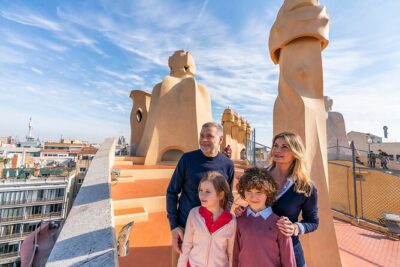
La Pedrera-Casa Mila Admission Ticket with Audioguide
Read our review →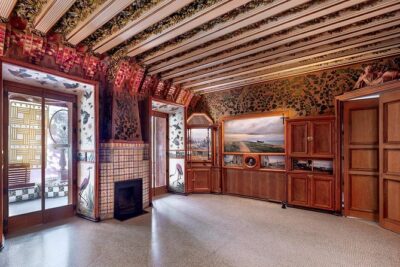
Gaudi´s Casa Vicens Skip the Line Ticket with Audioguide
Read our review →Browse the lists this tour appears in