
Review · AUDIO TOURS
Barcelona: Mies van der Rohe Pavilion Ticket and Audio Guide
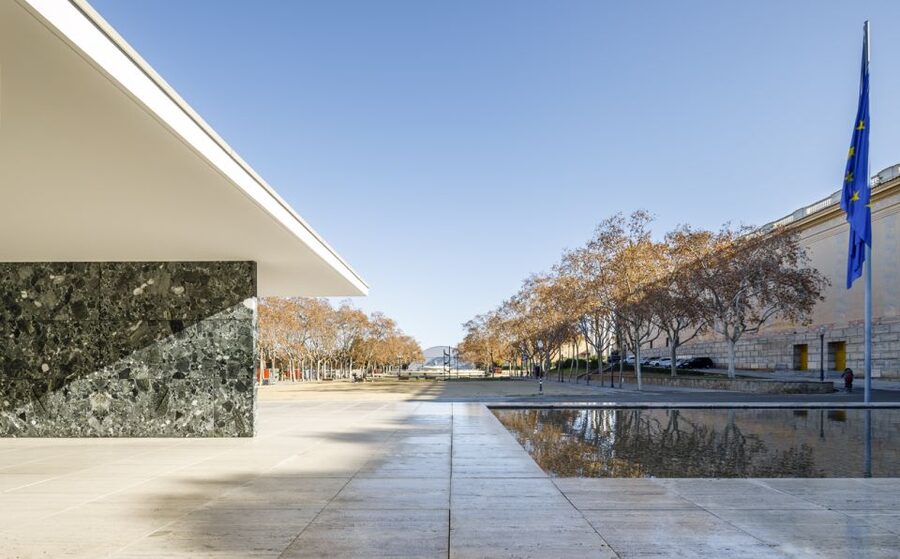
Minimalism can be surprisingly moving. The Mies van der Rohe Pavilion offers a calm look at one of Barcelona’s most influential buildings, with a ticket and audio guide that explain the ideas behind its clean lines, open rooms, and carefully chosen stone. I like the quiet setting, and I like that the visit gives you time to look closely rather than rush from room to room.
The $10 price is fair for architecture fans, especially since the audio guide adds useful background in five languages. My main reservation is simple: the Pavilion is a small site, so visitors expecting a long attraction may feel the visit ends quickly. Some people also question paying admission to a building that can be viewed in a relatively short time.
In This Review
- What Makes This Visit Worth Your Time
- A Modern Building With a Complicated Second Life
- Entering the Pavilion’s Open Rooms
- Stone, Glass, Water, and the Barcelona Chair
- Why the Audio Guide Matters
- A Calm Stop Near Barcelona’s Busy Sights
- The Short Nature Trail Nearby
- Is $10 Good Value?
- Who Will Enjoy the Pavilion Most?
- Practical Rules for a Smooth Visit
- How to Look at the Pavilion
- Should You Book the Mies van der Rohe Pavilion?
- FAQ
- Where is the Mies van der Rohe Pavilion located?
- Who designed the Pavilion?
- What was the original purpose of the Pavilion?
- Was the Pavilion always on its current site?
- What languages are available for the audio guide?
- Is the audio guide included in the ticket?
- How much does admission cost?
- Is the Pavilion wheelchair accessible?
- What is not allowed inside?
What Makes This Visit Worth Your Time
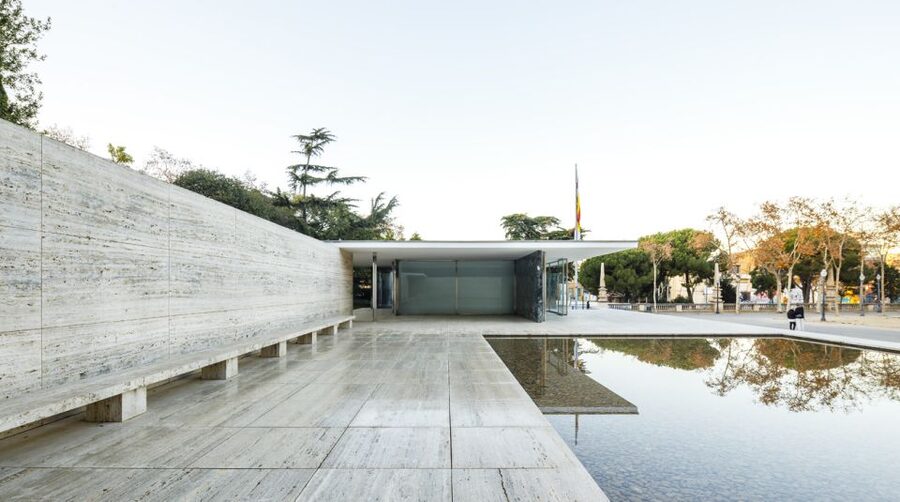
- The building was designed for the 1929 Barcelona International Exhibition: It first served as Germany’s national pavilion before being dismantled.
- The Pavilion reopened in 1986: Its reconstruction returned the design to its original site after decades away.
- Materials do much of the talking: Stone from the Alps, Tivoli, Atlas, and Tinos creates the building’s restrained but striking color scheme.
- The audio guide comes in five languages: Choose Spanish, Catalan, English, French, or German.
- The visit is calm and visually focused: There are no rides, crowds of displays, or long route to follow.
- Practical access is easy: The Pavilion is wheelchair accessible, and skip-the-ticket-line entry is included.
A Modern Building With a Complicated Second Life
The Pavilion was designed by Mies van der Rohe and Lily Reich for the 1929 Barcelona International Exhibition. It was intended as Germany’s national pavilion, so its purpose was not to house a large collection or tell a long national story. The building itself was the message.
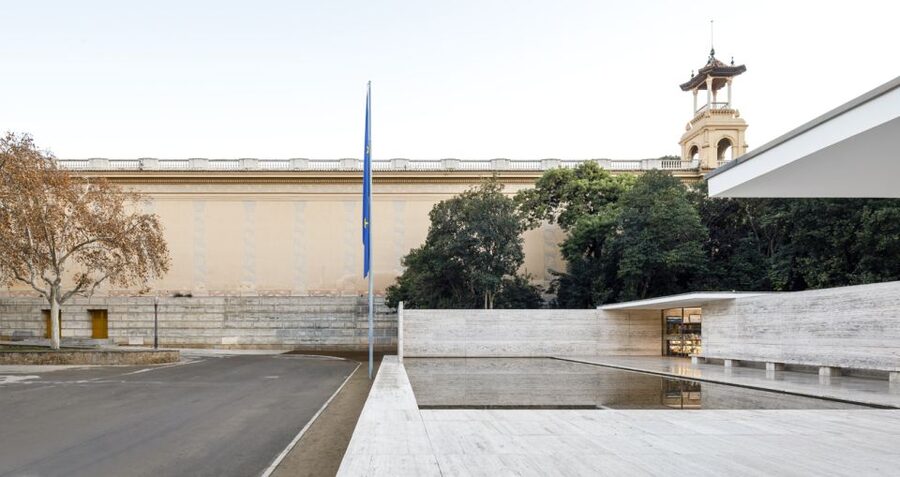
After the exhibition ended, the Pavilion was dismantled. That might have been the end of it, but architects and artists continued to study its form and influence. The structure was reconstructed on its original site and reopened in 1986.
That fact changes how I look at the building. You are not seeing a surviving 1929 shell. You are seeing a carefully recreated work that had become important enough to bring back. The reconstruction also lets you consider a useful question: can a modern building retain its meaning after it has been taken apart and rebuilt?
For many people, the answer is yes. The Pavilion is now used as a reference point for modern architecture. Its influence comes from restraint. There is no decorative overload to distract you. The walls, roof, floor, water, glass, and furnishings carry the full weight of the design.
More self-guided tours:
- Barcelona: Sagrada Familia Entry Ticket with Audio Guide
★ 4.6 · 105,312 reviews - Barcelona: La Pedrera-Casa Milà Ticket & Audio Guide Option
★ 4.7 · 15,099 reviews - Barcelona: Palau de la Música Self-Guided Tour
★ 4.6 · 3,603 reviews
Entering the Pavilion’s Open Rooms
The first surprise is how little there is to enter. This is not a museum with a chain of galleries. It is a compact architectural composition where the route is mostly yours to discover.
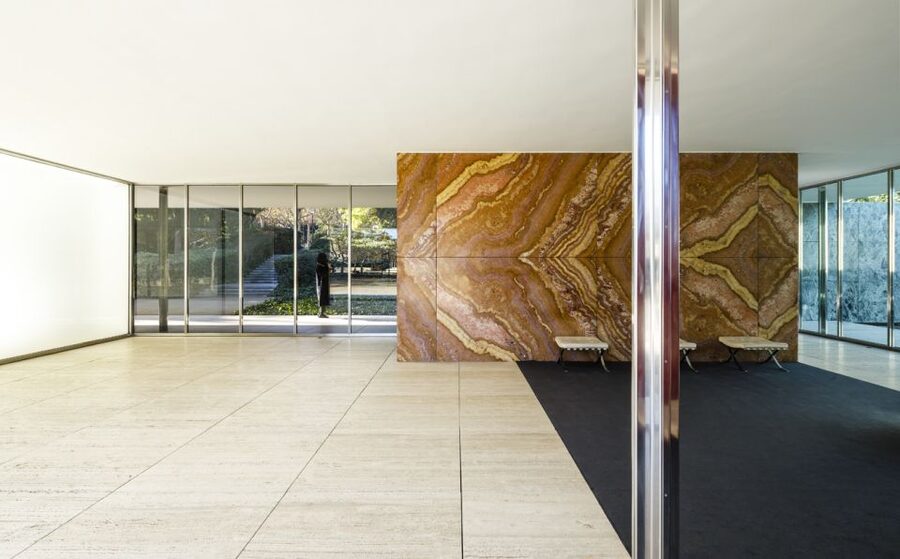
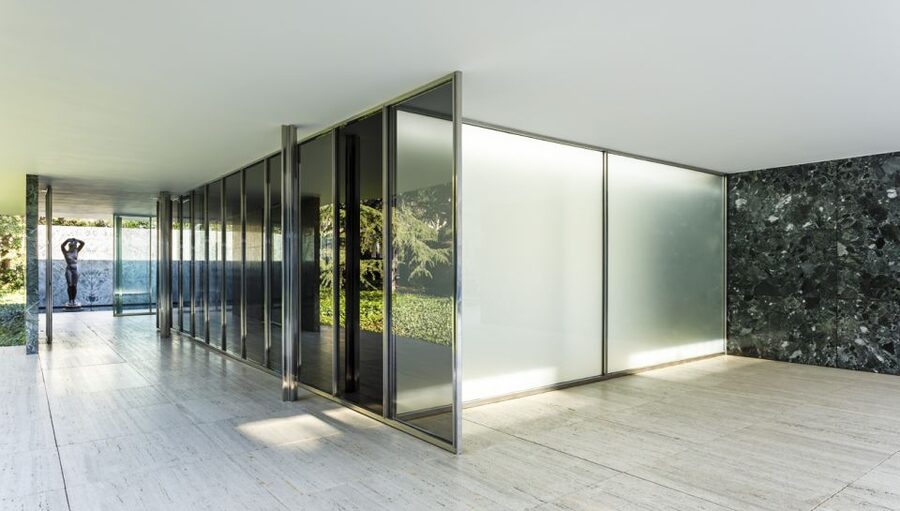
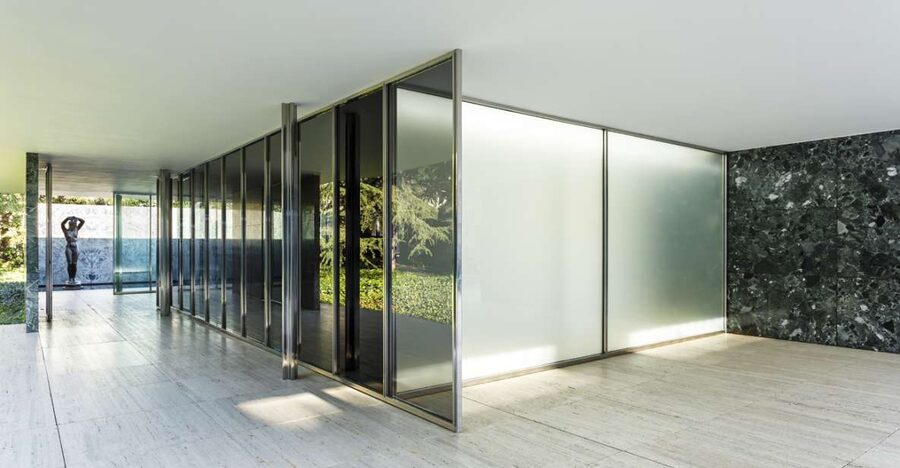
The design uses open space, thin walls, glass, and strong horizontal and vertical lines. Instead of placing you inside a sealed box, it keeps the boundary between indoors and outdoors in play. You can look through one space into another, then out toward the surrounding area. A wall may guide you without fully closing off the room.
That openness can make the Pavilion feel larger than its footprint. It also means that the building rewards slow looking. If you hurry, you may see only polished surfaces and empty space. If you pause, you begin to notice how one wall blocks a view while another reveals it, or how a change in material shifts the mood of a room.
I would give the building your full attention for a while, even if you are not an architecture specialist. Walk through the rooms more than once. Look back toward the entrance. Check how the views change as you move. This is a place where the route itself is part of the lesson.
Stone, Glass, Water, and the Barcelona Chair
The Pavilion’s simplicity is not plainness. Much of its effect comes from the contrast between materials.
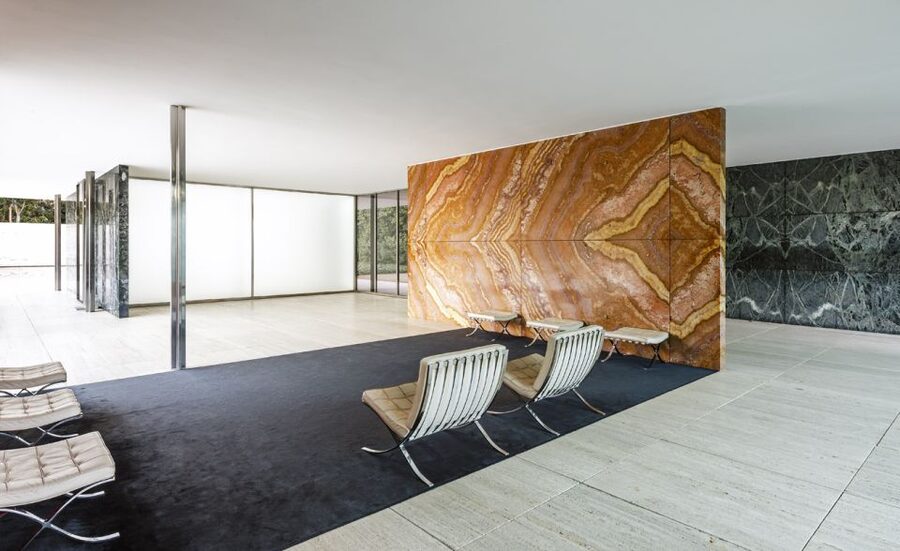
Stone from the Alps, Tivoli, Atlas, and Tinos was selected for its color and pattern. These surfaces give the building warmth and variety without adding decoration in the usual sense. Glass creates reflections and visual connections, while water adds another layer of movement and light.
The contrast is precise. Smooth and rough surfaces meet. Pale and dark tones sit beside each other. Solid walls are set against transparent panels. The result feels controlled, but not lifeless.
The Barcelona Chair is closely linked with the Pavilion and its designers. Its clean shape fits the rooms so well that it can seem like part of the architecture rather than a separate piece of furniture. You will likely notice how the furniture occupies very little visual space. It supports the design instead of competing with it.
This is also where the audio guide can help. A quiet building can leave you wondering what exactly you should be noticing. The commentary gives context about the Pavilion’s design, its place in the Modern Movement, and its reconstruction in the 1980s. Listen first, then look again. The building makes more sense when you understand that its empty areas are deliberate.
Why the Audio Guide Matters
The audio guide is included with admission and is available in Spanish, Catalan, English, French, and German. That range makes the visit easier for many international visitors, and it keeps you from needing to read a long printed explanation while trying to look at the building.
The commentary is most useful for visitors who want more than a photo stop. You can learn why the Pavilion mattered in 1929, how its materials were selected, and why later generations treated the structure as a major work of modern architecture.
Do check that you receive the audio guide you expect when you enter. One recent visitor arrived without the guide and felt confused, which is an avoidable problem at a place where the building itself offers few written explanations. If the audio device or access instructions are not clear, ask before moving through the site.
You should not expect the audio guide to turn the Pavilion into a long guided tour. Its role is to sharpen your view. The building remains the main event.
A few more Spain trips worth a look
- Casa Batllo Admission Ticket with Intelligent Audio Guide
★ 4.5 · 3,168 reviews - Barcelona: Montjuïc Cable Car Ticket with Audio Guide
★ 3.9 · 270 reviews - Granada: Alhambra Entry Ticket with Audio Guide
★ 4.1 · 5,950 reviews - Madrid: Las Ventas Bullring Tour with Audio Guide
★ 4.6 · 3,154 reviews
A Calm Stop Near Barcelona’s Busy Sights
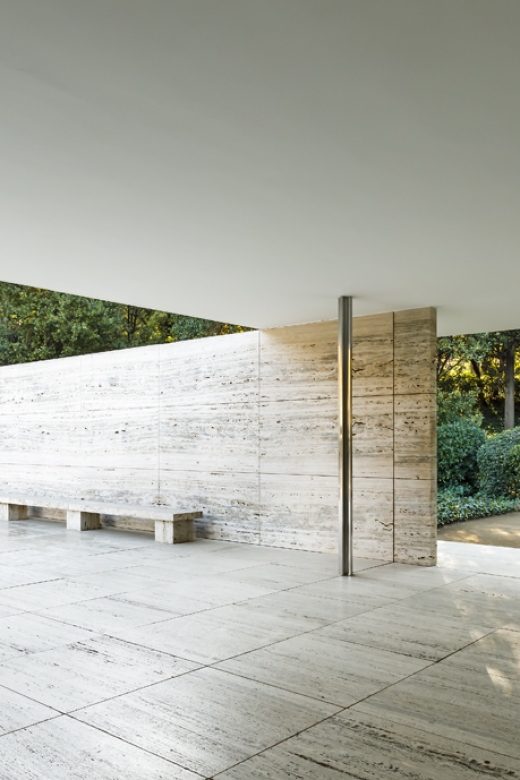
The Pavilion’s quiet mood is one of its best qualities. Barcelona has no shortage of grand churches, crowded streets, and famous interiors. This visit gives you a change of pace.
That calm does not mean you will always have the building to yourself. The Pavilion can be used by professional photographers and models, and they may become part of the scene during your visit. This is not necessarily a problem, but it can affect the clean, empty images many people hope to take.
If photography matters to you, be prepared for other people using the space. The building’s simple forms make it popular for photographs, and the polished surfaces can make even a small group feel noticeable. Take your time, but accept that the Pavilion is a working cultural site rather than a private photo studio.
Artistic interventions may also occasionally alter the building’s appearance. These installations can add a new way to think about the space, but they may disappoint you if you came hoping to see the Pavilion in its most stripped-down form. Opening hours can change too, so check the current schedule before setting out.
The Short Nature Trail Nearby
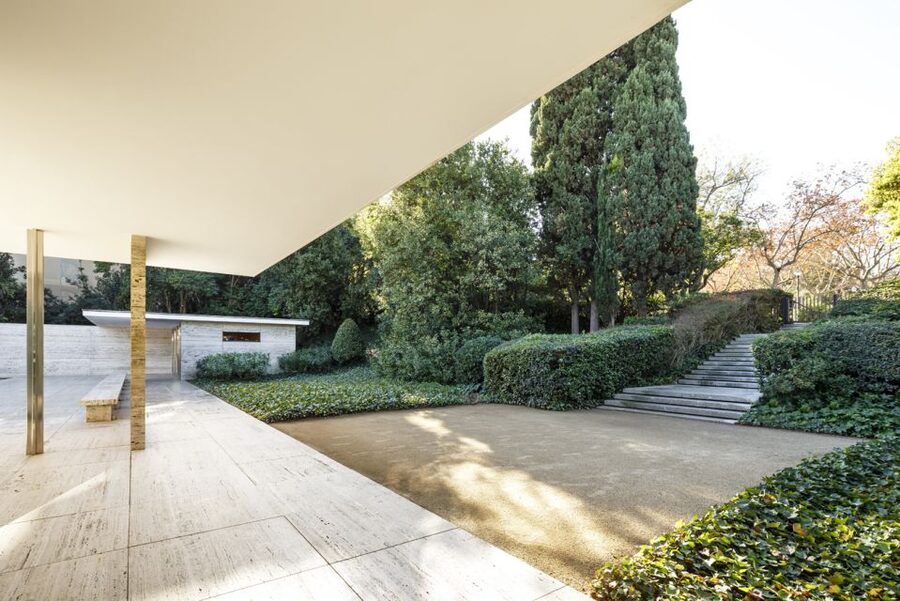
A short nature trail near the site can add a little breathing room to the visit. It is not part of the Pavilion itself, and the activity information does not give a detailed route or length. Still, it can be a pleasant follow-up if you want to spend more time in the area after seeing the building.
I would treat this as an optional extra, not a major part of the ticket. The Pavilion is the reason to come. The nearby trail may help balance the strong geometry of the building with a quieter outdoor walk, but you should not book this experience expecting a full park excursion.
Is $10 Good Value?
At $10 per person, this is a modest admission price by Barcelona standards. The value depends on what you want from a sightseeing stop.
For an architecture lover, design student, photographer, or anyone curious about the Modern Movement, the price is reasonable. You get entry, an audio guide, and access to a building that influenced generations of architects and artists. The chance to study the materials and layout in person is more useful than seeing photographs alone.
For a visitor who prefers large attractions with many rooms and exhibits, the price may feel less satisfying. The Pavilion is intentionally spare. You are paying for access to a single architectural work, not for hours of entertainment.
Some visitors feel the site should be free, and that opinion is understandable because the visit can be short. I would frame the cost as a small cultural admission rather than a full attraction ticket. If architecture interests you, it is a sound use of $10. If you are only collecting Barcelona landmarks, you may prefer to spend that money elsewhere.
The booking terms also reduce the risk. You can reserve now and pay later, and cancellation is allowed up to 24 hours before the visit for a full refund. The ticket is valid for one day, with available starting times shown during booking.
Who Will Enjoy the Pavilion Most?
I would recommend this experience to:
- Architecture students and design professionals
- Visitors who enjoy modern art and simple forms
- Photographers who appreciate lines, reflections, and materials
- People who want a quiet break from Barcelona’s crowded sights
- Anyone interested in how a building can influence later artists and architects
- Visitors who prefer self-guided sightseeing at their own pace
Families can visit, but children who need constant activity may find the space too quiet and brief. The same is true for anyone expecting a large museum collection.
The Pavilion also suits people who like to revisit a place visually. A first pass gives you the overall shape. A second pass reveals the material contrasts. The audio guide gives you the historical frame, and your own observations fill in the rest.
Practical Rules for a Smooth Visit
The Pavilion is wheelchair accessible, which makes the visit easier for people with mobility needs. Skip-the-ticket-line entry is included, though you still need to follow the designated admission process.
Smoking is not allowed. You cannot bring food or drinks inside, and pets are not permitted except for assistance dogs. Tripods are also prohibited, so photographers should plan to use handheld equipment.
Arriving at your chosen time matters. One visitor specifically advised arriving on time, and that is sensible for a site with scheduled entry. Opening hours can change, and artistic interventions may affect what you see, so check the latest information before you go.
Wear comfortable shoes if you plan to add the nearby nature trail. The Pavilion itself does not require a long walk, but the extra route may make your visit more complete.
How to Look at the Pavilion
You do not need a background in architecture to enjoy this building. Try three simple approaches.
First, look at the structure as a sequence of frames. Notice how the walls guide your eye without forming ordinary rooms. Then look at the relationship between interior and exterior. The building constantly asks you to reconsider where one space ends and another begins.
Next, focus on materials. Pick one stone surface and study its color and pattern. Compare it with the glass, water, and furniture. The design is quiet, but it is not colorless or textureless.
Finally, think about the difference between the original Pavilion and the reconstructed one. The building’s significance was strong enough to bring it back in 1986. That story gives the visit a second subject beyond appearance: the lasting power of an idea.
Should You Book the Mies van der Rohe Pavilion?
Book it if you enjoy architecture, thoughtful design, or calm cultural stops. For $10, the ticket and audio guide offer a focused lesson in modern architecture, and the five language choices make it accessible to a wide range of visitors.
Skip it if you need a large attraction, a long guided route, or many exhibits to fill your day. The Pavilion is deliberately limited in size and content, and some people will feel the admission is high for a short visit.
My practical advice is to pair it with another nearby activity, allow yourself time to look slowly, and confirm that the audio guide is available when you arrive. For the right visitor, this is not just an empty room with expensive stone. It is a compact, powerful example of how space, material, and restraint can change the way you see a building.
FAQ
Where is the Mies van der Rohe Pavilion located?
The Pavilion is in Barcelona, in Catalonia, Spain.
Who designed the Pavilion?
The Pavilion was designed by Mies van der Rohe and Lily Reich.
What was the original purpose of the Pavilion?
It served as the German national pavilion for the 1929 Barcelona International Exhibition.
Was the Pavilion always on its current site?
The original Pavilion was dismantled after the 1929 exhibition. It was reconstructed on its original site and reopened in 1986.
What languages are available for the audio guide?
The audio guide is available in Spanish, Catalan, English, French, and German.
Is the audio guide included in the ticket?
Yes. The admission includes both entry to the Pavilion and the audio guide.
How much does admission cost?
The listed price is $10 per person.
Is the Pavilion wheelchair accessible?
Yes. The Pavilion is wheelchair accessible.
What is not allowed inside?
Smoking, food, drinks, pets, and tripods are not allowed. Assistance dogs are permitted.
Recently added around Barcelona
- Intro Segway Tour Barcelona 1h★ 4.9 · 166 reviews
- Barcelona: Bike or eBike Tour, Top Sights & Local Insights★ 4.9 · 166 reviews
- Instagram Photoshoot Tour in Barcelona★ 5.0 · 167 reviews
- Artisan Ceramic Making Experience★ 5.0 · 168 reviews
- Barcelona: Big Fun Museum Ticket★ 4.2 · 169 reviews
- Gaudi’s Crypt in Colonia Güell with Audioguide★ 4.4 · 170 reviews
- Sagrada Familia Evening Private Tour with Expert Guide★ 4.5 · 170 reviews
- Las Golondrinas Barcelona 60-min Boat Tour★ 4.0 · 170 reviews
Audio Tours, compared.
Sagrada Familia Entry Ticket with Audio Guide
Read our review →La Pedrera-Casa Milà Ticket & Audio Guide Option
Read our review →
Casa Batllo Admission Ticket with Intelligent Audio Guide
Read our review →
Browse the lists this tour appears in