
Review · HISTORICAL TOURS
Barcelona in 2 Hours: Guided Walk Through History and Sights
Barcelona reveals its secrets on foot. This two-hour walk links cafés, churches, squares, Roman remains, Jewish heritage, and Catalan identity in one compact route through the old city. I like the way it goes beyond postcard views, especially at Els 4 Gats, where Picasso and Gaudí once met, and at Plaça Sant Felip Neri, where the city’s past feels especially close. The main consideration is pace: eleven stops in about two hours leaves little time to linger.
I also like the mix of famous sights and small details you might miss alone, from the legend beneath Pont del Bisbe to the traces of the old aqueduct at Casa de l’Ardiaca. Guides such as Darren, Petra, Jorge, Sonia, Vanessa, and Rolene have been praised for clear storytelling and useful food and sightseeing advice. But street noise can make explanations hard to hear, and one participant specifically wished for a speaker or audio guide.
In This Review
- Key points to know before you book
- Why this short Barcelona walk works
- Els 4 Gats: where modern Barcelona found its voice
- El Món Neix en Cada Besada and the meaning behind a photo stop
- Barcelona Cathedral and the story of Saint Eulalia
- Casa de l’Ardiaca and the Roman foundations
- Pont del Bisbe and a legend with teeth
- Plaça Sant Felip Neri and Barcelona’s sorrowful past
- El Call: Jewish Barcelona in narrow lanes
- Plaça de Sant Jaume: government, protest, and public life
- Plaça del Rei and the royal side of the city
- Plaça de l’Àngel and the Saint Eulalia legend
- Santa Maria del Mar: finishing in El Born
- Pace, sound, and the practical side of the route
- How the guides shape the experience
- Who should book this Barcelona walking tour?
- Is $22.99 a fair price?
- Should you book Barcelona in 2 Hours?
- FAQ
- How long is the Barcelona walking tour?
- Where does the tour begin?
- Where does the tour finish?
- Is admission to Barcelona Cathedral included?
- Is admission to Santa Maria del Mar included?
- What is the maximum group size?
Key points to know before you book
- Picasso and Gaudí’s café: Begin at Els 4 Gats, the Art Nouveau meeting place linked with two of Barcelona’s best-known artists.
- Eleven historic stops: The route covers the Gothic Quarter, El Call, the city center, and El Born before finishing at Santa Maria del Mar.
- Catalan identity matters here: Several stops explain the events, symbols, and traditions tied to Catalonia’s political and cultural story.
- Two church admissions cost extra: Entry to Barcelona Cathedral and the Basilica de Santa Maria del Mar is not included.
- A small group helps: The maximum group size is 20, though you can upgrade to a private tour for more personal attention.
- Good first-day orientation: The route gives you names, stories, and local suggestions that can help shape the rest of your Barcelona visit.
Why this short Barcelona walk works
At $22.99 per person, this is priced as an affordable introduction rather than a full historical study. You are paying for a guide who organizes the old city into a story, not for entrance tickets or a long stop inside any one building.
That distinction matters. Barcelona’s old center can feel like a maze of narrow lanes and handsome squares. A short guided walk helps you understand how Roman Barcino, medieval Barcelona, Catalan government, religious life, and modern art fit together. You will still need separate time and money if you want to enter the cathedral or basilica.
The route begins at Plaça del Vuit de Març in Ciutat Vella and finishes at Basílica de Santa Maria del Mar in El Born. It is offered in English, uses a mobile ticket, and is near public transportation. The group limit of 20 is reasonable for an urban walk, though the experience will feel more personal if you choose the private upgrade.
The tour is particularly useful on your first day. Jorge, for example, was praised for showing lesser-known corners and offering local suggestions, while Darren received strong marks for clear explanations and practical recommendations. A guide can give you a useful list of places to return to after the walk, including food stops such as Tapas 2254, recommended by Sonia.
More Historical Tours in Barcelona
- Barcelona: Tapas Walking Tour with Food, Wine, and History
★ 4.8 · 4,261 reviews - Barcelona Tapas Walking Tour: Food, Wine & History
★ 4.5 · 1,928 reviews - Barcelona: 2.5-Hour Bike or E-Bike Historical Tour
★ 4.5 · 1,262 reviews
Els 4 Gats: where modern Barcelona found its voice
The first stop sets the tone. Els 4 Gats is more than an attractive café with an Art Nouveau façade. It was a meeting place for artists and thinkers, including Pablo Picasso and Antoni Gaudí.
You will hear why the café matters to Barcelona’s creative story and see how its design fits the city’s love of decorative architecture. The stop is listed as about 10 minutes, with no admission charge. That is enough for an introduction and a look at the exterior, but not a long meal or a full examination of the interior.
I like starting here because it gives the tour a human face. Instead of opening with dates and rulers, you begin with artists, conversation, and the city’s creative energy. If you want to return later, ask your guide what is currently open and how to visit.
El Món Neix en Cada Besada and the meaning behind a photo stop
The next stop is El Món Neix en Cada Besada, a large photomosaic often treated as a simple social-media backdrop. Its deeper meaning connects to Catalonia’s defeat on September 11, 1714, and to La Diada, Catalonia’s national day.
This is one of the tour’s most useful corrections to surface-level sightseeing. You get the attractive image, but also the political and emotional context behind it. The stop shows how public art in Barcelona can carry memory and identity.
Expect roughly 10 minutes here, with no ticket required. The guide’s explanation is the main reason to stop. If the surrounding street is noisy, stay close to the guide and avoid drifting toward the edge of the group.
Barcelona Cathedral and the story of Saint Eulalia
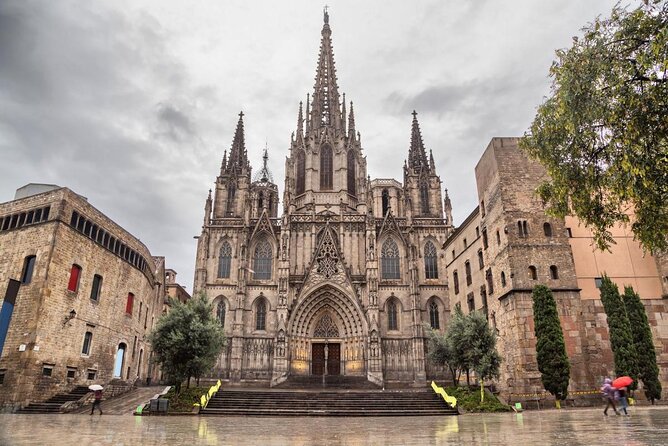
Barcelona Cathedral brings you into the city’s religious and medieval center. Built over several centuries, the Gothic church is associated with Saint Eulalia, Barcelona’s patron saint, whose death made her a martyr.
The guide explains the cathedral’s connection to her life and death, giving the building a personal story rather than treating it as a collection of stone arches. You should expect only about 10 minutes at this point in the route, so the focus is on orientation and history.
Admission is not included. That is important when judging the $22.99 price. The tour takes you to the cathedral, but you will need to pay separately if you want to enter. If the interior is a priority, ask about current admission arrangements and plan extra time after the walk.
More Walking Tours in Barcelona
- Barcelona Tapas and Wine Experience Small-Group Walking Tour
★ 5.0 · 5,804 reviews - Barcelona: Tapas Food Crawl Walking Tour with Tastings
★ 4.9 · 1,798 reviews - Barcelona: Gothic Quarter Ghosts and Legends Walking Tour
★ 4.7 · 1,443 reviews - Barcelona Helicopter, Sailboat & Old Town Private Walking Tour
★ 5.0 · 1,395 reviews
Casa de l’Ardiaca and the Roman foundations
Casa de l’Ardiaca is a small architectural surprise in the Gothic Quarter. Its design brings together Gothic and Renaissance elements, while the surrounding remains point back to Roman Barcelona.
The stop includes traces of the old city wall and arcades from the aqueduct that once carried water to Barcino. Those details help you see that the Gothic Quarter is not only medieval. Layers of the Roman city survive beneath and beside later buildings.
This is the sort of place you might pass without noticing if you were following a map from one major attraction to another. The 10-minute visit will not cover every architectural detail, but it gives you a reason to slow down and look upward, along walls, and through openings that reveal older construction.
Pont del Bisbe and a legend with teeth
Pont del Bisbe, or Bishop’s Bridge, is one of the best-known photo spots in the old city. The bridge links buildings above the street and has a legend that gives the stop a slightly spooky edge.
The story is designed to appeal to superstitious people and make everyone else pause before walking underneath. I like this kind of tale on a city walk because it breaks up the formal history. Barcelona is not only dates, dynasties, and architecture. It is also rumor, ritual, and stories repeated in tight streets.
The stop is free and takes about 10 minutes. Expect a popular setting, so the guide may need to position the group carefully while keeping the walkway clear.
Plaça Sant Felip Neri and Barcelona’s sorrowful past

Plaça Sant Felip Neri is one of the most serious stops. The square carries scars from a tragic past and connects to the long-running desire for Catalan independence.
The atmosphere changes here. Instead of simply admiring façades, you are asked to consider loss, memory, and the way political history remains visible in a city’s walls. The square is small, which makes the story feel close and direct.
This is a valuable part of the route for anyone who wants more than architectural sightseeing. It also demands attention. The guide’s explanation gives the place its meaning, so you will want to remain near the group and listen closely.
El Call: Jewish Barcelona in narrow lanes
The route continues through MUHBA El Call, the former Jewish district. Its narrow streets and medieval buildings preserve the shape of a neighborhood that once served Barcelona’s Jewish population.
The stop offers a chance to look at the old city through a different lens. You are not only following Christian churches and royal buildings. You are also learning about a community that formed an important part of medieval Barcelona.
The name MUHBA refers to the Barcelona History Museum, but the route information identifies this stop as a walk through El Call rather than a separate museum visit. Do not assume that museum admission is included. The experience here is primarily about the streets, buildings, and the guide’s account of the district.
Plaça de Sant Jaume: government, protest, and public life
Plaça de Sant Jaume is Barcelona’s main civic square. It contains the seat of the Catalan government and City Hall, making it a natural place to discuss politics, public celebrations, and protest.
The square also connects to an important figure honored during one of Catalonia’s most beloved holidays. Your guide can explain the local tradition and how the square functions during major public events.
This stop helps connect the older parts of the tour to present-day Barcelona. Catalan identity is not presented as a museum topic here. It is part of public life, government, and the way people use the city center.
Vanessa was praised for tying together government architecture, archaeology, art, religious buildings, and Catalan political tension. That broad approach is what makes the walk useful: each stop adds a piece to the same larger story without requiring you to sit through a lecture.
Plaça del Rei and the royal side of the city
Plaça del Rei has a more imposing mood. The square is home to the Royal Palace and offers a way to discuss Barcelona’s royal past and the darker era of the Spanish Inquisition.
You will see how power was displayed through architecture and open civic space. The visit is still brief, about 10 minutes, so the guide will point out the main features and explain why the square matters rather than take you through every building.
This is another stop where expectations matter. The tour does not promise a full palace visit, and the itinerary does not include admission. Think of Plaça del Rei as a strong exterior introduction, followed by a place you can revisit if you want more detail.
Plaça de l’Àngel and the Saint Eulalia legend
Plaça de l’Àngel once served as a grain-trading center and was formerly known as Wheat Square. Its later name comes from a heavenly apparition said to have appeared during a procession carrying Saint Eulalia’s body.
The story gives the square a link to the earlier cathedral stop. You begin hearing about Saint Eulalia there, then encounter another part of her legend here. This kind of connection makes the route easier to remember.
The square also shows how a place can change function and meaning over time. Trade, religion, and urban naming all meet in one short stop. No admission ticket is required.
Santa Maria del Mar: finishing in El Born
The walk ends at the Basilica de Santa Maria del Mar in El Born. This Gothic basilica is tied to Barcelona’s maritime past and is one of the neighborhood’s major landmarks.
Ending here makes sense geographically and thematically. The tour has moved from artists and Roman remains through medieval religion, royal authority, Catalan politics, and Jewish heritage. Santa Maria del Mar brings the story toward the sea, commerce, and the people who helped build Barcelona’s medieval world.
Admission is not included, so plan to pay separately if you want to go inside. The exterior alone gives you a clear sense of the basilica’s importance, but the tour’s two-hour schedule means you should not expect a long interior visit as part of the guided walk.
Pace, sound, and the practical side of the route
The tour lists about 10 minutes at each of its 11 stops. That accounts for roughly 110 minutes before allowing much time for walking between locations, gathering the group, or answering questions. In practice, you should expect a brisk route with short explanations rather than extended visits.
Wear comfortable walking shoes. Lydia’s advice to bring sunblock is also sensible, particularly if you take the tour during a bright part of the day. The route passes through narrow streets and public squares, and background noise can be a real issue.
One participant found it difficult to understand parts of the explanation because the guide had no speaker or audio device. That is the clearest practical weakness in the experience. Stay close, especially near busy streets, and ask the guide to repeat anything you miss.
The walk is offered in English and most people can participate. It is near public transportation, and the start point is Plaça del Vuit de Març in Ciutat Vella. The end point is Santa Maria del Mar at Plaça de Santa Maria, 1, in Ciutat Vella and El Born.
How the guides shape the experience
The route covers a lot, so the guide matters. Darren received praise for clarity and enthusiasm. Petra was singled out for bringing Catalan culture into the story. Jorge was valued for local tips and lesser-known stops.
Sonia’s archaeological angle added extra interest at the old-city sites, while Vanessa was praised for answering questions and linking art, government, religion, and archaeology. Rolene was described as fun and able to fit a great deal of history and culture into two hours, though one person felt the content could have been stronger.
Sarah and Mariah were also praised for friendly, spirited presentations that balanced information with conversation. Guides can vary, so your experience may depend partly on who leads the walk and how well the group responds to the pace.
Who should book this Barcelona walking tour?
I would choose this tour if you are visiting Barcelona for the first time and want a quick framework for the old city. It suits people who enjoy stories, architecture, religion, and politics, but do not want to spend half a day inside one museum.
It is also a good match for a short stay. You can finish near El Born and continue exploring on your own, perhaps using the guide’s food suggestions or returning to one of the churches and squares that caught your interest.
Families and mixed-age groups may appreciate the short stops and changing subject matter. The walk does not stay focused on one difficult theme for long. On the other hand, you should choose a longer or more specialized tour if you want detailed architectural analysis, extended church visits, or a slow photographic walk.
A private upgrade makes sense if you want to ask many questions, move at your own pace, or have a specific interest in Catalan politics, medieval religion, Roman remains, or modern art. The standard group is capped at 20, which keeps the price low but may make it harder to hear in noisy spots.
Is $22.99 a fair price?
Yes, if you treat the experience as an orientation walk. At $22.99, you receive two hours of guided context across several of Barcelona’s oldest districts, with no extra charge for the many outdoor stops.
The value drops if you expect included entry to major interiors. Cathedral and basilica admission are separate, and the walk itself moves quickly. Still, the route covers enough ground that paying for a guide can save you from wandering past important places without understanding them.
Free cancellation is available when you cancel at least 24 hours before the start time. Changes or cancellations made later are not accepted for a refund.
Should you book Barcelona in 2 Hours?
Book it if you want a lively first look at Gothic Barcelona and El Born, especially at the start of your trip. The strongest parts are the local stories, the range of subjects, and the route’s ability to connect art, faith, royal power, Roman remains, and Catalan identity.
Skip it if you prefer long visits inside churches or museums, or if you dislike a brisk group walk. Bring good shoes, sunblock, and a willingness to stay close to the guide in noisy streets. For most first-time visitors, the modest price makes this a sensible way to get oriented before exploring Barcelona on your own.
FAQ
How long is the Barcelona walking tour?
The tour lasts approximately two hours.
Where does the tour begin?
It begins at Plaça del Vuit de Març in Ciutat Vella, Barcelona, Spain.
Where does the tour finish?
The walk ends at Basílica de Santa Maria del Mar, Plaça de Santa Maria, 1.
Is admission to Barcelona Cathedral included?
No. Admission to Barcelona Cathedral is not included in the tour price.
Is admission to Santa Maria del Mar included?
No. Admission to the Basilica de Santa Maria del Mar is not included.
What is the maximum group size?
The tour allows a maximum of 20 participants. A private tour upgrade is also available.
More Walking Tours
- Barcelona: Old Town and Gothic Quarter Walking Tour
★ 4.8 · 1,393 reviews - Barcelona: Helicopter Flight, Boat Ride, and Walking Tour
★ 4.7 · 1,334 reviews - Barcelona: City Walking Tour with Local Guide
★ 4.9 · 980 reviews - Barcelona: Guided Food Walking Tour with Tapas and Wine
★ 5.0 · 848 reviews
More Historical Tours
- Barcelona Erotic Museum – Explore Art, History & Fun
★ 4.4 · 450 reviews - Andorra Original History and Sightseeing Tour (Private, Pickup)
★ 5.0 · 350 reviews - Barcelona: Dark History Night Walking Tour
★ 4.8 · 344 reviews - Tarragona and Sitges Small Group Tour – Roman History & Culture
★ 4.5 · 339 reviews
Recently added around Barcelona
- Intro Segway Tour Barcelona 1h★ 4.9 · 166 reviews
- Barcelona: Bike or eBike Tour, Top Sights & Local Insights★ 4.9 · 166 reviews
- Instagram Photoshoot Tour in Barcelona★ 5.0 · 167 reviews
- Artisan Ceramic Making Experience★ 5.0 · 168 reviews
- Barcelona: Big Fun Museum Ticket★ 4.2 · 169 reviews
- Sagrada Familia Evening Private Tour with Expert Guide★ 4.5 · 170 reviews
- Gaudi’s Crypt in Colonia Güell with Audioguide★ 4.4 · 170 reviews
- Las Golondrinas Barcelona 60-min Boat Tour★ 4.0 · 170 reviews
Historical Tours, compared.
Madrid Essential: Historic Center, Plaza Mayor & Royal Palace
Read our review →
Tapas Walking Tour with Food, Wine, and History
Read our review →
Sevilla Food Tour: Tapas, Wine, History & Traditions
Read our review →
Valencia Old Town Tour with Wine & Tapas in 11th Century Historic Monument
Read our review →
Barcelona Tapas Walking Tour: Food, Wine & History
Read our review →
Ultimate Seville Tapas, Wine & History Small Group Tour
Read our review →
Skip-the-Line Great Mosque-Cathedral History Tour
Read our review →
Browse the lists this tour appears in