
Review · CADIZ TOURS
Andalusian Horses Dance Show
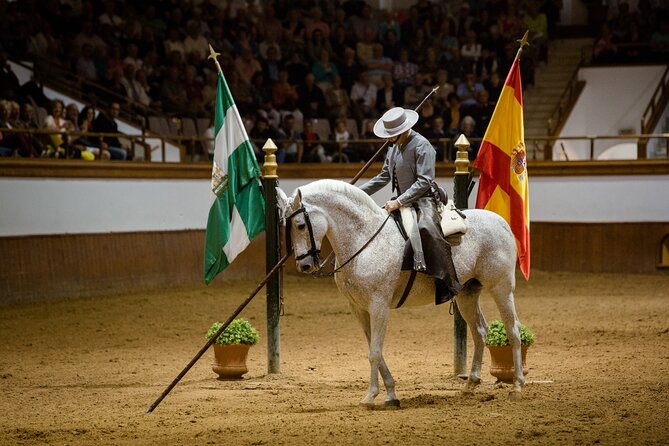
Horses really can dance. At Jerez’s Royal Andalusian School of Equestrian Art, you watch highly trained horses and riders perform classical dressage, traditional cattle-herding techniques, carriage driving, and a polished group finale. I like the wide range of skills on display, and I like that the 90-minute show works well for families and first-time visitors. The main caution is seating: tickets are sold by category, not by exact row or seat, and some positions can have a restricted view.
This is more than a pretty horse show. It gives you a clear look at Spanish riding traditions, from the practical movements of doma vaquera to the controlled grace of Haute École dressage. I would allow extra time for the grounds, cafe, and warm-up areas, but plan carefully for summer heat, Spanish-only narration, and your return transport after the performance.
In This Review
- Key points to know before booking
- Why this Jerez horse show is worth your time
- Arriving at the Royal Andalusian School
- Doma vaquera, the practical side of Spanish horsemanship
- Classical dressage with music and precision
- Carriage driving brings a different kind of drama
- Work in hand and the strength behind the elegance
- The carrousel makes a fitting finale
- Seating, sound, and summer comfort
- Parking and the ride back to Cádiz
- Who will enjoy this experience most
- Booking value and cancellation flexibility
- Should you book the Andalusian Horses Dance Show?
- FAQ
- Where does the Andalusian horse show take place?
- How long does the performance last?
- What time does the experience begin?
- What is included in the ticket?
- Are other facilities included?
- How many choreographies are in the show?
- What riding styles might I see?
- Can I choose my exact seat?
- Do I need to bring a printed ticket?
- Can I cancel for a refund?
Key points to know before booking
- Six to eight choreographies: Each performance draws from a set repertoire, so the exact program can vary by day.
- Traditional Spanish riding: Doma vaquera shows skills developed by cattle herders, including one-handed riding, sharp rhythm changes, pirouettes, and sudden gallops.
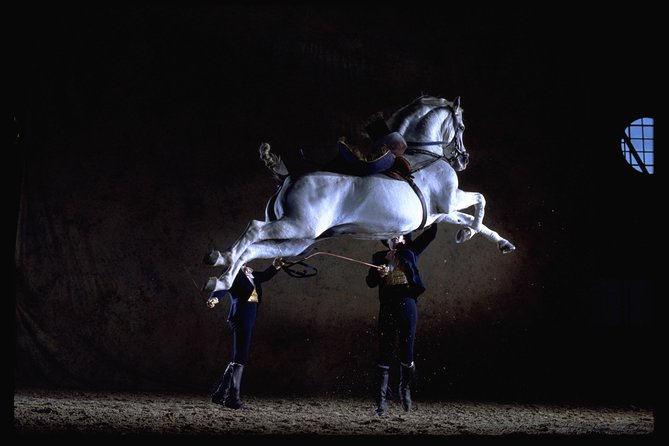
- Classical dressage: Expect exercises such as passage, piaffe, Spanish walk, levades, caprioles, and coordinated rider-and-horse routines.
- Carriages and long reins: Horses perform both carriage-driving skills and dressage exercises while the rider works from the ground.
- Best seating tip: Higher seats often provide a better overall view, while front-row seats bring you close to the action but may not show the full arena.
- Practical warning: Bring a fan or prepare for warmth in summer, and do not rely on finding an easy taxi immediately after the show.
Why this Jerez horse show is worth your time
Jerez de la Frontera is one of the best places in Andalusia to see the region’s horse culture presented at a high level. The Royal Andalusian School of Equestrian Art is not offering a simple animal performance with a few tricks added for tourists. The program is built around formal riding disciplines, careful training, music, costumes, and the long partnership between horse and rider.
At $33.43 per person, the show offers solid value if you enjoy horses, classical music, dance, or traditional Spanish culture. You get about an hour and a half of entertainment in one sitting, with several distinct sections rather than one repeated routine. The variety also helps families: younger children can enjoy the movement and spectacle, while adults can appreciate the precision behind each exercise.
I would not book this only because you happen to be near Cádiz and need to fill an hour. The venue is in Jerez, not Cádiz city, so transport takes planning. But if you can reach Jerez without stress, the show gives you something far more specific to the region than a standard sightseeing stop.
The program changes according to the day. Each show contains six to eight choreographies selected from the school’s repertoire. That means you should expect the same level of skill and entertainment, but not necessarily every named routine described in the full program.
More horse riding:
- Jerez de la Frontera: How the Andalusian Horses Dance
★ 4.6 · 6,168 reviews - El Salobre: Horse Riding Adventure with Transfer Options
★ 4.5 · 1,609 reviews - Jerez de la Frontera: Andalusian Horse Dance and Museums
★ 4.7 · 1,289 reviews
Arriving at the Royal Andalusian School
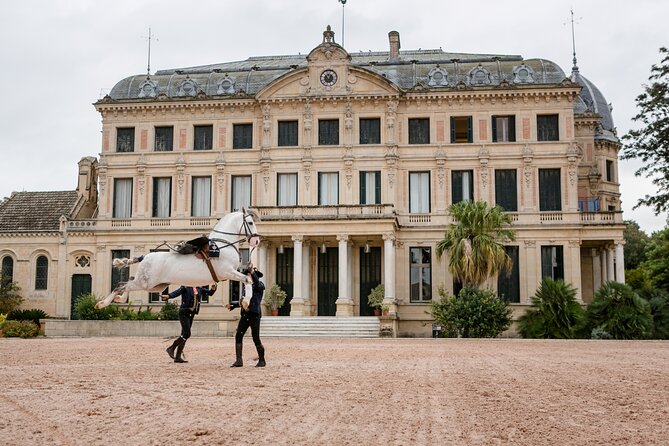
Your meeting and ticket redemption point is the Royal Andalusian School of Equestrian Art at Av. Duque de Abrantes, s/n, 11407 Jerez de la Frontera. The listed start time is 12:00 p.m. You present your printed receipt at the ticket office and receive admission for the show How the Andalusian Horse Dance.
Give yourself extra time before the performance. A useful buffer is 30 to 45 minutes, especially if you need to locate the ticket window, find parking, or get oriented. The grounds include a cafe and shop, and the setting is worth seeing before you take your seat. Some people also enjoy watching the horses and riders warm up before the main event.
Ticket-window signs may not be perfectly clear. Prepaid tickets can involve a separate window from the one you first expect, so do not wait until the last minute. If you bought a discounted ticket, bring proof that you qualify. Without documentation, you may have to pay the difference up to the full standard price, if tickets remain available.
The school is near public transportation, but the information provided does not specify a single best route. Pay close attention when planning a train journey to Jerez de la Frontera. Confusion between similarly named towns or stops can lead to an expensive taxi ride and a rushed arrival.
Doma vaquera, the practical side of Spanish horsemanship
The first major style you may see is doma vaquera. This discipline grew from the work of Spanish cattle herders, so it has a more practical feel than formal dressage. The rider guides the horse with one hand while controlling speed and direction around the arena.
The movement begins with trotting and can progress to galloping. The rider changes rhythm, performs pirouettes, and uses sudden accelerations called arreones. These sharp transitions show how a working horse needs to respond quickly while remaining under control.
This section helps explain that the show is rooted in real riding traditions. The horse is not simply moving to music. It is responding to small signals from the rider, often with an impressive lightness that can make the commands hard to see from the audience.
If you know little about Spanish riding, the Spanish-only narration may limit your understanding of the details. You can still follow the action, but an explanation in English would help you understand why each maneuver matters. A printed program or an audio guide would make this part easier for first-time visitors, but neither is guaranteed by the experience details provided.
Classical dressage with music and precision
Classical dressage is the section most people picture when they hear about dancing horses. The horses move to classical music while carrying out highly controlled exercises. Riders appear calm and nearly still, which makes the horses’ footwork seem almost effortless.
The repertoire includes The Colts, Airs on Horseback, Pas de Deux, Passage and Piaffer, Domino on Horseback, Airs Above the Ground, and Fantasy. You may not see every one of these in a single performance, since the school chooses six to eight choreographies for each show.
Passage is a collected, elevated trot with a measured rhythm. Piaffe is a controlled movement performed almost in place. These exercises require balance, timing, and a very responsive horse. The effect is part ballet, part musical performance, and part athletic demonstration.
The appeal is easy to understand even if you have never ridden. You watch the horse lift its legs, hold its posture, and change pace in time with the music. The best moments are often the quiet ones, when the rider gives an almost invisible cue and the horse answers at once.
A few more Spain trips worth a look
- Seville: Live Flamenco Dancing Show Ticket at the Theater
★ 4.7 · 16,396 reviews - Seville: Casa de la Memoria Flamenco Show
★ 4.8 · 12,964 reviews - Madrid: Live Flamenco Show with Food and Drinks Options
★ 4.5 · 9,901 reviews - Barcelona: Flamenco Show at the Theater
★ 4.5 · 8,442 reviews
Carriage driving brings a different kind of drama
Carriage driving changes the pace and shape of the show. Instead of carrying riders, the horses pull carriages fitted with classical harness. Coachmen guide the teams through the arena, showing control over both the horses and the vehicle behind them.
These carriages were once used for transportation. Here, they serve as a sporting and exhibition tradition. That distinction matters because the section is not simply a ride around the arena. The coachmen demonstrate dexterity, coordination, and control while managing several moving parts at once.
You may find this section especially interesting if you enjoy historic transport or traditional crafts. It also gives the horses a different job, showing that their training extends beyond the saddle. The change from dressage to carriage work keeps the 90-minute program from feeling repetitive.
Work in hand and the strength behind the elegance
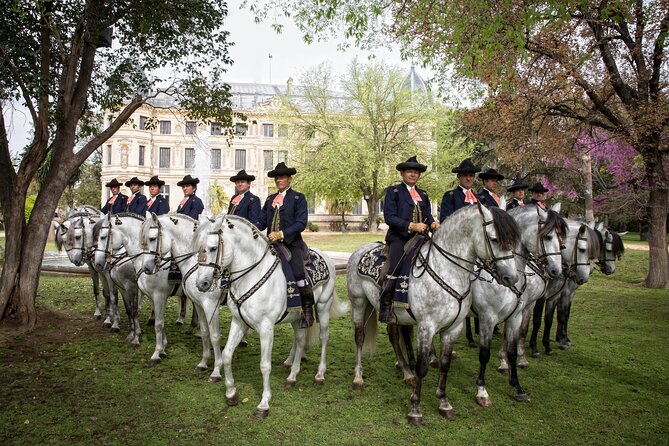
In the work-in-hand section, the horse performs without the rider sitting in the saddle. The horseman remains on the ground and gives commands through long reins or other traditional methods.
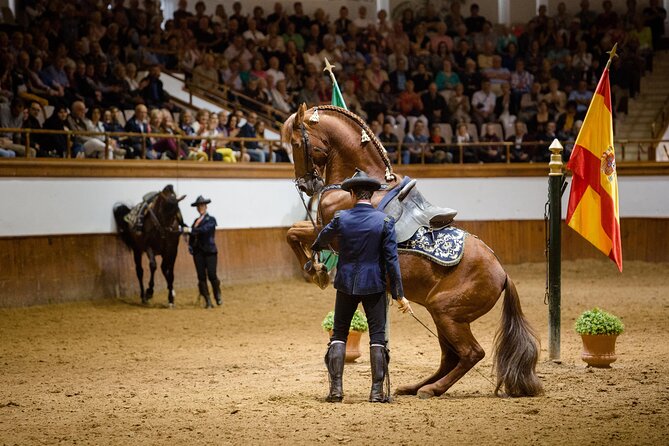
The exercises can include levades, caprioles, courbettes, piaffe between pillars, the Spanish walk, and long-rein work. Some of these movements involve the horse lifting the front of its body or making controlled jumps. They are demanding displays of balance and strength.
This is one of the clearest reminders that the show depends on training rather than decoration. The rider must communicate from a different position, and the horse must follow those instructions without the usual weight and posture of a mounted rider.
The acrobatic jumps can be a surprise, particularly if you expect a gentle parade of horses. For children, this may be one of the most exciting sections. For adults, it offers a closer look at the technical side of classical Haute École dressage.
The carrousel makes a fitting finale
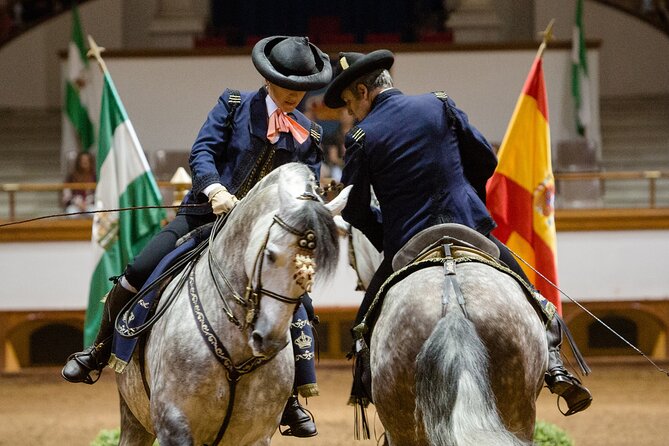
The final carrousel brings several horses and riders together in the center of the arena. They move in unison while performing advanced exercises, creating the most coordinated part of the performance.
A group routine is harder to stage than a solo display. Each rider must keep pace, spacing, and direction while the horses respond to individual cues. The result is a clean, formal ending that pulls together the show’s themes of discipline, music, and partnership.
The carrousel also gives you a useful reason to think about seating. A restricted view can matter most during a group formation, when the full shape of the routine spreads across the arena. If you are choosing among ticket categories, a higher position may give you a better overall view than the closest possible seat.
Seating, sound, and summer comfort
Tickets are sold by price category, not by selected row and seat number. Seats are assigned according to the order of purchase or booking, so you cannot count on choosing your favorite location after arrival.
The seating experience appears to depend heavily on where you are placed. Front-row seats can put you close to the horses and riders, which is wonderful for seeing expressions, tack, and fine movements. Yet higher seats can offer a wider view of the full arena. If your assigned position has a restricted view, you may miss part of the action.
For that reason, I would consider paying for a better ticket category if the difference is reasonable. If you are deciding between a close seat and a higher one, think about what you value most: detail at short range or a complete view of formations and carriage work.
The arena can get warm in summer. Bring a fan, dress for the conditions, and avoid assuming that an indoor performance will feel cool. You cannot bring bottles, cans, animals, or other items management considers unsuitable into the grounds. Photography, filming, and recording are also prohibited unless you are an authorized professional.
The spoken explanations are in Spanish only, according to the practical information available. Announcements may appear in several languages, but the descriptions before each performance segment may not. You will still understand the visual action, though you may miss useful context about the riding discipline.
Parking and the ride back to Cádiz
Driving can work, but parking deserves attention. Nearby parking is available, and some people find a space close to the venue or on a nearby street. Be cautious with anyone waving you toward a parking place and asking for money. Confirm the arrangement before handing over cash, and do not assume an informal parking helper is official.
If you arrive by train, check the exact station and town name before setting out. A wrong stop can turn a straightforward visit into a costly taxi journey. The school is in Jerez de la Frontera, and that detail should be clear in your transport plan.
The ride from a cruise port can take roughly 30 to 40 minutes by taxi, based on the practical experience provided. Agree on the fare before leaving and be wary of offers to wait for you at a price that sounds vague. Finding a taxi immediately after the show may be difficult, so arrange your return ahead of time if you are working around a ship departure or a fixed train.
Once the show ends, you are in Jerez, close to historic sites, cafes, and other city destinations. That makes it sensible to combine the performance with time in town rather than rushing straight back to Cádiz. Just keep enough margin for transport.
Who will enjoy this experience most
I recommend this show most strongly to horse lovers, families, and anyone interested in classical riding. You do not need to know dressage to enjoy the sight of the horses moving to music, but a basic interest in animal training or Spanish culture will make the experience even more rewarding.
It also suits people who enjoy ballet, classical music, and visual performance. The horses’ movements are graceful, but the carriage work, sudden gallops, and raised-air exercises add athletic force.
The show may be less satisfying if you need extensive spoken explanations in English or if you dislike the uncertainty of assigned seating. It is also not the easiest choice for a tight cruise-port schedule, particularly if you have not arranged transport in advance.
Families should find the 90-minute length manageable. There is enough variety to hold attention, and the carrousel gives the performance a clear ending. Most people can participate, and the venue is near public transportation, though exact route details should be checked before you go.
Booking value and cancellation flexibility
At $33.43 per person, the admission fee is fair for a specialized performance lasting about 90 minutes. You are paying for trained horses, riders, music, several riding disciplines, and access to a formal equestrian production rather than a short demonstration.
The value improves if you make a full half-day of your visit to Jerez. Allow time for the school grounds, cafe, warm-up area, and nearby city sights. The value drops if you must pay a large last-minute taxi fare or spend the same amount again getting back to Cádiz.
This experience is often booked about 31 days ahead. That is a useful clue for popular dates, especially if you need a particular ticket category or are coordinating a full Andalusia itinerary. Confirmation is sent within 48 hours of booking, subject to availability.
Free cancellation is available up to 24 hours before the local start time for a full refund. Changes or cancellations made less than 24 hours before the show are not accepted and are not refunded. The school may also alter the program, so treat the named choreography list as a repertoire rather than a guaranteed running order.
Should you book the Andalusian Horses Dance Show?
Book it if you want an authentic Jerez experience built around Spanish horsemanship, not just a quick photo opportunity. The most praised features are the horses’ beauty, the remarkable precision of their training, the range of riding styles, and the polished musical presentation.
I would book early, print the receipt, bring discount documentation if needed, prepare for heat, and choose your ticket category with the view in mind. Plan your transport both ways, especially from Cádiz or a cruise port.
Skip it only if your schedule cannot handle the trip to Jerez, you require English narration, or a restricted-view seat would spoil the experience for you. For everyone else, this is a memorable and family-friendly way to see Andalusia’s equestrian traditions performed with grace and serious skill.
FAQ
Where does the Andalusian horse show take place?
The show takes place at the Royal Andalusian School of Equestrian Art, Av. Duque de Abrantes, s/n, 11407 Jerez de la Frontera, Cádiz, Spain.
How long does the performance last?
The performance lasts approximately 1 hour and 30 minutes.
What time does the experience begin?
The listed start time is 12:00 p.m.
What is included in the ticket?
The ticket includes entrance to the show How the Andalusian Horse Dance.
Are other facilities included?
No. Entrance to other facilities is not included in this experience.
How many choreographies are in the show?
Each performance includes between six and eight choreographies. The school selects them from its repertoire, so the exact program can vary by day.
What riding styles might I see?
The repertoire includes doma vaquera, classical dressage, carriage driving, work in hand, and a final carrousel.
Can I choose my exact seat?
No. Tickets are sold by price category, and the row and seat number are assigned according to the order of purchase or booking.
Do I need to bring a printed ticket?
Yes. You must present a printed receipt at the ticket office to collect admission.
Can I cancel for a refund?
Yes. You can cancel at least 24 hours before the local start time for a full refund. Cancellations or changes made less than 24 hours before the start are not accepted or refunded.
Recently added around Spain
- Guided Visit to the Estrella Galicia Museum with Beer Tasting★ 5.0 · 382 reviews
- Costa Adeje: Masca and Los Gigantes Whale Watching Cruise★ 4.3 · 382 reviews
- Santiago de Compostela: Cathedral, Museum, and Old Town Tour★ 4.8 · 382 reviews
- Barcelona: Tibidabo Amusement Park Admission Ticket★ 4.2 · 383 reviews
- Córdoba: Mosque-Cathedral & Alcazar Guided Tour★ 4.6 · 383 reviews
- Barcelona: Gothic Quarter Walking Tour★ 4.9 · 383 reviews
- Half-Day Spanish Cooking Class & Boqueria Market Tour★ 4.9 · 383 reviews
- From Seville: Granada & Alhambra Tour with Optional Ticket★ 4.2 · 383 reviews
Cadiz Tours, compared.

Tarifa: Whale & Dolphin Watching in the Strait of Gibraltar
Read our review →

Cultural excursion for one day to Tangier with ferry included
Read our review →
Walking Tour through Cádiz: Stories from the hand of a local guide
Read our review →
Tangier Private Tour with Ferry & Lunch from Tarifa
Read our review →
English Cádiz Tour: Walking Tour with Local Guide
Read our review →Browse the lists this tour appears in