
Review · JEWISH QUARTER TOURS
Private Tour Jewish Quarter, center and Plaza de España
Seville reveals itself one alley at a time. This private two-hour walk links the old Jewish Quarter, Santa Cruz, the city center, the former Tobacco Factory, María Luisa Park, and Plaza de España, giving you a useful first look at Seville’s layered past. I especially like the private format for up to 12 people and the thoughtful route from Plaza de Santa Cruz to Plaza de España, which keeps you moving through the city rather than circling back to the starting point.
I also like the way the tour connects history with art and literature: Murillo, Don Juan, Carmen, Figaro, and the legend of Susona all appear along the way. The main consideration is time. Two hours is brisk for this many subjects, so you should expect an engaging introduction rather than a slow, detailed visit to every monument.
In This Review
- Key points at a glance
- Starting in Santa Cruz, where Seville’s stories overlap
- City walls, old gates, and the world of Don Juan
- Santa María la Blanca and Murillo’s Seville
- Courtyards, narrow lanes, and the Barber of Seville
- The pogrom, expulsion, and the story of Susona
- Santa Cruz as Seville’s City of Opera
- The World Heritage view near the cathedral
- From the Torre del Oro to Seville’s modern makeover
- The former Tobacco Factory and Mérimée’s Carmen
- María Luisa Park and Plaza de España
- What the private format is worth
- Who should book this Seville walk?
- Final verdict: a smart route for first-time Seville planning
- FAQ
- Where does the tour begin?
- Where does the tour end?
- How long does the tour last?
- What language is the tour offered in?
- How many people can join the private tour?
- Is admission included at the tour stops?
- Is the tour accessible by public transportation?
- Can I cancel for a full refund?
Key points at a glance
- The route connects two major Seville areas: You start in Santa Cruz and finish at Plaza de España, with no need to return to the meeting point.
- The Jewish Quarter is treated with real historical context: The guide explains the former Sephardic enclosure, the pogrom, and the expulsion under the Catholic Monarchs.
- Santa María la Blanca adds art to the walk: You enter the church free of charge and see works associated with Murillo.
- Literature shapes the route: Don Juan, Rosina, Figaro, and Mérimée’s Carmen all help explain Seville’s image in European culture.
- The final section covers Seville’s grand public face: María Luisa Park and Plaza de España reflect the city’s transformation for the Ibero-American Exposition.
- The price can work well for a small group: At $189.87 for up to 12 people, the cost is much more attractive when shared by several participants.
Starting in Santa Cruz, where Seville’s stories overlap
Meet your guide at Plaza de Santa Cruz in the old city. The opening talk sets the tone by explaining the place of Jewish communities in Seville and showing how one area could contain a mosque, a synagogue, and a church. That is a fine introduction to Andalusia, where Roman, Islamic, Jewish, and Christian influences meet in a compact space.
You also hear about Bartolomé Esteban Murillo, one of Spain’s best-known painters, whose connection to Seville appears later in the walk. The guide uses the square to point out the main places ahead, so you get a mental map before entering the narrow lanes.
This first stop matters because Santa Cruz can feel like a maze. I prefer having a guide explain the neighborhood’s larger shape before the walk turns into a series of pretty corners. The route is not just about taking photographs of whitewashed walls. It tries to explain who lived here, how the area changed, and why it became such a powerful symbol of Seville.
More Jewish Quarter walks:
- Seville: Small-Group Jewish Quarter Discovery Walking Tour
★ 4.9 · 499 reviews - Seville: Small Group Jewish Quarter Tour with Tapas & Drinks
★ 5.0 · 119 reviews - Seville Jewish Quarter Small Group Tour with Tapas and Drinks
★ 5.0 · 110 reviews
City walls, old gates, and the world of Don Juan
The next section moves toward Seville’s old defenses. You learn how the walls and gates defined the city and where the Sephardic community lived within that larger enclosure. The location of the necropolis adds another layer, since it reminds you that the Jewish quarter was part of a working city with its own religious and burial customs.
The walk then jumps forward to Spain’s Golden Age and the figure of Don Juan. His statue provides a physical stop for a literary story that has traveled far beyond Seville. This is one of the tour’s strengths: history is not kept in one box, and literature is not treated as decoration. The guide shows how legends and plays helped shape the way Europe imagined Seville.
I would not expect a full lecture on the Spanish Golden Age in a few minutes. Instead, you get a compact explanation and a useful point of reference. If Don Juan is a particular interest, ask follow-up questions early, since the route covers many subjects in a short time.
Santa María la Blanca and Murillo’s Seville
The visit to Iglesia de Santa María la Blanca is one of the clearest stops on the route. The church occupies the site of a former synagogue, and the guide explains the change in religious use. A plaque connected with the Caminos de Sefarad network helps place Seville within the wider story of Jewish heritage in Spain.
You enter the current church free of charge and see works by Murillo. That makes this more than a quick exterior stop. You get a chance to connect the neighborhood’s Jewish past with the later Christian art that filled its churches.
The contrast is important. Seville’s religious buildings often carry several identities over time, and Santa María la Blanca makes that visible in one place. I like this kind of stop because it adds substance to the walk without requiring a separate museum visit.
Still, keep your expectations sensible. The listed visit lasts about 10 minutes, so this is an introduction to the church and its art, not an extended art-history session. If you want long viewing time, you may need to return on your own.
Courtyards, narrow lanes, and the Barber of Seville
From the church, the route slips into the small lanes of Santa Cruz. You stop at traditional courtyards, see one of the narrowest streets in Seville, and look toward Rosina’s balcony. The balcony leads into the world of Rossini’s The Barber of Seville, where Figaro and Rosina helped turn Seville into a stage for comic opera.
These details give the neighborhood a playful side. You are not only hearing about dates and rulers. You are also seeing how balconies, alleyways, and intimate squares became raw material for artists and writers.
The old Seville aqueduct appears along the way as another reminder that everyday city life depends on infrastructure. It is easy to walk through Santa Cruz and notice only flowers, tiled walls, and shady passages. A guide helps you see the systems and stories behind the scenery.
The route can be uneven in its appeal if you prefer large monuments. Much of this portion involves looking, listening, and imagining rather than entering major sites. For me, that is exactly why a walking tour helps, but visitors focused only on grand interiors may find this section less satisfying.
A few more Spain trips worth a look
- Seville: Royal Alcázar Entry Ticket
★ 4.6 · 28,378 reviews - Seville: Live Flamenco Dancing Show Ticket at the Theater
★ 4.7 · 16,396 reviews - Seville: 1-Hour Guadalquivir River Sightseeing Eco Cruise
★ 4.2 · 10,281 reviews - Seville: Cathedral, Giralda, and Royal Alcázar Guided Tour
★ 4.7 · 9,165 reviews
The pogrom, expulsion, and the story of Susona
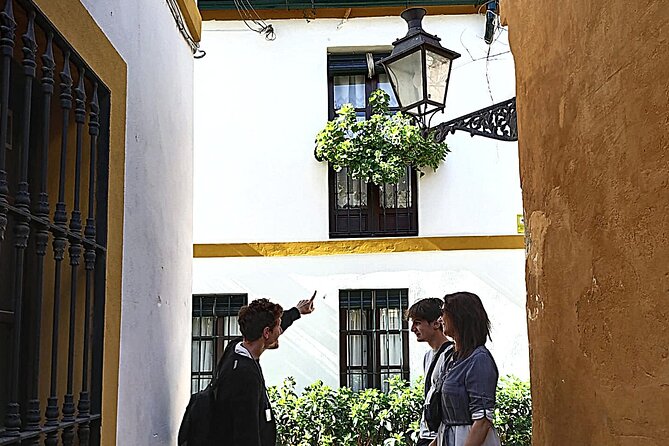
The tour turns toward the difficult history of Seville’s Jewish community in the 14th and 15th centuries. You hear about the pogrom and the final expulsion of Jews by the Catholic Monarchs. These events are central to understanding why the former Jewish Quarter changed so dramatically.
The story of Susona adds a personal and legendary dimension. Her tale is tied to the neighborhood and shows how local memory can preserve painful events through a human story. The guide presents her legend as part of Seville’s traditional storytelling, alongside the documented history of the community.
This is an important part of the walk, and I appreciate that the route does not treat the Jewish Quarter as a purely picturesque setting. Narrow streets and charming courtyards can hide the fact that this was also a place marked by violence, religious pressure, and forced departure.
Because the tour is short, the treatment is necessarily selective. You will not receive a full academic account of Sephardic life in Spain. You will, however, gain enough context to look at Santa Cruz with greater care.
Santa Cruz as Seville’s City of Opera
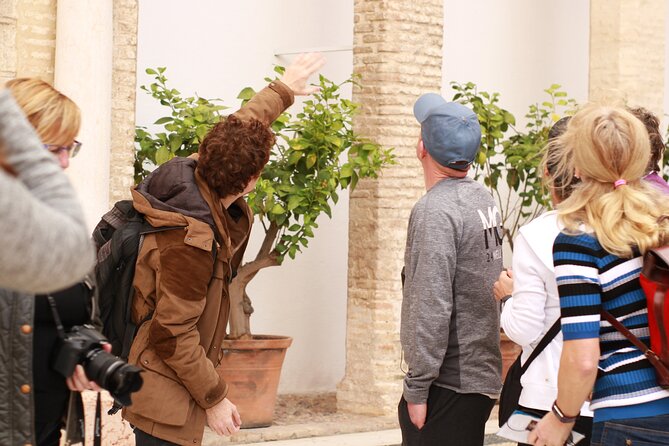
The older Jewish Quarter became a favorite setting for European writers and artists. The walk uses its lanes to explain Seville’s reputation as a City of Opera, a title linked with the city’s place in several major stories and stage works.
This is where the route’s historical and literary themes meet. The same streets can bring to mind Don Juan, Carmen, Rosina, and Figaro. You get a sense of why foreign artists found Seville so theatrical, especially in the 18th and 19th centuries.
I like this approach because it gives the city a cultural explanation rather than simply calling it romantic. The guide helps you understand how that image was made. The neighborhood’s scale, balconies, courtyards, and winding lanes gave writers and composers plenty to work with.
If you want time for photographs, say so. A private tour gives you more freedom than a large group, and the guide can adjust the pace. With only two hours available, though, every extended photo stop means less time for stories later.
The World Heritage view near the cathedral
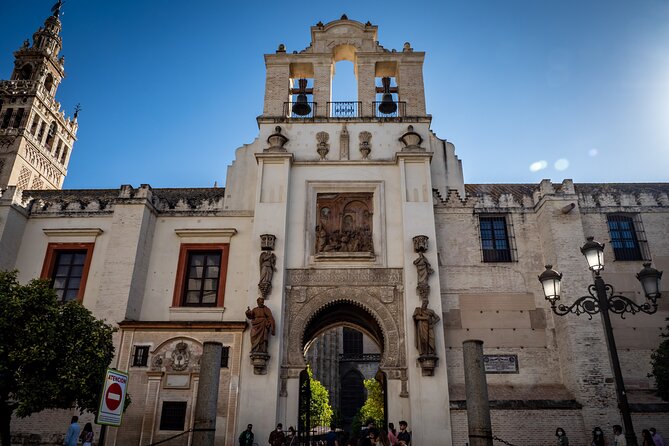
At one point, you reach a view framed by Seville’s major monuments: the Cathedral, the Giralda, the Real Alcázar, and the Archivo de Indias. All four form part of the UNESCO-listed historic center, and seeing them together helps you understand the city’s scale.
This is a strong orientation stop. From one viewpoint, you can connect the cathedral’s Christian role, the Giralda’s Islamic origins, the palace complex, and the archives of Spain’s overseas empire. The guide explains the relationship between the buildings rather than presenting each one as an isolated attraction.
You do not enter the Cathedral or Alcázar on this tour, so plan separate visits if those interiors are on your list. That is not a flaw in the route, but it is an important distinction. This walk gives you context and exterior views, while dedicated tickets and more time are needed for the monuments themselves.
The viewpoint also helps you decide what to see next. I would use the tour early in your stay, then return to the buildings that catch your attention.
From the Torre del Oro to Seville’s modern makeover
The walk leaves the tight streets of the historic center and turns toward the Torre del Oro. The tower helps explain Seville’s riverfront and its defensive past. From there, the guide shifts to a much newer chapter: the reshaping of the city for the Ibero-American Exposition.
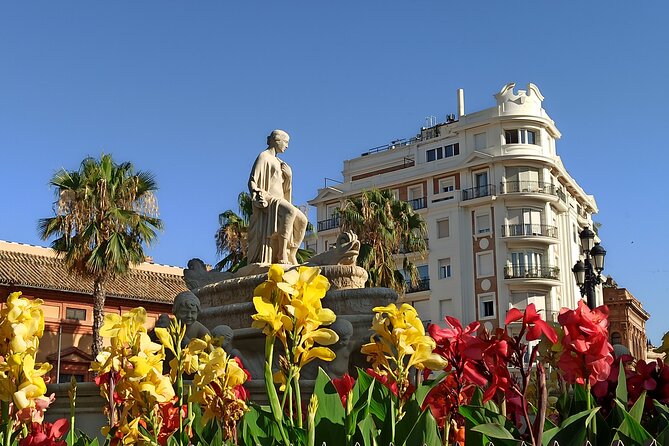
You learn how important avenues, including the route along Constitution Avenue, helped create a more open public face for Seville. The Alfonso XIII hotel is another surviving reminder of that period.
This change of subject keeps the tour from becoming a single-era history lesson. You move from medieval walls and Jewish neighborhoods to the urban planning and architecture of the early 20th century.
The walk between the old center and María Luisa Park also gives you a practical sense of Seville’s layout. You finish well outside the starting square, so the route functions as both a tour and a useful transfer through the city. Wear comfortable shoes, since the experience is on foot and covers several districts.
The former Tobacco Factory and Mérimée’s Carmen
The University of Seville occupies the former Royal Tobacco Factory, an imposing building tied to the history of tobacco production in Spain. The guide explains how French political and administrative influence helped establish these factories under the Bourbon monarchy.
This stop also connects directly to Prosper Mérimée, whose Carmen drew on Seville and the world of tobacco workers. The story later became famous through Bizet’s opera, further strengthening the city’s link with the European stage.
The factory is not just a backdrop for a literary tale. It tells you something about trade, manufacturing, government policy, and the way Spain’s industries developed. That broader context makes the building more interesting than a quick photograph from the street.
The visit lasts about 15 minutes and admission is free. Again, this is a guided look rather than a full tour of every university space. University activity may affect what you can see, so treat the stop as an exterior and historical introduction unless your guide indicates otherwise.
María Luisa Park and Plaza de España
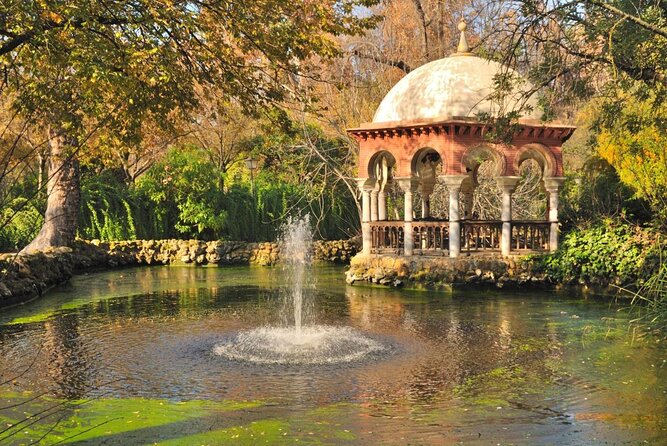
The final section reaches Parque de María Luisa, a graceful public park shaped by the French garden designer Jean-Claude Nicolas Forestier. The park’s design gives the route a softer finish after the dense lanes of Santa Cruz and the formal streets near the center.
The park also provided the setting for the Ibero-American Exposition. Its pavilions reflect the effort to present Spain and its overseas connections through architecture, gardens, and public space. The most famous building is the Spanish Pavilion, now known simply through its setting at Plaza de España.
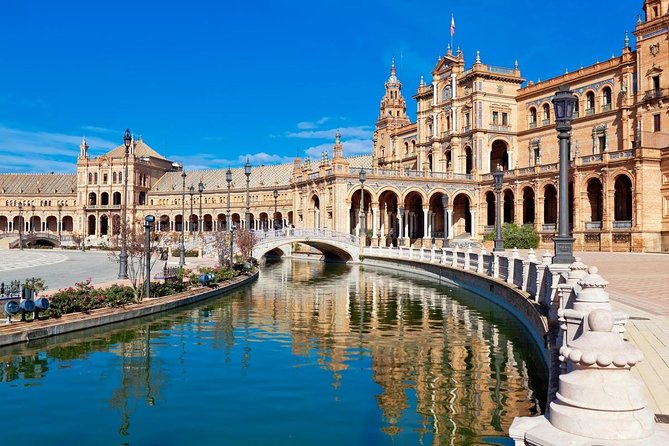
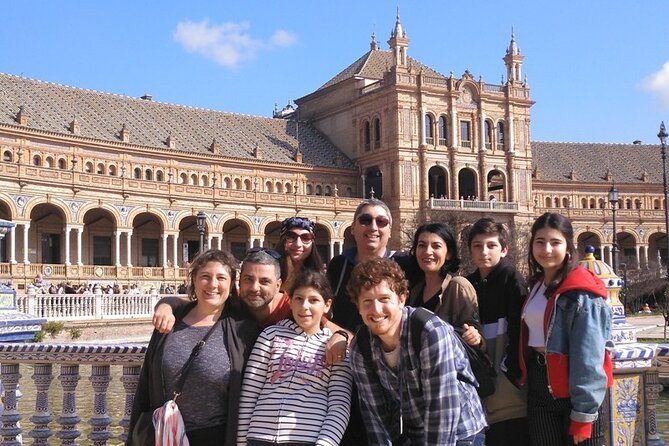
The tour ends in the plaza, where tiled benches, bridges, water, and monumental architecture create one of Seville’s most recognizable scenes. The 15-minute visit here is enough for an explanation and some photographs, but not for a leisurely exploration of every detail.
I like ending here because the route builds toward a clear visual payoff. Plaza de España is large and easy to enjoy on your own after the guide leaves. You can linger, walk around the semicircular building, and explore the María Luisa gardens at your own pace.
What the private format is worth
The price is $189.87 per group, with up to 12 people included. For one or two people, that is a considerable amount for a two-hour walk. For a family or small group, the arithmetic changes: six people would pay roughly $31.65 each, while 12 people would pay about $15.82 each before any currency conversion or booking charges.
The private structure is the main reason to consider it. You are not sharing the route with strangers, and you can ask questions about Jewish heritage, painting, literature, architecture, or food. Victor Fernández is the listed provider, and his guiding style is described as friendly, humorous, responsive, and full of local recommendations. Manuel is also associated with the company’s Seville guiding, so confirm who will lead your specific departure.
The experience is offered in English and uses a mobile ticket. It is listed for daily departures from 10 a.m. to noon during the stated operating period. Most people can participate, service animals are allowed, and the start and finish are close to public transportation.
The timing deserves attention. A two-hour route covering Santa Cruz, the center, the Torre del Oro area, the former Tobacco Factory, María Luisa Park, and Plaza de España moves at a purposeful pace. It is best for orientation, storytelling, and seeing the city’s connections. It is not designed for long interior visits.
Feedback about the guides also points to useful extras: clear communication before the tour, good humor, help with planning other Andalusian stops, and suggestions for tapas bars and local food. Those additions can be especially helpful on your first day, when a short list of practical places is worth more than another page of general advice.
Who should book this Seville walk?
I would choose this tour for a small group that wants a private introduction to Seville without spending half a day inside one monument. It suits families, couples traveling with friends, and history-minded visitors who enjoy stories tied to real streets.
It is especially useful if you want to understand Santa Cruz before exploring it alone. The route also works well early in a Seville stay because it ends at Plaza de España, leaving you in a good position to continue through María Luisa Park.
You might choose something else if your top priority is the Cathedral, Giralda, or Alcázar interiors. None of those sites receives a full interior visit here. You may also prefer a longer tour if you want extensive time for art, photography, or detailed discussion of Sephardic history.
Free cancellation is available up to 24 hours before the start time. Changes or cancellations inside that window are not accepted for a refund, so keep the local cut-off time in mind.
Final verdict: a smart route for first-time Seville planning
Book this walk if you want Seville explained through its neighborhoods, writers, artists, and changing religious communities. I like its one-way design, the free entry to Santa María la Blanca, the literary thread from Don Juan to Carmen, and the final arrival at Plaza de España.
The best value comes when several people share the private price. Go in expecting a brisk introduction, not a full museum tour, and you will get a useful sense of how Seville’s Jewish Quarter, historic center, riverfront, university, park, and exhibition architecture fit together.
FAQ
Where does the tour begin?
The tour begins at Plaza de Santa Cruz in Seville’s Casco Antiguo.
Where does the tour end?
It ends at Plaza de España, in the gardens of María Luisa.
How long does the tour last?
The tour lasts approximately two hours.
What language is the tour offered in?
The tour is offered in English.
How many people can join the private tour?
The price covers one private group of up to 12 people.
Is admission included at the tour stops?
The listed visits to Iglesia de Santa María la Blanca, Universidad de Sevilla, and Parque de María Luisa have no admission charge. The tour does not list entrance to the Cathedral or Real Alcázar.
Is the tour accessible by public transportation?
The meeting and ending areas are near public transportation.
Can I cancel for a full refund?
Yes. You can cancel at least 24 hours before the experience starts for a full refund. Cancellations or changes made less than 24 hours before the start time are not accepted.
Recently added around Seville
- Seville Jewish Quarter walking tour: Santa Cruz District★ 4.8 · 104 reviews
- Seville Former Jewish Quarter Walking Tour: Santa Cruz★ 5.0 · 105 reviews
- Seville: Museum of Fine Arts Guided Tour★ 4.8 · 107 reviews
- Seville: El Patio Sevillano Flamenco Show Ticket & Dinner★ 4.1 · 108 reviews
- Seville: 3 Bars Pub Crawl + VIP Club Entrance & 3 Free Shots★ 4.3 · 108 reviews
- Seville: Flamenco Show at Tablao Flamenco Andalusí★ 4.7 · 109 reviews
- Seville Jewish Quarter Small Group Tour with Tapas and Drinks★ 5.0 · 110 reviews
- Flamenco Show & Tapas Small Group Tour in Seville★ 5.0 · 111 reviews
Jewish Quarter Tours, compared.
Cordoba Mosque & Jewish Quarter Tour with Tickets
Read our review →
Mosque-Cathedral, Jewish Quarter and Alcázar Tour
Read our review →
Jewish Quarter and Mosque-Cathedral Guided Tour
Read our review →
Mosque-Cathedral, Alcazar & Jewish Quarter with Tickets
Read our review →
Mosque-Cathedral of Cordoba and Jewish Quarter Tour
Read our review →
Small-Group Jewish Quarter Discovery Walking Tour
Read our review →Browse the lists this tour appears in