
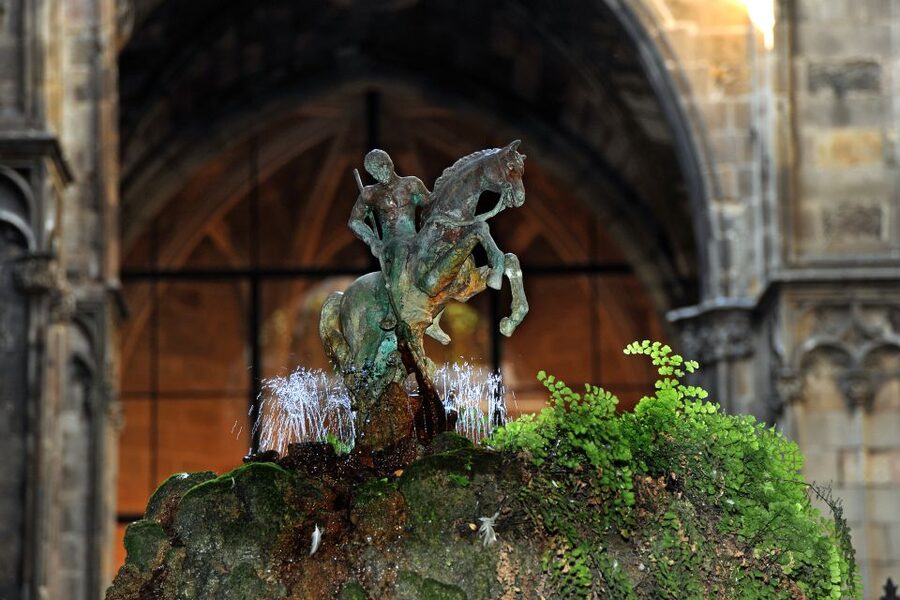
Review · WALKING TOURS
Barcelona 2-Hour Gothic Walking Tour
Barcelona’s oldest quarter rewards slow looking. This two-hour Gothic Quarter tour links Roman ruins, medieval palaces, quiet squares, and the Cathedral with an official local guide who explains what you are seeing, not just where to point your camera. I especially like the visit to the Cathedral cloister and the stories around Plaça del Rei, Saló del Tinell, and the Roman Temple of Augustus. I also like that the English option includes free time at the Museu Frederic Marès. The main consideration is simple: two hours on cobbled streets can feel tiring, especially in hot weather, and the tour offers little time to linger at each stop.
At $32 per person, this is a sensible way to get your bearings before exploring Barcelona alone. Guides such as Olga Escribano, Jordi, Alex, Pilar, and Alexandra have been praised for turning dates and architectural details into clear, entertaining stories. Bring water and eat first. One happy but hungry participant gave the practical warning that the final stretch can feel long if you arrive without a snack.
In This Review
- Key points at a glance
- Why a two-hour walk works so well here
- Meeting at Plaça de la Seu
- Barcelona Cathedral and its cloister
- Roman Barcelona at the Temple of Augustus
- Plaça del Rei, royal power, and Saló del Tinell
- Plaça Sant Felip Neri and the quarter’s harder memories
- The Museu Frederic Marès bonus
- What the guides add
- Price, pace, and practical value
- Who should book this Gothic Quarter walk
- Should you book it?
- FAQ
- How long is the Barcelona Gothic walking tour?
- How much does the tour cost?
- What language is the tour offered in?
- Where does the tour meet?
- Where does the tour finish?
- Is Barcelona Cathedral included?
- Does the tour visit the Roman Temple of Augustus?
- Is the Museu Frederic Marès included?
- What other historic sites are covered?
- Can I cancel for a full refund?
Key points at a glance
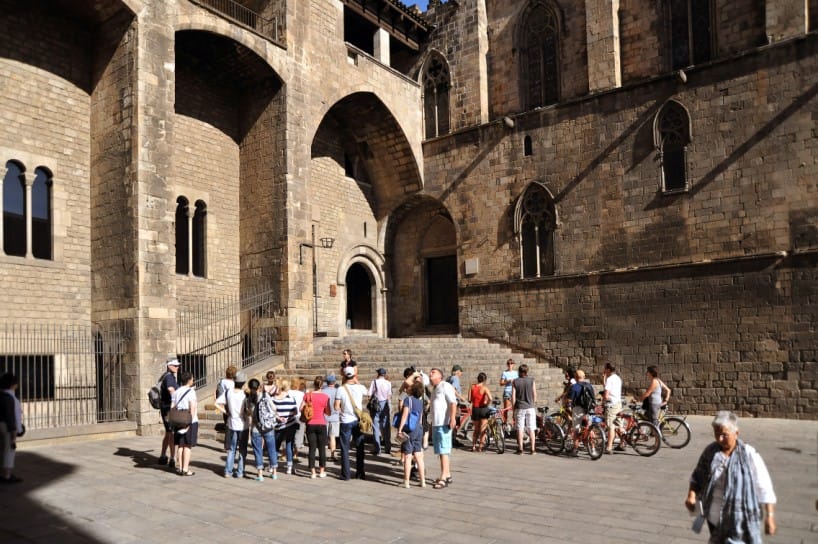
- Roman Barcelona in a medieval setting: Find the Temple of Augustus tucked into a quiet courtyard among later buildings.
- The Cathedral gets more than a photo stop: The guided visit includes a closer look at its cloister.
- Plaça del Rei brings medieval power to life: See the former royal complex, including the Saló del Tinell and Capella de Santa Àgata.
- Plaça Sant Felip Neri adds a sobering modern chapter: Its damaged walls recall the Spanish Civil War.
- English tours include the Museu Frederic Marès: You receive free admission and time to explore after the walk.
- A compact route with a strong value: Most sights sit close together, so you cover a lot without crossing the whole city.
Why a two-hour walk works so well here
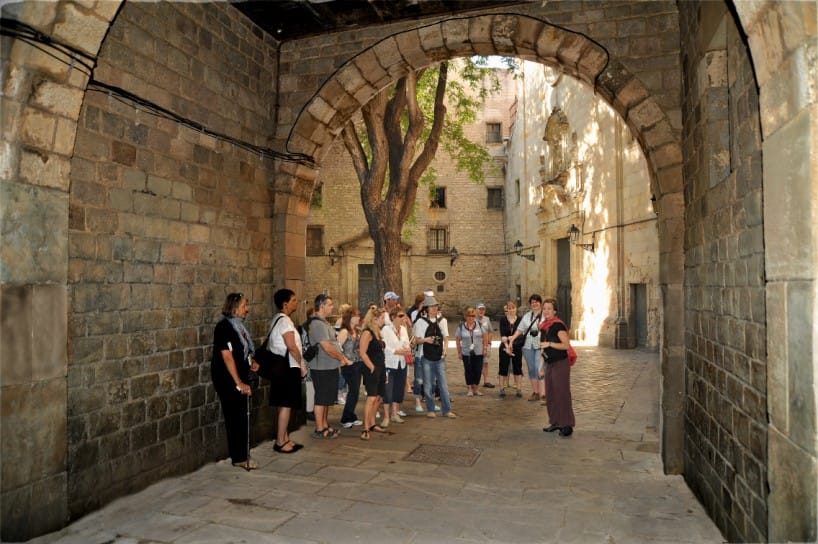
The Gothic Quarter is not a single monument. It is a maze of lanes and small squares where Roman foundations, medieval churches, royal buildings, and modern shops sit almost on top of one another. Without context, you can easily walk past an important doorway or mistake a later facade for an untouched medieval building.
That is where this tour earns its price. The guide moves you from one nearby site to the next and explains how the pieces fit together. You are not spending half the morning on buses or waiting in lines between attractions. You are using your feet, looking up, and learning the story of old Barcelona in the place where it happened.
I would choose this early in a Barcelona visit. It gives you a working map of the Barri Gòtic and helps you decide which spots deserve a second visit. Several guides have also offered suggestions for other city sights and places to eat, which is useful when you are still finding your way.
The pace appears to suit many people. A two-hour tour is long enough to cover substantial ground but short enough to fit before lunch or another major attraction. Still, this is a walking tour, not a sit-down lecture. Expect uneven paving, frequent stops, and plenty of standing. One participant with movement difficulties found the pace manageable, while another sensibly advised eating and drinking before starting.
More Walking Tours in Barcelona
- Barcelona Tapas and Wine Experience Small-Group Walking Tour
★ 5.0 · 5,804 reviews - Barcelona: Tapas Walking Tour with Food, Wine, and History
★ 4.8 · 4,261 reviews - Barcelona Tapas Walking Tour: Food, Wine & History
★ 4.5 · 1,928 reviews
Meeting at Plaça de la Seu
The meeting point is the tourist information office at Plaça de la Seu. Look for the information symbol, the letter i. This is directly beside Barcelona Cathedral, so you begin in one of the city’s most recognizable historic settings rather than wasting time finding an obscure street corner.
The listed starting location is Plaça Seu, 2, and the walk also finishes in the same general area. That makes planning easy. You can continue toward other central sights, stop for food, or return to your hotel without arranging transport.
Arrive with a little spare time. The quarter’s lanes can be confusing, and the cathedral square may be busy. Since the experience uses a live English guide, you do not have to manage an audio app while walking. On rainy days, an earpiece has helped people hear the guide clearly under umbrellas, though weather can affect what is open. A past participant reported that rain led to a tower closure and required a refund request for that part of the visit, so keep expectations flexible when conditions turn poor.
Barcelona Cathedral and its cloister
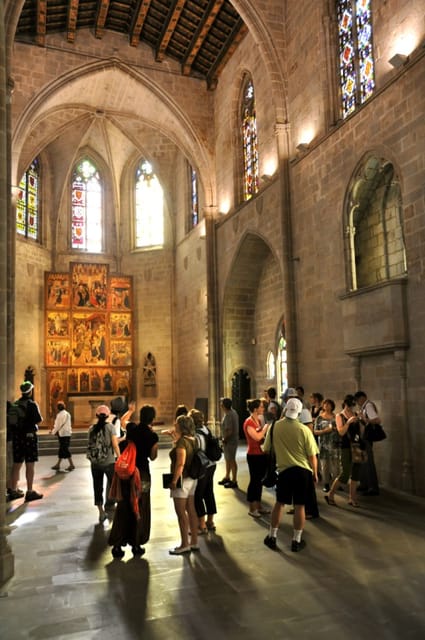
The Cathedral is the natural opening act. Its Gothic towers and formal facade draw your eye at once, but the guided visit helps you look beyond the grand exterior. The cloister is especially worthwhile because it offers a quieter, more detailed side of the cathedral complex.
The cloister gives the tour a change of mood. Instead of only hearing about Gothic architecture from a plaza, you get closer to the building’s religious spaces and design. The guide can point out details that are easy to miss when you visit alone, which is one of the strongest reasons to take a guided walk in this district.
The tour description promises a guided visit rather than simply an outside explanation. That matters, but you should not read it as a full cathedral exploration at the pace of an art museum visit. With several other sites packed into two hours, the guide must keep moving. If the Cathedral becomes your favorite stop, return later and give it more time.
Roman Barcelona at the Temple of Augustus
The Roman Temple of Augustus is one of the route’s best surprises. The remains belong to Barcino, the Roman city beneath modern Barcelona, yet they are tucked into a medieval courtyard. That contrast tells you much about the Gothic Quarter: the city was not rebuilt from scratch every few centuries. It kept growing around what was already there.
You may find the temple more rewarding after the guide explains its setting. On your own, you could walk through the surrounding lanes without realizing that Roman columns are nearby. This is a small stop physically, but it provides a large shift in perspective. Barcelona becomes a layered city, not simply a collection of Gothic facades.
The tour does not promise extensive time at every Roman remain in the quarter. I would treat this as a focused introduction to ancient Barcelona, then use the information to notice other traces beneath the later streets.
More walking tours:
- Barcelona: Tapas Food Crawl Walking Tour with Tastings
★ 4.9 · 1,798 reviews - Barcelona: Gothic Quarter Ghosts and Legends Walking Tour
★ 4.7 · 1,443 reviews - Barcelona Helicopter, Sailboat & Old Town Private Walking Tour
★ 5.0 · 1,395 reviews - Barcelona: Old Town and Gothic Quarter Walking Tour
★ 4.8 · 1,393 reviews
Plaça del Rei, royal power, and Saló del Tinell
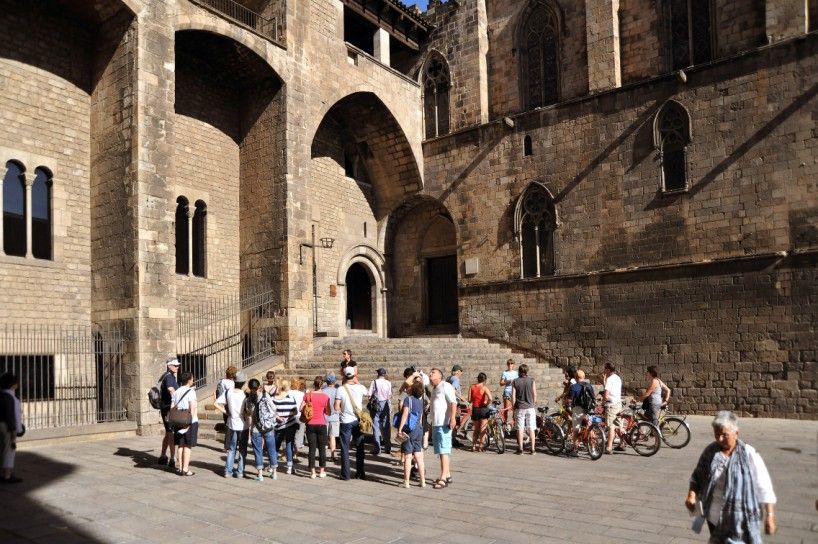
Plaça del Rei is one of the most atmospheric squares on the route. Its enclosed arrangement and stone buildings make it easier to picture medieval Barcelona than in the wider, traffic-filled parts of the city. Here, the guide introduces the Palau Reial Major, the former palace of Catalan kings.
The Saló del Tinell is a major highlight. This grand hall is tied to the royal complex and to the famous meeting in which Ferdinand and Isabella received Christopher Columbus after his voyage to the New World. The value of the stop is not only the event itself. It connects Barcelona’s medieval political center with the larger forces that shaped Spain and the Atlantic world.
I like this part of the walk because the setting does much of the teaching. You are standing in a place built for power, then hearing about the people and decisions associated with it. Guides often use images or visual aids to make the past easier to picture, a detail that has been particularly useful on this tour.
The Capella de Santa Àgata adds another layer to the palace complex. Its presence shows how royal, religious, and civic life occupied the same small area. You should expect a guided look rather than a long, independent visit. The benefit is the connection between sites. The limitation is that the schedule keeps you from lingering over every architectural detail.
Plaça Sant Felip Neri and the quarter’s harder memories
The route eventually reaches Plaça Sant Felip Neri, a quieter square with a baroque church and walls marked by damage from Spanish Civil War bombings. Children now play there, and musicians may fill the space with sound, but the scars keep the mood serious.
This is one of the most affecting stops because it resists the postcard version of Barcelona. The Gothic Quarter is not only handsome stone, flower-filled balconies, and romantic lanes. It also carries painful memories. A good guide can explain that shift without turning the stop into a history lecture detached from the place itself.
Allow yourself a quiet moment here. The square works best when you look closely at the walls and listen to the guide rather than rushing toward the next photograph. It is also a useful reminder that the quarter’s story continues well beyond the Middle Ages.
The Museu Frederic Marès bonus
English-language participants receive free admission to the Museu Frederic Marès after the walking tour, with free time to explore. The museum is housed in a medieval palace and presents Frederic Marès’s collection of sculptures, religious art, antique curiosities, and everyday objects from the 19th century.
This bonus changes the value calculation. At $32, you are paying for a guided walk, an official local guide, and an additional cultural stop that can extend your time in the area. The museum is not an optional extra in the same sense as a restaurant recommendation. It is included for the English tour, so check that your selected departure is the English version if you want it.
The museum also gives you something the street walk cannot: time to browse at your own speed. During the tour, you follow the guide and keep to the schedule. Afterward, you can focus on objects that catch your eye. The collection ranges from medieval sculpture to personal and household items, so it offers a broader view of Catalan culture than a route focused only on royal buildings and churches.
The supplied route details also mention the Museu d’Història de Barcelona. The experience information separately specifies the Museu Frederic Marès as the included post-tour museum for English participants. Since both names appear in the published route details, I would confirm the exact museum arrangements when booking, while treating the Frederic Marès visit as the stated English-language bonus.
What the guides add
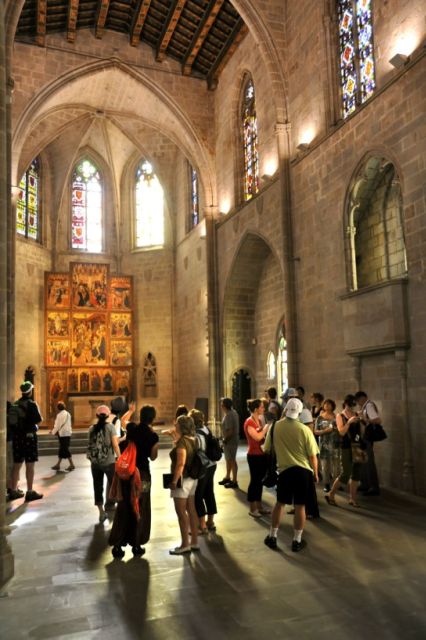
The strongest part of this experience is the human explanation. Past guides named Olga Escribano, Jordi, Alex, Pilar, Alexandra, Luca, Theo, Miguel, and others have been praised for clear historical explanations, humor, patience, and helpful recommendations.
Olga Escribano receives especially warm praise for adjusting her stories to the group, answering questions, and making the quarter feel personal rather than academic. Other guides, including Jordi and Alexandra, have been praised for their friendly manner and strong command of Barcelona’s past. That range suggests the experience depends partly on the individual guide, as any live tour does, but the overall pattern is encouraging.
I would ask questions as you go. This is not a silent walk with a script playing in your ear. The guide is there to explain architecture, local culture, political events, and the people connected with the buildings. If you are curious about Catalan identity, Roman Barcelona, or why a quiet square matters, this is the moment to ask.
The use of pictures by at least one guide has also helped make vanished buildings and historical events easier to understand. That is a practical advantage when you are looking at foundations, fragments, or buildings altered over time.
Price, pace, and practical value
At $32 per person, the tour is good value if you want context as well as sightseeing. You receive two hours with an official local guide, a concentrated route through important sites, the Cathedral and cloister visit, and free admission to the Museu Frederic Marès on the English tour.
The value is weaker for someone who prefers to wander alone or already knows Barcelona’s history. The Gothic Quarter is free to explore, and independent visitors can see many of the exterior locations without paying. You are paying for the explanations, the route design, and access to details you might miss.
The tour’s 4.7 rating from 317 reviews supports its strong reputation, but I would still keep the format in mind. This is not a private tour with unlimited stops. Group size is not specified, so the experience may feel more personal on a small departure and less so on a full one. Guides have been praised for keeping groups together and answering questions, but a busy quarter can make it harder to hear or take photographs.
The activity allows cancellation up to 24 hours before departure for a full refund and offers reserve-now, pay-later booking. Those policies help if your Barcelona schedule is still shifting. Starting times vary, so check availability before building the rest of your day around it.
Who should book this Gothic Quarter walk
I would recommend it to first-time visitors, history fans, architecture lovers, and anyone who looks at old buildings and wants to know what happened inside them. Families with older children and teenagers can also get a lot from it because the route mixes royal stories, Roman remains, war memories, and atmospheric streets rather than focusing on dates alone.
It is also a smart choice for a first morning in Barcelona. You finish near the Cathedral with a better sense of direction and several ideas for later exploration. The museum option makes it useful on a day when you want both outdoor sightseeing and indoor culture.
You should think twice if you dislike cobblestones, standing, or a fixed pace. Two hours is not extreme, but it is still two hours on foot. Bring water, wear sensible shoes, and eat beforehand. Rain can alter access to some areas, and the tour may feel less relaxed in harsh heat.
Should you book it?
Book this tour if you want Barcelona’s Gothic Quarter to make sense, not merely look attractive. The Temple of Augustus, royal halls, Cathedral cloister, Santa Àgata, and Plaça Sant Felip Neri form a strong sequence, and the guides add the human detail that turns stones into stories.
Skip it if you prefer complete independence or plan to spend a full day studying one building. For most first-time visitors, though, $32 buys a useful introduction, a well-planned walk, and a museum visit that helps round out the experience. Take it early, bring water, and keep the rest of the day open for the places that catch your eye.
FAQ
How long is the Barcelona Gothic walking tour?
The guided walking tour lasts two hours.
How much does the tour cost?
The price is $32 per person.
What language is the tour offered in?
The live guided tour is offered in English.
Where does the tour meet?
It meets at the tourist information office at Plaça Seu, 2. Look for the information symbol with the letter i.
Where does the tour finish?
The listed drop-off location is also Plaça Seu, 2.
Is Barcelona Cathedral included?
Yes. The itinerary includes a guided visit to Barcelona Cathedral, including a closer look at its cloister.
Does the tour visit the Roman Temple of Augustus?
Yes. The Roman Temple of Augustus is one of the historic locations covered during the Gothic Quarter walk.
Is the Museu Frederic Marès included?
The English tour includes a free visit to the Museu Frederic Marès after the walking tour, with free time inside.
What other historic sites are covered?
The route includes the Gothic Quarter, Barcelona Cathedral, the Chapel of Santa Àgata, the Museu d’Història de Barcelona in the listed itinerary, and Plaça Sant Felip Neri. The tour also highlights the Saló del Tinell and the Palau Reial Major.
Can I cancel for a full refund?
Yes. You can cancel up to 24 hours in advance for a full refund. The activity also offers reserve-now, pay-later booking.
More 2-Hour Experiences
- Barcelona: Two-Hour Midday or Sunset Sailing Cruise
★ 4.8 · 1,732 reviews - Barcelona: 2-Hour City Sights Guided Segway Tour
★ 4.9 · 453 reviews - Barcelona: 2-Hour Sailboat Tour with Snacks and Drinks
★ 4.8 · 357 reviews - Barcelona: Jewish Quarter 2-Hour Walking Tour
★ 4.8 · 333 reviews
Recently added around Barcelona
- Intro Segway Tour Barcelona 1h★ 4.9 · 166 reviews
- Barcelona: Bike or eBike Tour, Top Sights & Local Insights★ 4.9 · 166 reviews
- Instagram Photoshoot Tour in Barcelona★ 5.0 · 167 reviews
- Artisan Ceramic Making Experience★ 5.0 · 168 reviews
- Barcelona: Big Fun Museum Ticket★ 4.2 · 169 reviews
- Gaudi’s Crypt in Colonia Güell with Audioguide★ 4.4 · 170 reviews
- Sagrada Familia Evening Private Tour with Expert Guide★ 4.5 · 170 reviews
- Las Golondrinas Barcelona 60-min Boat Tour★ 4.0 · 170 reviews
Walking Tours, compared.
Barcelona Tapas and Wine Experience Small-Group Walking Tour
Read our review →
Tapas Walking Tour with Food, Wine, and History
Read our review →
Albaicín and Sacromonte Guided Sunset Walking Tour
Read our review →
Toledo Tour & Vineyard Walk with Wine Tasting from Madrid
Read our review →

Barcelona Tapas Walking Tour: Food, Wine & History
Read our review →
Madrid Old Town & Royal Palace Walking Tour Skip the Line Ticket
Read our review →
Browse the lists this tour appears in