Review · GUIDED
Palau de la Musica Catalana Guided Tour
Barcelona hides some of its best art indoors. The Palau de la Música Catalana guided tour makes this UNESCO-listed concert hall easy to appreciate, especially if you want more than a quick look at its colorful façade. I like the small group of up to 15 people and the useful 15-minute film, which gives the building a clear setting before you start walking. I also like the chance to choose a time that fits around other Barcelona plans. The main drawback is simple: the tour lasts only about an hour, and one or two guides may speak quickly or explain things in a rather mechanical way.
At $26.60 per person, this is a fair-priced architectural visit rather than a full cultural event. You will not attend a concert, and food and drinks are not included, but you do get admission, a local guide, and access to rooms that are easy to miss on your own. If the Palau is not already on your list, this is the sort of short stop that can surprise you.
In This Review
- Key points about the Palau tour
- Why this concert hall deserves an hour
- Meeting your guide on Carrer Palau de la Música
- The Rehearsal Hall and the 15-minute film
- The staircases, tiles, and glass balusters
- Light and flowers in the Lluís Millet Hall
- The Concert Hall and its inverted skylight
- How strong is the guiding?
- Is $26.60 a fair price?
- Timing, tickets, and who should book
- My verdict: book it for the building, not the concert
- FAQ
- How long does the Palau de la Música Catalana tour last?
- What is included in the tour price?
- Is the tour offered in English?
- Where does the tour begin?
- Where does the tour end?
- How large is the tour group?
- Is food or drink included?
- Can I cancel for a full refund?
Key points about the Palau tour
- The Concert Hall is the grand finale: Stained glass, sculpture, tiled surfaces, and the inverted-dome skylight make this the visual high point.
- A 15-minute film comes first: It explains the building’s construction and the society of early 20th-century Barcelona.
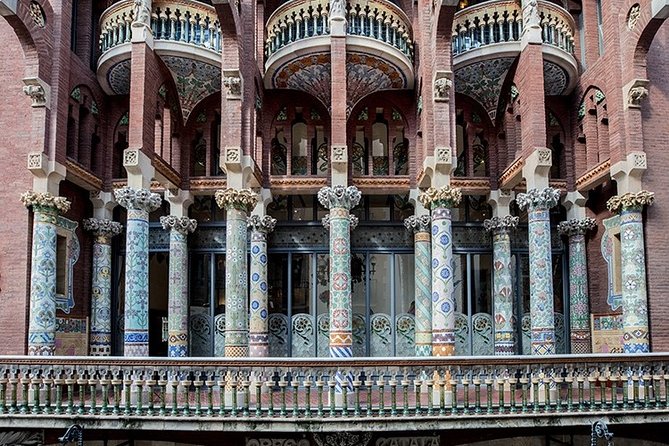
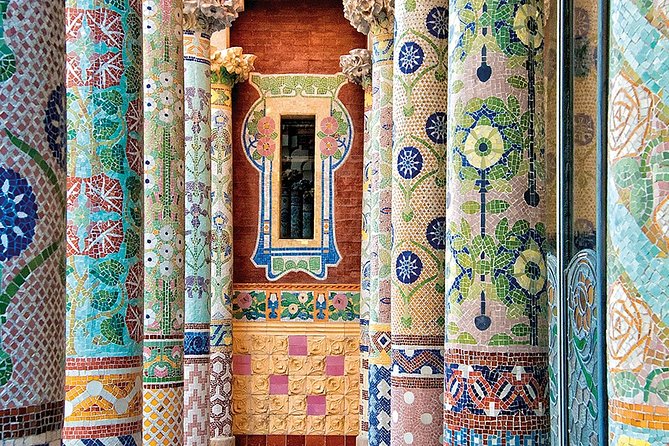
- The Lluís Millet Hall offers a close look at the façade: Floor-to-ceiling windows open onto a balcony colonnade decorated with flower mosaics.
- The tour is small and scheduled: Groups are capped at 15, and advance booking matters because time slots can fill.
- You receive a mobile ticket and skip-the-line entry: That saves time at a popular city-center attraction.
- You may hear the organ: Several tour times have included organ practice or other musicians rehearsing, though this is not guaranteed.
Why this concert hall deserves an hour
The Palau de la Música Catalana is not a plain concert box. It is a Modernisme masterpiece, with decoration spread across nearly every surface. The building was designed for the Orfeó Català, a major Catalan choral society, and construction began in 1905.
That background matters because the decoration is not random ornament. Nature, music, Catalan identity, sculpture, ceramics, stained glass, and ironwork all share the same space. Without a guide, you can certainly admire the colors. You may miss why the flowers, figures, arches, and materials were placed where they are.
I would not compare the Palau directly with Barcelona’s better-known Gaudí buildings. The mood is different. Instead of one architect’s highly personal fantasy, you get a working music hall shaped by several artists and craftspeople. The result is lively, detailed, and slightly overwhelming in the best way.
The hall is still active, so this is not a frozen museum. Concerts, rehearsals, and cultural events take place here. That gives the visit a useful sense of purpose. You are seeing a beautiful building, but you are also seeing a place built for music that continues to serve that role.
A few more Spain trips worth a look
- Barcelona: Sagrada Familia Entry Ticket with Audio Guide
★ 4.6 · 105,312 reviews - Barcelona: Park Güell Admission Ticket
★ 4.4 · 76,534 reviews - Barcelona: Casa Batlló Entry with Self-Audioguide Tour
★ 4.7 · 25,359 reviews
Meeting your guide on Carrer Palau de la Música
The official meeting point is Palau de la Música Catalana, C/ Palau de la Música, 4-6, in Barcelona’s Ciutat Vella district. The activity begins and ends at the building.
The directions describe meeting your guide outside, but one practical detail deserves attention. A booking experience has reported that the actual meeting point was inside, behind the bar, rather than directly on the street. I would arrive a little early, keep the mobile ticket ready, and check the exact meeting instructions before joining the group.
The Palau is near public transportation, and the central location makes it easy to fit into a day of sightseeing in the old city. Since the tour lasts roughly one hour, you can place it between other scheduled activities without giving up half a day.
The group limit of 15 is useful here. In a heavily decorated building, a large crowd would make it harder to hear and easier to miss small details. A smaller group also gives you a better chance to ask about the musicians, architects, and decorative features.
The Rehearsal Hall and the 15-minute film
The tour starts in the Rehearsal Hall of the Orfeó Català. This is where the foundation stone was laid in 1905, so the first room connects the building to its original purpose.
Before the walking portion begins, you watch a 15-minute audio-visual presentation. It covers the building’s history and the social setting of early 20th-century Barcelona. This is more useful than it may sound. The Palau contains so many visual details that a little context helps you sort the important from the merely pretty.
I like this opening because it gives the tour a backbone. You learn why the hall was built, then see the spaces with that purpose in mind. The film also helps if your guide speaks quickly, since it supplies a basic introduction before the more detailed explanations.
The possible weakness is pace. With only about an hour in total, fifteen minutes takes up a sizeable part of the visit. If you prefer to spend every minute inside the main hall, the film may feel like a delay. If you enjoy architecture and want the social setting explained, it is time well used.
The staircases, tiles, and glass balusters
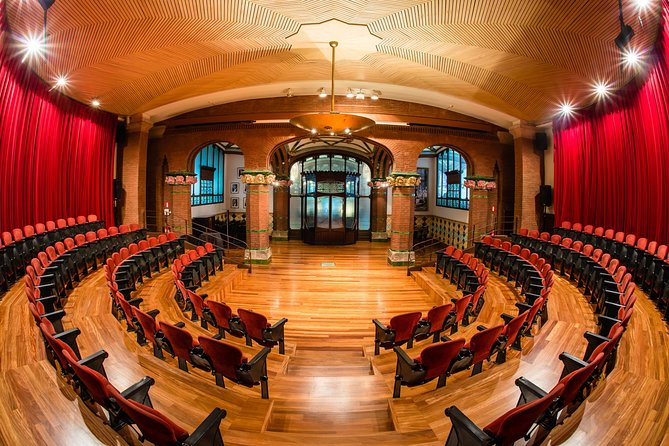
From the Rehearsal Hall, you move toward the elaborate staircases leading to the second floor. This section is easy to rush through, but it deserves a slow look.
Pay attention to the tiling beneath the stairs. The underside is decorated, not treated as a hidden structural space. Then look at the unusual glass balusters supporting the marble banisters. These details show the building’s willingness to make practical elements part of the artistic design.
The stairway also changes your view of the Palau. You are not simply looking at a façade or sitting in an auditorium. You are moving through a building where floors, railings, windows, and ceilings all contribute to the experience.
This is one reason a guide adds value. A self-guided visit might lead you toward the obvious stained glass and sculptures, but the staircases reward someone who points out what is easy to overlook. The guide also provides information about the architects and artists responsible for the decoration.
The stairs may require a bit of attention for anyone who finds climbing difficult. The supplied details do not describe an alternate route, so it is sensible to ask the venue about access needs before booking if this is important for you. Service animals are allowed, and most people can take part.
A completely different kind of day out in Barcelona:
- Barcelona: 24 or 48-Hour Hop-On Hop-Off Bus Tour
★ 4.4 · 20,872 reviews - Barcelona: Park Guell Guided Tour with Skip The Line Entry
★ 4.7 · 17,563 reviews - Barcelona: La Pedrera-Casa Milà Ticket & Audio Guide Option
★ 4.7 · 15,099 reviews - Barcelona in 1 Day: Sagrada Familia, Park Guell,Old Town & Pickup
★ 5.0 · 13,541 reviews
Light and flowers in the Lluís Millet Hall
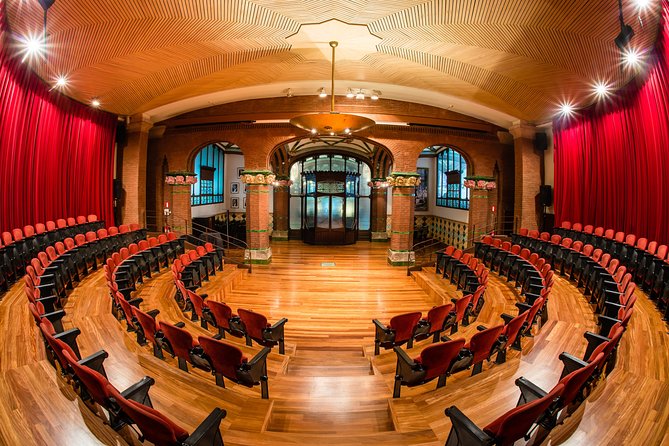
At the top of the stairs, the Lluís Millet Hall provides a pause from the tighter stairway space. Its floor-to-ceiling windows look out toward the balcony colonnade on the main façade.
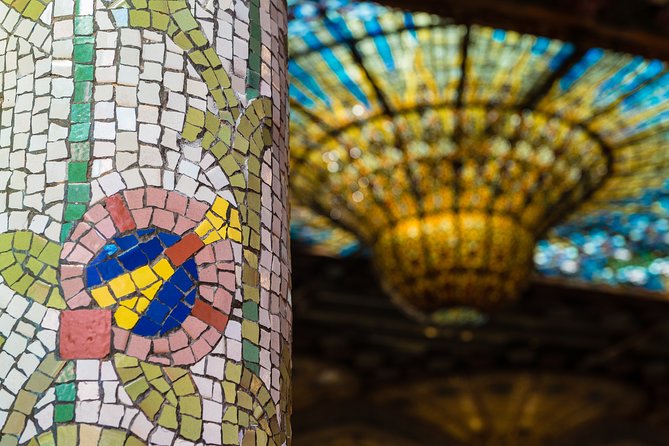
The windows bring in a great deal of light, which helps you see the decorative work from a different angle. Look at the columns and pillars outside. They are covered with mosaics showing flowers, part of the building’s wider tribute to nature.
This room is a good reminder that the Palau’s design works from inside and outside at once. The façade is not just something to admire from the street. From the Lluís Millet Hall, you can study its columns and mosaics as part of the interior experience.
You may find this room less dramatic than the Concert Hall, but I would not skip it. It gives you time to examine the detail without the same sense of spectacle. It also creates a natural bridge between the staircases and the main auditorium.
The Concert Hall and its inverted skylight
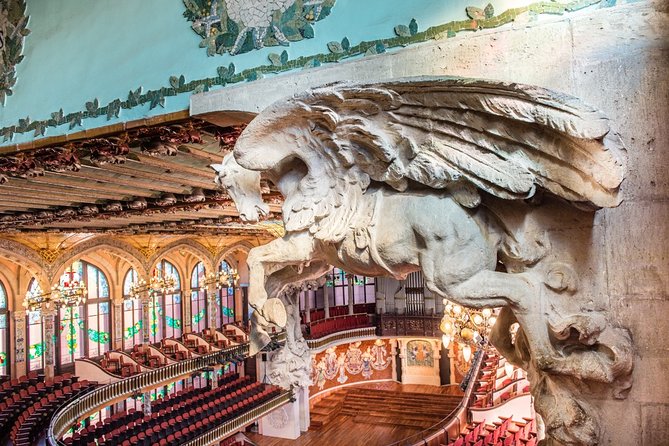
The Concert Hall is the reason many people remember this visit. Once inside, look first at the walls, where large stained-glass panes are set into arches. Then turn your eyes upward to the enormous skylight shaped like an inverted dome.
The skylight is the room’s visual center. It brings light down into the auditorium and reverses the usual feeling of a ceiling pressing overhead. The effect is theatrical even when no concert is taking place.
The room also contains sculpture and decorative work connected with music. Your guide explains the contributions of Eusebi Arnau, Pau Gargallo, Lluís Bru, and Antoni Rigalt. These names matter because the Palau was not the work of one person alone. Sculptors, ceramic artists, mosaic makers, and stained-glass designers helped create the finished interior.
Give yourself a moment to look around before following the explanation. The first impression is color and light. After that, you can pick out individual forms, tiles, figures, and patterns. The design is so dense that a second glance often reveals something the first one missed.
The hall’s acoustics are another important part of the visit. The building was created for singing and orchestral performance, so the decoration serves a practical musical purpose as well as a visual one. Some tour times have included an organist, vocalist, or other performers rehearsing. You might hear the organ, which has almost 3,000 pipes, but this is an occasional bonus rather than part of the advertised program.
Several people have left wanting to return for a live concert. That is a useful sign of the tour’s value. The visit does not replace a performance, but it can show you why attending one here would be special.
How strong is the guiding?
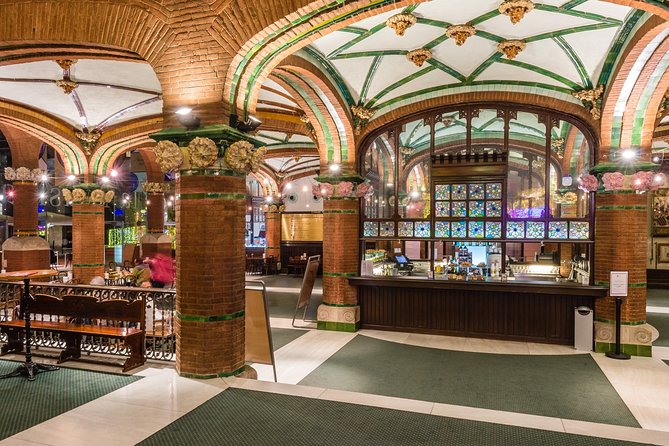
The guide is an important part of this experience. The best version of the tour gives you background on the building, points out the meaning of the sculptures and mosaics, and explains how the design supports music.
Many guests have praised guides for being friendly, well organized, and full of useful information. The audio equipment also helps. The earpiece hooks behind your ear, and you can adjust the volume yourself. That is valuable in a group, especially inside a large hall where sound can carry unevenly.
The quality may vary by guide and language comfort. One experience included a guide whose English was difficult to follow, while another guide spoke quickly and did not help the group adjust its earpieces. A few minutes were also lost from the promised hour on one occasion.
That does not make the tour a poor choice, but it is worth setting expectations. This is a scheduled group visit, not a private architectural lesson. Some guides will build a warm connection with the group. Others may deliver the facts briskly and move on.
The small group helps reduce this risk. With no more than 15 people, you are not lost in a large crowd, and the guide can usually be heard through the headset. If you have a question, ask it early rather than waiting until the final room.
Is $26.60 a fair price?
At $26.60, the tour is reasonably priced for Barcelona. The fee includes the Palau admission ticket, a local guide, the 15-minute audio-visual presentation, and skip-the-line entry.
The value is strongest if you care about architecture or want a structured introduction. You could enter the building and admire the main spaces, but the guide gives you names, dates, artistic context, and an explanation of how the pieces fit together. That is what turns a short look into a proper visit.
The value is less clear if you are hoping for a concert or a long museum-style experience. Food and drinks are not included, and the tour ends after about an hour. You are paying for access and interpretation, not an evening of music.
I see it as a good add-on for a Barcelona itinerary. It costs far less time than a major half-day attraction, and the building itself provides enough visual reward to justify the stop. For people who already plan to attend a concert here, the tour can also help you understand the room before the performance.
Timing, tickets, and who should book
The tour is offered in English, with several departure times to choose from. Since the experience is often reserved about 29 days ahead, I would not leave a preferred time until the last minute if your Barcelona schedule is tight.
A mobile ticket keeps things simple. Advance booking also matters because the interior has limited space and tour groups are capped at 15 people. The skip-the-line feature is useful during busy sightseeing periods, though the tour still begins at a fixed time.
This visit suits you best if you:
- Enjoy architecture, decorative arts, or music
- Want a short activity between larger Barcelona plans
- Prefer a guide to explain details you might overlook
- Are curious about Catalan Modernisme beyond the most famous names
- May attend a concert later and want to see the room beforehand
You might choose something else if you want a long, relaxed museum visit or if you dislike fixed departure times. The itinerary is compact, and the group moves through several rooms in about an hour.
Free cancellation is available up to 24 hours before the start time. Changes or cancellations inside that window are not accepted for a refund, and the cut-off follows local Barcelona time.
My verdict: book it for the building, not the concert
I would book this tour if you want to see one of Barcelona’s most extraordinary interiors without spending half a day. The stained glass, flower mosaics, sculpted details, decorated staircases, and inverted skylight give you plenty to look at, while the film and guide explain why it all matters.
The main caution is the short duration and variable guide delivery. If your guide speaks too fast, some details may pass you by, and the visit can finish before the full hour. Still, the admission price is fair, the group is limited, and the building is genuinely special.
Book it when you want a compact, well-planned cultural stop. If you have the chance to attend a performance at the Palau afterward, even better. The tour lets you admire the hall in daylight, then return to hear what the architecture was made to do.
FAQ
How long does the Palau de la Música Catalana tour last?
The tour lasts approximately one hour, including the visit through the main rooms and the 15-minute audio-visual clip.
What is included in the tour price?
The price includes a local guide, the Palau de la Música admission ticket, and the 15-minute audio-visual presentation.
Is the tour offered in English?
Yes. The tour is offered in English.
Where does the tour begin?
The listed meeting point is Palau de la Música Catalana, C/ Palau de la Música, 4-6, Ciutat Vella, 08003 Barcelona, Spain.
Where does the tour end?
The activity ends back at the meeting point, near the Palau’s exit.
How large is the tour group?
The maximum group size is 15 people.
Is food or drink included?
No. Food and drinks are not included in the tour.
Can I cancel for a full refund?
Yes, if you cancel at least 24 hours before the experience starts. Cancellations or changes made less than 24 hours before the start time are not accepted for a refund.
Recently added around Barcelona
- Intro Segway Tour Barcelona 1h★ 4.9 · 166 reviews
- Barcelona: Bike or eBike Tour, Top Sights & Local Insights★ 4.9 · 166 reviews
- Instagram Photoshoot Tour in Barcelona★ 5.0 · 167 reviews
- Artisan Ceramic Making Experience★ 5.0 · 168 reviews
- Barcelona: Big Fun Museum Ticket★ 4.2 · 169 reviews
- Gaudi’s Crypt in Colonia Güell with Audioguide★ 4.4 · 170 reviews
- Sagrada Familia Evening Private Tour with Expert Guide★ 4.5 · 170 reviews
- Las Golondrinas Barcelona 60-min Boat Tour★ 4.0 · 170 reviews
Guided, compared.
Sagrada Familia Entry Ticket with Audio Guide
Read our review →La Pedrera-Casa Milà Ticket & Audio Guide Option
Read our review →
Caminito del Rey Guided Tour with Transportation
Read our review →
Caminito del Rey: Guided Tour and Entry Ticket
Read our review →
Skip-the-Ticket-Line Mosque-Cathedral Guided Tour
Read our review →
Cathedral, Giralda & Alcazar Entry With Guided Tour
Read our review →