
Review · TUK TUK TOURS
Madrid Expert Tour with Local Guide in Eco Tuk Tuk Private
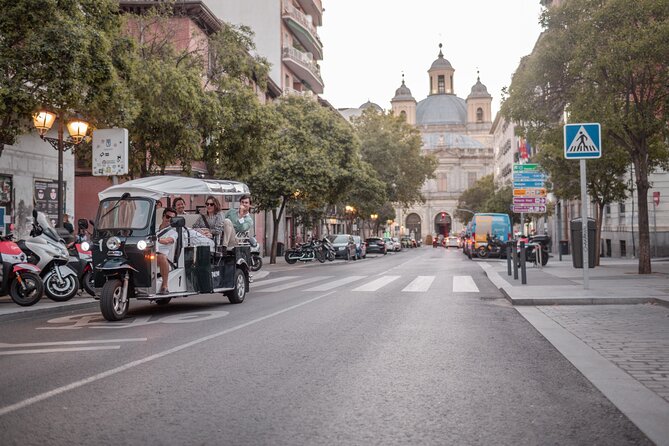
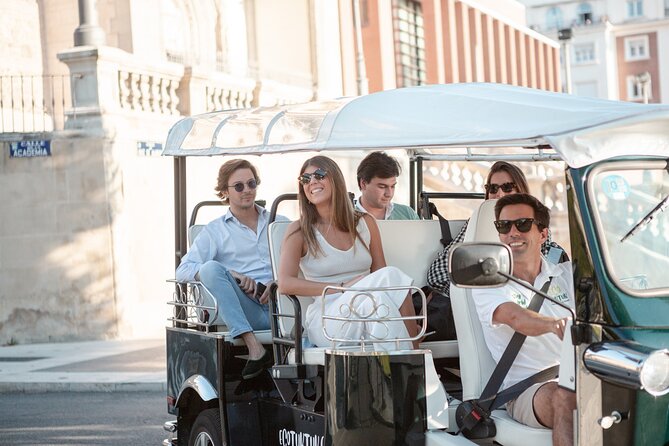
Madrid is best seen in motion. This private electric tuk-tuk tour gives you a quick, comfortable look at the capital, from Atocha and the Prado to the Royal Palace, Bernabéu Stadium, and the Temple of Debod. I like the small private vehicle, which lets your group stay together, and the way the route covers both old Madrid and the grand avenues of newer districts. The main consideration is that this is an orientation tour, not a deep visit inside Madrid’s museums or monuments.
I also like the practical touch of blankets and rain protection. Guides such as Jaime, Carlos, Lucia, Gustavo, David, and Manuel have been praised for friendly storytelling, good English, and useful suggestions for the rest of a Madrid stay. The route is broad, so you should expect brief photo stops and plenty of sightseeing from your seat rather than long walks.
In This Review
- Key things to know before you book
- Why a tuk-tuk works well in Madrid
- From the meeting point to Madrid’s food markets
- Atocha, the Spanish Courts, and Neptune
- The Prado and the church of Los Jerónimos
- Puerta de Alcalá and the Salamanca district
- Bernabéu and Paseo de la Castellana
- Columbus, the National Library, and Cibeles
- Santa Ana, San Francisco el Grande, and the Almudena Cathedral
- The Royal Palace, Campo del Moro, and the final temple
- Price, comfort, and the practical tradeoffs
- Who should book this Madrid tuk-tuk tour?
- Should you book it?
- FAQ
- How long does the Madrid Eco Tuk Tuk tour last?
- How many people can ride in one tuk-tuk?
- Is the tuk-tuk private?
- Is the tour offered in English?
- Where does the tour start and finish?
- Is hotel pickup included?
- What happens if I arrive late?
- Does the tour operate in bad weather?
- Can children and pets join the tour?
Key things to know before you book
- A three-hour city overview: You can cover a remarkable stretch of Madrid in one ride, including the historic center, Salamanca, Paseo de la Castellana, and the western royal quarter.
- Private electric tuk-tuk: Only your group rides together, with a legal limit of four passengers per vehicle.
- Strong guide element: The best part of the experience is the live commentary, with guides praised for warmth, humor, history, and local recommendations.
- Useful first-day tour: I would take this early in a Madrid visit so you can mark places to return to, such as the Prado, cathedral, Royal Palace, or Basilica of San Francisco el Grande.
- Weather protection included: Blankets, ponchos, and protective layers are available, but the tour still takes place in ordinary rain or heat.
- Strict timing and route rules: A delay of more than 15 minutes can cancel the activity without a refund, and photo stops cannot be changed.
Why a tuk-tuk works well in Madrid
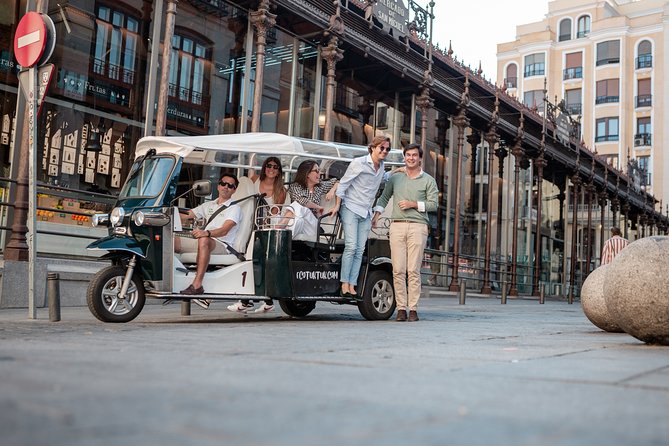
Madrid is walkable, but it is not small. The historic core is easy to explore on foot, yet major sights such as Atocha, the Salamanca district, Santiago Bernabéu Stadium, and the Temple of Debod are spread across the city. A tuk-tuk lets you connect these areas without spending half your day changing between metro lines or marching along broad avenues.
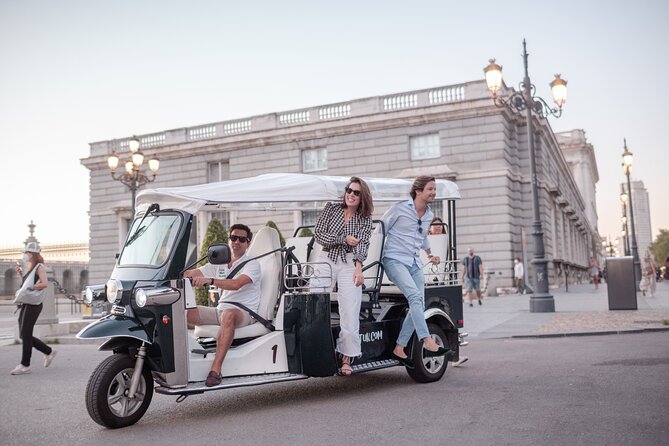
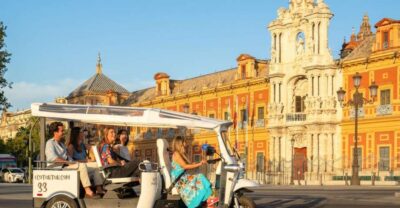
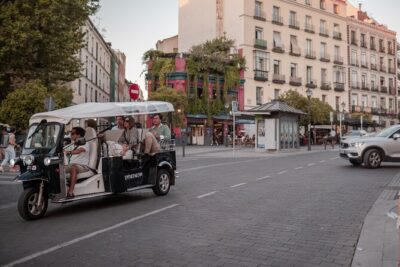
The open-sided vehicle also gives you a better view than a standard coach. You can look up at façades, spot monuments, and hear the guide without being sealed behind tinted glass. The tradeoff is space. A tuk-tuk is intimate, and four passengers is the maximum legal capacity, so it may feel snug if your group is carrying bags or prefers a lot of legroom.
This is a private activity, not a shared sightseeing bus. That matters because you can ask questions as you go. Several guides have been praised for keeping the pace relaxed and explaining Madrid without turning the ride into a lecture. Carlos, in particular, was praised for keeping teenagers laughing while still offering useful information.
The tour is offered in English and lasts about two to four hours, with roughly three hours being the common experience. The exact route can change because of closed streets or demonstrations, and the company does not promise custom stops. Think of it as a carefully planned city circuit with fixed photography points.
More Tuk Tuk Tours in Madrid
- Madrid Welcome Tour with Local Guide in Eco Tuk Tuk Private
★ 5.0 · 2,936 reviews - Madrid: Private City Tour by Eco Tuk Tuk
★ 4.9 · 2,876 reviews - Madrid Historical Tour with Local Guide in Eco Tuk Tuk Private
★ 5.0 · 876 reviews
From the meeting point to Madrid’s food markets
The meeting point is at Calle de Bailén 4, beside the Royal Palace, though the address can confuse map users. The actual pickup is at the underground bus station near Plaza de Oriente, opposite the Prince’s Gate. Searching for Puerta del Príncipe on Google Maps is the clearest way to locate it.
The first part of the route includes a covered market dating from around 1916. It has local food, delicatessen stalls, and events in an elegant setting. The market is useful context for Madrid beyond its monuments. You see how food halls and neighborhood markets remain part of city life, rather than simply moving from one palace to another.
The market stop is primarily part of the drive and sightseeing circuit. Do not assume you will have a long time to shop or eat there. If you want to return for a proper food stop, note the location and come back later on foot.
Atocha, the Spanish Courts, and Neptune
The tuk-tuk then reaches Atocha station, Madrid’s major railway hub near Plaza del Emperador Carlos V. It is the busiest station in Spain and one of Europe’s key rail stations, so this stop helps you understand Madrid’s role as a national transport center.
Atocha is also a useful landmark if you are arriving by train or planning a day trip. You may not spend much time inside, but knowing its position can make the city feel easier to navigate later.
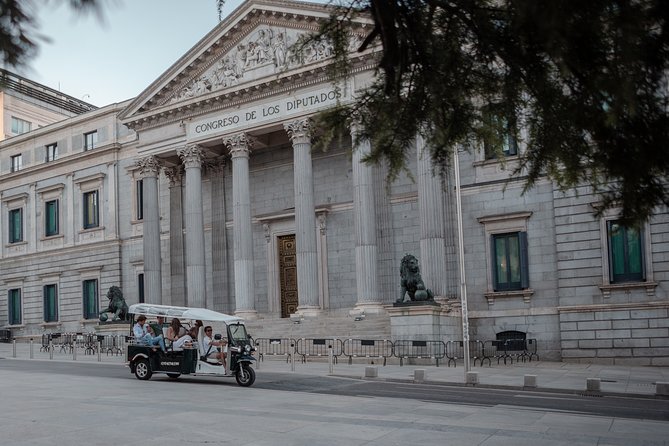
Near the Spanish Parliament, the Palace of the Spanish Courts presents a more formal side of Madrid. Its neoclassical façade has six fluted Corinthian columns, a triangular pediment, and bronze doors that open only on important occasions. The lions beside the entrance were cast from iron taken from cannons captured during the war in Africa.
The building is not simply a pretty façade. It represents Spain’s political center, and the guide can help connect the architecture with the country’s modern civic life. Since entry is not part of the tour, you will view it from outside.
The Fountain of Neptune follows at Plaza de Cánovas del Castillo. Built between 1782 and 1786, the neoclassical fountain depicts the Roman sea god. It is one of several grand fountains that give Madrid’s central avenues their theatrical scale, and it is a quick but worthwhile photo stop.
The Prado and the church of Los Jerónimos
The route passes the Prado Museum, one of the great collections of European painting. Its strongest holdings include Velázquez, El Greco, Goya, Titian, Rubens, and Bosch, along with major works by Murillo, Raphael, Van Dyck, and other masters.
I see the tuk-tuk’s visit here as a preview, not a substitute for entering the museum. The Prado needs several hours if you want more than a hurried look. Your guide may point out the building and explain why it matters, but you should reserve separate time for the galleries.
A useful tip from the tour experience is to check the Prado’s free admission period after 6 p.m. The exact rules can change, so confirm them before relying on this plan. If the museum is high on your list, take notes during the ride and return when you have enough time to see it properly.
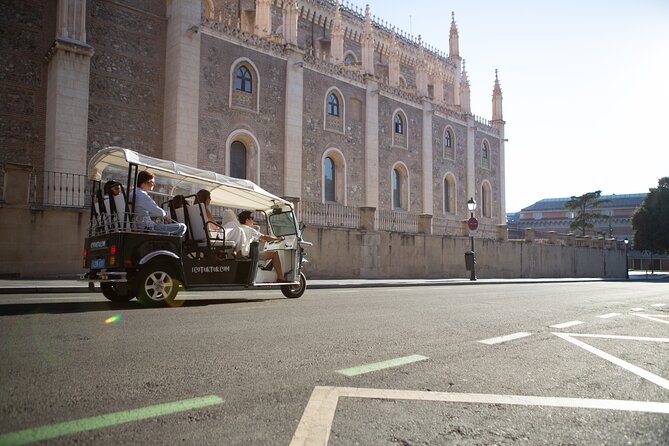
Next comes the Church of San Jerónimo el Real, commonly called Los Jerónimos. This late Gothic church, with Renaissance touches, sits behind the Prado. It has been remodeled many times, but its link with Spain’s monarchy remains clear. The Catholic Monarchs ordered its construction, and it later served as a place of royal retreat and investiture.
The church also hosted the wedding of Alfonso XIII. The large staircase leading to the entrance was built for that 1906 event. A short stop here adds a human and ceremonial layer to the grand buildings around the Prado.
More tuk tuk tours:
- Madrid Express Tour with Local Guide in Eco Tuk Tuk Private
★ 5.0 · 413 reviews - Madrid: City Highlights Tuk Tuk Tour
★ 4.4 · 334 reviews - Tour Welcome Barcelona with Local Guide in Eco Tuk Tuk Private
★ 5.0 · 1,882 reviews - Barcelona: Private City Tour by Eco Tuk Tuk
★ 4.9 · 1,339 reviews
Puerta de Alcalá and the Salamanca district
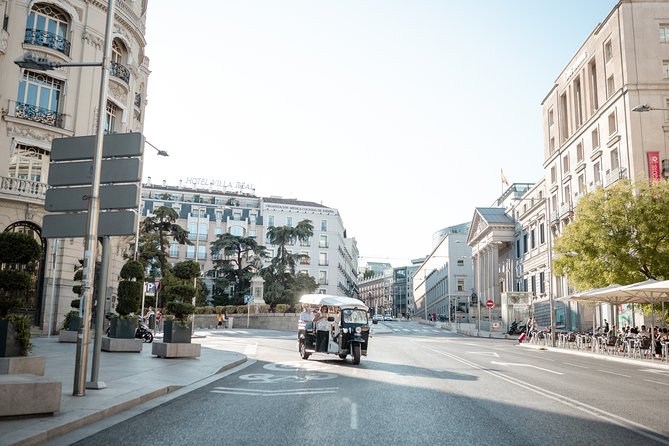
Puerta de Alcalá is one of Madrid’s most recognizable monuments. Carlos III ordered it to replace an earlier gate, and Francesco Sabatini designed the granite neoclassical arch, completed in 1778. It has five openings rather than the more usual three.
The two sides are decorated differently. The city-facing side is simpler, while the outer side has a larger royal shield and more decoration. The name comes from the road toward Alcalá de Henares. This is a good place to look carefully at the carving, since the structure is more interesting than a quick postcard glance suggests.
The tuk-tuk then travels through the Salamanca district along streets such as Velázquez, Ortega y Gasset, and Serrano. This part of Madrid feels different from the old center. The avenues are broad, the architecture is grand, and the district is associated with refined shopping and city wealth.
You will not have time to explore every street, but the ride gives you a useful sense of Madrid’s scale. If Serrano shopping or the Salamanca architecture interests you, return on foot later. The tuk-tuk is best at showing the relationship between the streets, not at replacing a slow neighborhood walk.
Bernabéu and Paseo de la Castellana
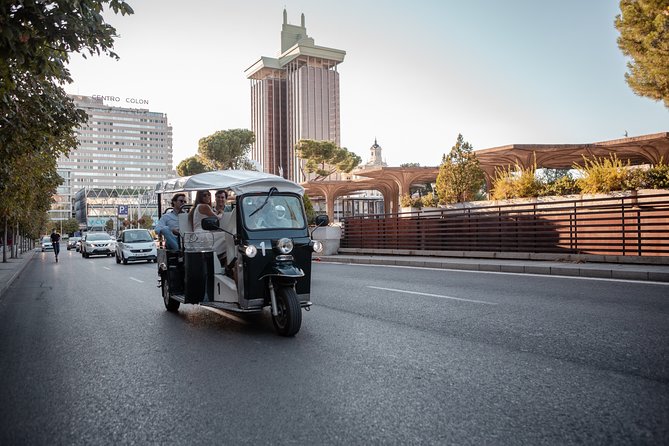
The route continues along Paseo de la Castellana toward Santiago Bernabéu Stadium. The stadium opened in 1947 and now holds 81,044 spectators. For football fans, even a brief view can be a highlight.
The stadium is a drive-by attraction unless a separate stadium visit is arranged. That distinction matters. You will see the exterior and hear about its place in Madrid life, but this tour does not include a stadium museum or match.
The ride along Castellana is valuable because it shows Madrid’s modern business and civic axis. From the Salamanca district to the stadium, you move through a very different part of the capital than the narrow streets around Plaza Mayor and the Royal Palace.
One guide, Carlos, added the stadium as a surprise on a longer four-hour outing. Do not count on an extra stop, since the company says the route is prearranged, but the example shows that the guide may add a little flexibility when traffic and timing allow.
Columbus, the National Library, and Cibeles
The Christopher Columbus monument occupies the center of the fountain at Plaza de Colón. The white marble statue and stone pedestal rise 17 meters and date from 1885. Nearby are the Gardens of Discovery and the Fernán Gómez Cultural Center below ground.
Colón is another place where the guide’s explanation improves a simple photo stop. The monument connects Madrid’s public spaces with Spain’s role in the exploration of the Americas, while the surrounding gardens give the area a more open feel.
The National Library of Spain is close by. It holds about thirty million publications produced in Spain since the early eighteenth century, including books, maps, prints, drawings, music, magazines, and pamphlets. You will see the building from outside. The interior is generally limited to educational groups, universities, and certain nonprofit cultural organizations.
The Fountain of Cibeles then brings you to one of Madrid’s most famous crossroads. The Roman goddess of earth, farming, and fertility rides a chariot pulled by two lions, Hippomenes and Atalanta. The fountain is framed by the Buenavista Palace, Linares Palace, the former Post Office Palace, now Madrid City Hall, and the Bank of Spain.
Cibeles is also where Real Madrid supporters celebrate major titles. That football connection makes the fountain more than an old monument. It remains part of the city’s current public life.
The Bank of Spain adds another grand architectural stop. The building was created to give the National Bank a seat suited to its role in issuing currency, and its decoration won recognition at the 1884 National Exhibition of Fine Arts. You cannot normally visit the interior as an independent sightseer, so the exterior commentary is the main benefit here.
Santa Ana, San Francisco el Grande, and the Almudena Cathedral
Plaza de Santa Ana is a more open, urban square in the Cortes neighborhood. It dates from 1810 and has changed through several redesigns. After large monuments and wide avenues, the plaza offers a more everyday Madrid setting.
The Basilica of San Francisco el Grande is one of the most rewarding exterior stops in the historic center. Officially the Basilica of Our Lady of the Angels, it sits in the Palacio neighborhood. Some tour schedules allow a short walk inside, and one guide was praised for taking a group into the basilica and the church beside the Royal Palace.
The Almudena Cathedral is Madrid’s main religious building. Pope John Paul II consecrated it in 1993, making it the first cathedral consecrated by him outside Rome. The cathedral museum contains objects connected with the Madrid diocese, including mosaics, episcopal shields, and liturgical ornaments.
If time permits, I would return to the cathedral interior after the tour. The tuk-tuk gives you the location and basic story, while a separate visit lets you appreciate the building at a slower pace. One direct tip from the tour experience is simple: make sure you see inside.
The Royal Palace, Campo del Moro, and the final temple
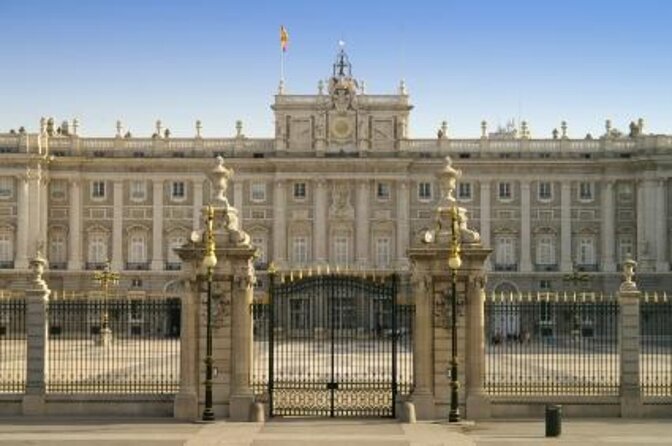
The Royal Palace, also called the Palacio de Oriente, occupies the site of the earlier Habsburg palace, destroyed by fire on Christmas Eve in 1734. Construction began in 1738 and lasted 17 years. Carlos III made it his regular residence in 1764.
Today, Spain’s kings use the palace for official receptions, ceremonies, and state events, while the royal family lives at Zarzuela Palace. The tuk-tuk lets you see the palace setting and its relationship with the surrounding gardens, but palace entry is not included.
Campo del Moro extends west from the Royal Palace toward the Paseo de la Virgen del Puerto. The garden covers about twenty hectares and received historical-artistic protection in 1931. If it is open during your visit, it can be a peaceful place to explore after the ride.
The final stop is the Temple of Debod, an ancient Egyptian building relocated to Madrid. It sits west of Plaza de España beside Paseo del Pintor Rosales, on the hill once occupied by the Mountain Barracks. The temple has free admission, and the tour allows about 15 minutes there.
This is a fitting end because it shows Madrid’s range in one glance: royal Spain, modern city streets, and an ancient Egyptian monument in a Spanish park. You will want to check the temple’s opening arrangements separately if you hope to enter, since the ride itself provides only a short visit.
Price, comfort, and the practical tradeoffs
At $28.67 per person, the price is strong if four people share one tuk-tuk. The private format gives you a guide and vehicle reserved for your group, while a comparable private city tour can cost more. For two people, the per-person value is less striking, but the ability to move through Madrid without organizing transport still has real worth.
The vehicle is fully electric, which keeps the experience quieter and avoids the fumes of a conventional sightseeing vehicle. It is also suitable for older people, and drivers can help passengers board. If you have mobility concerns, contact the provider before arrival. An elevator can be arranged for access from the underground meeting point.
Babies are not allowed. The minimum age is two, and the minimum weight is 9 kilograms. Pets are not permitted for safety reasons.
Weather is a real factor. Tours operate in rain or heat and are canceled only in extreme conditions. Blankets, ponchos, and rain or wind layers help, but you should still dress for the forecast and bring water, a hat, and sunscreen on hot days.
Arrive early. If you are more than 15 minutes late, the activity can be canceled with no refund, and a shorter delay cuts into your tour time. Free cancellation is available up to 24 hours before the start time. After that, changes and refunds are not accepted.
Who should book this Madrid tuk-tuk tour?
I would choose this tour for a first morning or afternoon in Madrid, especially if you have only a few days. It is also a good fit for families, older relatives, and anyone who wants short walks rather than a full walking tour.
It works best for people who want orientation, city views, and a guide’s running commentary. It is less suitable if your main goal is long museum visits, extended food tasting, shopping, or a fully customized route.
The guide can make or break the experience. Names praised for clear English, humor, warmth, and helpful advice include Jaime, Juan, Lucia, Carlos, Manuel, Gustavo, Arturo, David, Christian, Alex, Natalia, Salvador, and Alicia. You cannot guarantee a particular guide, but the repeated strength of the guiding is a good reason to book rather than simply hire a vehicle.
Should you book it?
Yes, if you want to get your bearings fast and see Madrid’s major districts without tiring yourself out. The route covers an unusually wide range of sights, and the private format makes it easy to ask questions and collect ideas for later.
Book it early in your stay, then return to the Prado, Royal Palace, Almudena Cathedral, San Francisco el Grande, or Temple of Debod with time to look around properly. Skip it if you prefer slow neighborhood walks or want detailed interior visits. For most first-time visitors, though, this is a practical and enjoyable introduction to Madrid at a fair price.
FAQ
How long does the Madrid Eco Tuk Tuk tour last?
The tour lasts approximately two to four hours, with about three hours being typical.
How many people can ride in one tuk-tuk?
The legal maximum is four passengers per tuk-tuk. The number of vehicles required depends on your group size.
Is the tuk-tuk private?
Yes. The vehicle is reserved for your group only.
Is the tour offered in English?
Yes. The experience is offered in English.
Where does the tour start and finish?
It starts near Calle de Bailén 4, at the underground bus station beside Plaza de Oriente and the Royal Palace. The tour ends back at the meeting point.
Is hotel pickup included?
No. Hotel pickup and drop-off are not included and are not legally available for this activity.
What happens if I arrive late?
A delay reduces the tour time and may change the planned route. If you are more than 15 minutes late, the activity can be canceled without a refund.
Does the tour operate in bad weather?
Tours operate in rain and heat and are canceled only under extreme conditions. Blankets and protective layers for rain and wind are available.
Can children and pets join the tour?
Children must be at least two years old and weigh at least 9 kilograms. Babies and pets are not allowed.
Recently added around Madrid
- Madrid: Thyssen Museum Guided Tour with Skip-the-Line Entry★ 4.5 · 165 reviews
- Axe Throwing 1 hour session★ 5.0 · 166 reviews
- Madrid Food Walking Tour with Tapas and Vermouth★ 5.0 · 167 reviews
- Toledo Full-Day Walking Tour with Guide from Madrid★ 4.5 · 170 reviews
- Madrid: Top Pub Crawl Madrid & Party★ 5.0 · 173 reviews
- Madrid Gourmet Tapas Small Group Tour★ 5.0 · 175 reviews
- Street Art Guided Tour in Madrid★ 5.0 · 175 reviews
- Iberian Ham and Wine Small Group Tour in Madrid★ 5.0 · 176 reviews
Tuk Tuk Tours, compared.

Madrid Welcome Tour with Local Guide in Eco Tuk Tuk Private
Read our review →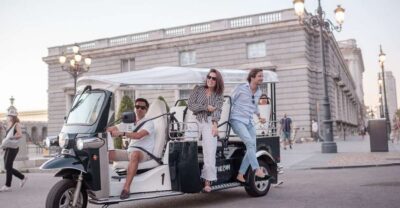
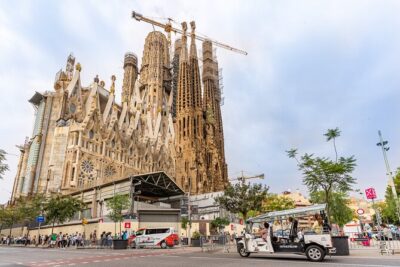
Tour Welcome Barcelona with Local Guide in Eco Tuk Tuk Private
Read our review →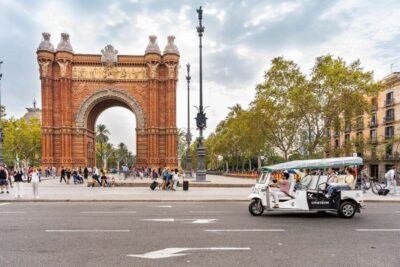

Madrid Historical Tour with Local Guide in Eco Tuk Tuk Private
Read our review →
Browse the lists this tour appears in