
Review · EVENING EXPERIENCES
guided night tour
Cuenca looks best after sunset. This two-hour night walk brings the old town’s limestone buildings, ravines, and famous Hanging Houses into soft illumination, while guides add the stories that make each corner matter. I like the calm evening setting, and I like how the route helps you get your bearings before exploring on your own. The main consideration is that the group can reach up to 50 people, so the experience may feel less personal on a busy night.
The walk begins at 8 p.m. on Calle Alfonso VIII and ends near the Spanish Museum of Abstract Art at the Casas Colgadas. Guides such as Carlos, Guillermo, and Hugo have earned praise for clear explanations, humor, local curiosities, and an easy way with questions. The route is mostly a gentle stroll, though Cuenca’s old town still has uneven streets and some slopes.
In This Review
- At a glance
- Why Cuenca works so well at night
- Starting in the Plaza Mayor
- San Pedro and the upper old town
- The Antonio Pérez Foundation Museum and a former palace
- Castle ruins at the narrow ridge
- The Inquisition building above the Huécar gorge
- The Hanging Houses at their best hour
- The old bridge and the iron replacement
- The Parador above the ravine
- What the guides add to the walk
- Price, group size, and practical value
- Who should book this Cuenca night tour?
- Should you book it?
- FAQ
- How long does the guided night tour last?
- What time does the tour begin?
- Where does the tour meet?
- Where does the tour end?
- What sights are included?
- How many people can join the tour?
At a glance
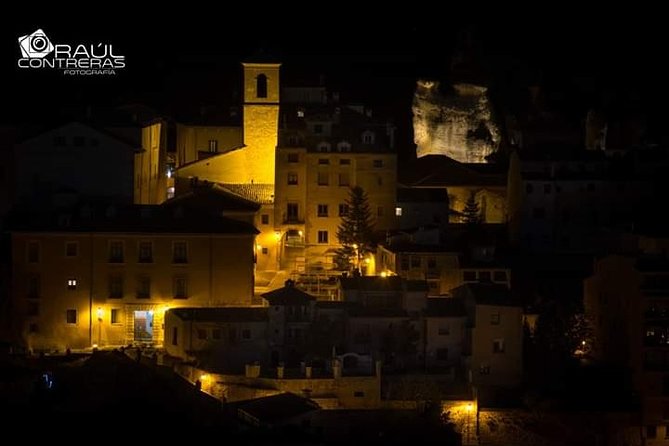
- See Cuenca after dark: Illuminated churches, bridges, ravines, and the Hanging Houses give the medieval center a very different mood.
- Eight useful historic stops: The route covers the Plaza Mayor, San Pedro, the Antonio Pérez Foundation Museum, the castle ruins, the former Inquisition site, the Hanging Houses, the San Pablo bridge, and the Parador.
- A strong orientation walk: You finish beside the Casas Colgadas, well placed to continue exploring the old town or return to favorite spots in daylight.
- Guides add character: Carlos is praised for humor and unusual stories, while Guillermo and Hugo are noted for friendly, clear presentations.
- Good value at $9.88: For about two hours of guided sightseeing, the price is modest, especially if you want context rather than just photographs.
- Plan for a group setting: The maximum is 50 people, and the tour is designed as a shared walking experience rather than a private visit.
Why Cuenca works so well at night
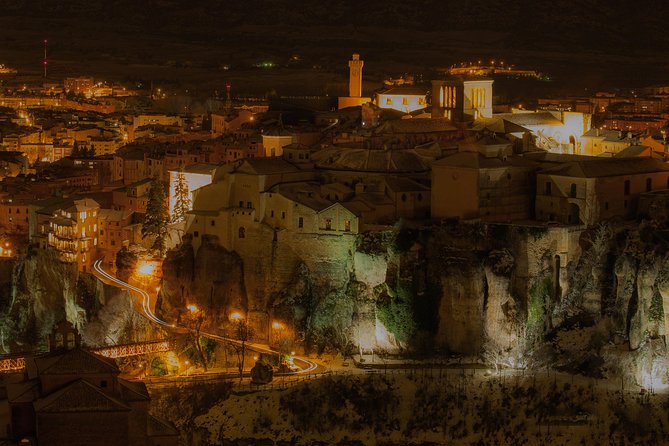
Cuenca is a city of height, stone, and sudden views. Its old center sits between the Hoz del Huécar and Hoz del Júcar gorges, with buildings pressed along a narrow ridge. In daylight, you notice the steep setting. At night, lighting picks out the important shapes and lets the darker ravines frame them.
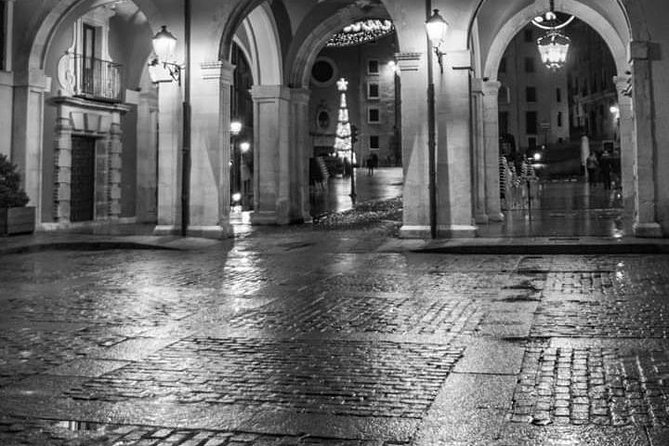
That change in light is the chief reason to choose this outing. The Plaza Mayor becomes a theatrical opening, with colorful leaning houses around the square and the illuminated Cathedral and City Hall facing one another. You are not simply ticking off monuments. You are seeing how Cuenca’s buildings cling to the rock and how the city’s ravines shaped its streets.
The timing also helps in warmer months. An 8 p.m. start avoids the worst afternoon heat and usually gives you the first blue shadows of evening before full darkness settles in. The tradeoff is simple: interior sights are not the focus. This is an outside walking tour, built around views, façades, streets, and spoken interpretation.
A few more Spain trips worth a look
- Barcelona: Daytime or Sunset Catamaran Cruise with Music
★ 4.3 · 5,923 reviews - Barcelona: La Pedrera Night Experience
★ 4.4 · 4,633 reviews - Valencia: Catamaran Cruise with Sunset Option
★ 4.0 · 3,566 reviews
Starting in the Plaza Mayor
Meet at Calle Alfonso VIII, 1, at 8 p.m. The walk begins around the Plaza Mayor, Cuenca’s main historic square. This is a sensible starting point because it gives you an immediate visual map of the old center: the Cathedral, City Hall, sloping houses, and lanes leading farther uphill toward the castle.
Give yourself enough time to find the meeting point. The information provided does not include a hotel pickup, so you should make your own way to the address. The area is near public transportation, and the tour finishes at the Spanish Museum of Abstract Art by the Hanging Houses, not back at the starting point.
The plaza is also a good place to pay attention to the guide’s opening explanation. Cuenca can seem like a maze at first. A short introduction here helps you understand that the narrow streets, abrupt drops, and unusual building positions are not random quirks. They are the result of a city built into a very tight natural setting.
San Pedro and the upper old town
One of the early stops is the Church of San Pedro, an octagonal church raised on a limestone outcrop. Its shape and position are more striking from outside than a simple street-side church would be. The rock beneath it tells part of the story: in Cuenca, religious buildings had to adapt to the ridge instead of spreading across broad, flat ground.
This is where a good guide makes a real difference. The church is easy to photograph and just as easy to pass without understanding. Guides have been praised for explaining construction details, especially the way Cuenca’s houses and monuments respond to the stone beneath them. Carlos, in particular, is noted for turning architectural facts into stories rather than reciting dates.
The evening setting is helpful here. Artificial light gives the church a clear outline, while the surrounding lanes remain atmospheric. You get a strong sense of the old quarter without the visual clutter that can come with a crowded daytime visit.
The Antonio Pérez Foundation Museum and a former palace
The route continues past the Antonio Pérez Foundation Museum, housed in a former 17th-century convent. The building is also connected with the Palace of Sebastián de Covarrubias, a detail many people do not know before arriving in Cuenca.
The tour does not present this as a long museum visit. Instead, you get the setting and the historical meaning of the building as part of a wider walk. That distinction matters. If you want to study the art collection inside, you will need separate time and an admission plan. If you want to understand how Cuenca reused grand religious and civic buildings, the stop gives you a useful introduction.
This part of the route also adds variety. The walk is not only about the city’s most photographed buildings. You hear about less obvious structures, former institutions, and people connected with Cuenca. That broader view helps the old town feel like a lived-in place rather than a row of scenic façades.
A completely different kind of day out in Spain:
- Barcelona: Sagrada Familia Entry Ticket with Audio Guide
★ 4.6 · 105,312 reviews - Barcelona: Park Güell Admission Ticket
★ 4.4 · 76,534 reviews - Seville: Royal Alcázar Entry Ticket
★ 4.6 · 28,378 reviews - Barcelona: Casa Batlló Entry with Self-Audioguide Tour
★ 4.7 · 25,359 reviews
Castle ruins at the narrow ridge
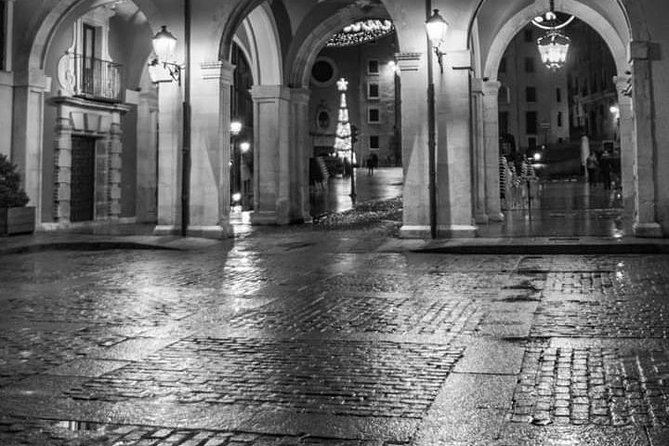
Cuenca Castle is represented today by ruins from the 13th century. The remains sit at the narrowest part of the historic center, between the two gorges. The site marks the strategic logic of the city better than almost any intact monument could.
From here, the natural setting becomes especially important. The castle occupied a defensive pinch point, and the ridge explains why the old town developed in such a compact form. You can look beyond the stone remains and understand the city’s position as a protected medieval settlement.
This stop may appeal most to people who enjoy connecting geography with history. There is not a complete fortress to explore, so keep your expectations in check. The attraction is the location, the fragments, and the views, along with the guide’s explanation of what once occupied this part of the city.
The route is described as not especially tiring, with few major climbs. Still, not tiring does not mean flat. Cuenca’s historic center includes stone streets, steps, and slopes, so comfortable shoes are a practical choice.
The Inquisition building above the Huécar gorge
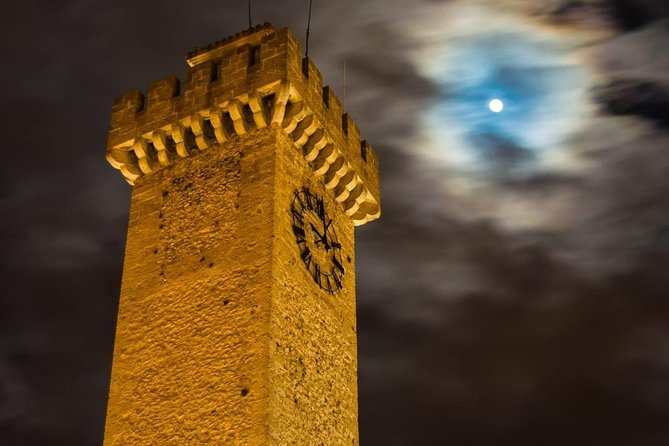
Another stop is a former court of the Inquisition and later prison. The building dominates the historic center from the edge of the Hoz del Huécar, giving it both a strong visual position and a darker historical association.
This is one of the places where the guide’s storytelling can change how you see the street around you. A large old building may seem merely picturesque after dark. Learning how it was used adds weight to the view, reminding you that Cuenca’s monuments held courts, prisons, religious institutions, and private homes, not just modern cultural attractions.
The location also offers the kind of outlook that makes the night route worthwhile. The Huécar gorge falls away beside the upper town, and illumination draws attention to the rock and buildings without requiring a long excursion outside the center.
The Hanging Houses at their best hour
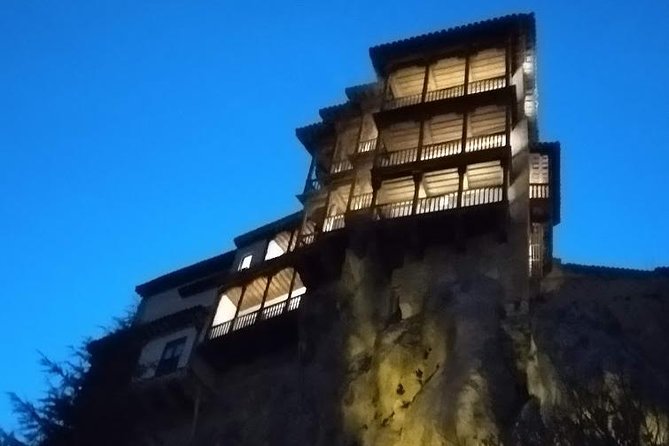
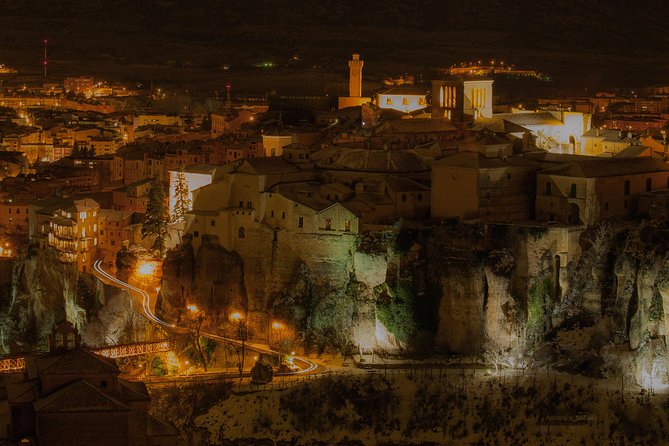
The Casas Colgadas, or Hanging Houses, are the city’s signature sight. More than 600 years old, they project over the ravine and seem to defy the drop below. Their unusual position is impressive in daylight, but the lighting after sunset gives them a sharper, more dramatic presence.
The timing is one of the smartest features of the tour. The walk reaches the Hanging Houses near the end, when they are illuminated. You can spend the earlier part of the route learning how the old center is arranged, then finish with the image most closely associated with Cuenca.
The stop ends near the Spanish Museum of Abstract Art, housed in the Casas Colgadas. The museum itself is not described as part of the guided visit, so plan a separate daytime visit if you want to see the collection. Still, finishing here gives you an excellent reference point for later exploration.
For photographers, this is the moment to have your phone or camera ready. Night photography can be tricky, especially around bright lights and dark ravines, but the contrast is part of the appeal. The guide’s position and timing also help you see the buildings from a deliberate viewpoint instead of wandering around trying to find one.
The old bridge and the iron replacement
The route pauses to explain what happened to Cuenca’s earlier stone bridge and why the present iron bridge replaced it in 1903. This is a small but useful piece of local history. It connects the city’s grand monuments with the practical problems of crossing a deep gorge.
The bridge stop gives you another angle on Cuenca’s setting. The ravines are scenic, but they also shaped transport, construction, and daily life. A bridge here is not just a way from one side to another. It is part of the city’s struggle to connect steep and separated ground.
At night, the iron structure adds a different visual note to the tour. After churches, castle remains, and medieval houses, a 1903 bridge shows Cuenca changing over time. That mix of old stone and later engineering keeps the walk from feeling like a single-period history lesson.
The Parador above the ravine
The final major sight is the Parador, now occupying a former religious building in a dramatic position on rock beside the gorge. Its careful lighting makes it easy to appreciate from outside, especially against the darkness of the ravine.
The Parador also helps explain Cuenca’s appeal as a destination. The city’s most memorable buildings are not spread across a broad plain. They sit at the edge of drops, on ridges, and against rock faces. From this point, you get one more reminder that the scenery is inseparable from the architecture.
The exact sequence of every stop may vary with the guide and walking conditions, but the stated route covers the main historic core. By ending at the Hanging Houses and the museum, the experience leaves you in one of Cuenca’s most useful areas for further sightseeing.
What the guides add to the walk
The strongest part of this experience is the presentation. Carlos is repeatedly praised for being professional, funny, attentive, and good at revealing the less obvious side of a medieval city. Guillermo is described as particularly effective at explaining architecture in a way that makes you value what you are looking at. Hugo is noted for his kindness and interesting local information.
Those differences matter because Cuenca does not need another list of dates. It needs someone to explain why a church is octagonal, how a building fits its rock base, and what you are seeing when the street seems to turn into a cliff. The guides appear to do that with stories, anecdotes, and answers to questions.
You may also receive ideas for exploring independently afterward. The walk is useful as a first evening introduction, but it can also work if you have already visited Cuenca. One particularly useful pairing is a daytime monumental walk and this nighttime route, since the two experiences can show different buildings and viewpoints.
The guide may even point you toward local food discoveries. One account credits Carlos with helping introduce zarajos, a traditional Cuenca dish, during a wider visit. That is not part of the night walk itself, but it shows the kind of local orientation a good guide can provide.
Price, group size, and practical value
At $9.88 per person, this is inexpensive for a two-hour guided walk through Cuenca’s historic center. You are paying mainly for interpretation and route planning, not entry to an indoor attraction. For a first visit, that is good value because the guide helps you use the rest of your time better.
A group of up to 50 people is the main limitation. A larger group can make it harder to hear in narrow streets or gather around a small landmark. If you prefer long conversations with a guide or a quiet, private pace, this may not be the right format.
The experience is open to most people, and service animals are allowed. Because it takes place in the old center, you should still expect historic paving, uneven surfaces, and some uphill or downhill walking. The tour information says there are few strenuous climbs, but Cuenca is not a flat city.
The 8 p.m. start is worth considering alongside your dinner plans. You finish around 10 p.m., depending on the exact pace. Since the end point is different from the start, note where you are when planning your return or evening meal.
Free cancellation is available if you cancel at least 24 hours before the local start time. Changes or cancellations inside that window are not accepted for a refund.
Who should book this Cuenca night tour?
I would choose this walk if you have one evening in Cuenca and want a clear introduction to the old town. It is also a good fit if daytime heat bothers you, if you prefer illuminated architecture, or if you want a guide to explain the city before you explore alone.
History and architecture fans should get plenty from the route, especially at San Pedro, the castle ruins, the former Inquisition building, and the bridge. Photographers will appreciate the dusk views and the final approach to the Hanging Houses.
Families and older visitors may find the two-hour length manageable, but you should be comfortable walking through historic streets. People who need a fully step-free route should confirm details before booking, since the provided information does not promise full accessibility.
Should you book it?
Yes, if you want an affordable, well-paced introduction to Cuenca with strong evening views. A 4.9 out of 5 rating and 98 percent recommendation figure fit the experience described by the many positive accounts: the guides are the real value, and Carlos, Guillermo, and Hugo receive especially warm praise for making facts lively.
I would skip it only if you want a private tour, extensive indoor access, or a completely flat route. For most people, this is a smart first-night choice. You see the city’s defining sights, learn how the rock and ravines shaped Cuenca, and finish beneath the lights of the Hanging Houses.
FAQ
How long does the guided night tour last?
The tour lasts approximately two hours.
What time does the tour begin?
The tour starts at 8 p.m.
Where does the tour meet?
The meeting point is C. Alfonso VIII, 1, 16001 Cuenca, Spain.
Where does the tour end?
The tour ends at the Spanish Museum of Abstract Art, Juan March Foundation, Casas Colgadas, C. Canónigos, 3, Cuenca.
What sights are included?
The route includes the Plaza Mayor, Church of San Pedro, Antonio Pérez Foundation Museum, Cuenca Castle ruins, the former Inquisition court and prison, the Hanging Houses, the iron bridge from 1903, and the Parador.
How many people can join the tour?
The maximum group size is 50 people.
Recently added around Spain
- Half-Day Luxury Catamaran Sailing Cruise in Granada★ 5.0 · 165 reviews
- Jeep Safari to Teide and Masca★ 4.5 · 165 reviews
- Madrid: Thyssen Museum Guided Tour with Skip-the-Line Entry★ 4.5 · 165 reviews
- Visit in Spanish to the Cathedral Mosque. Does not include entrance ticket★ 5.0 · 165 reviews
- Canyoning in Andalucia: Rio Verde Canyon★ 5.0 · 165 reviews
- Guided Tour to Caminito del Rey from Malaga★ 4.5 · 165 reviews
- VIP Private Segway Tour of Palma★ 5.0 · 165 reviews
- Las Palmas: Private Old City Guided Walking Tour with Tapas★ 4.6 · 166 reviews
Evening Experiences, compared.

Daytime or Sunset Catamaran Cruise with Music
Read our review →

Albaicín and Sacromonte Guided Sunset Walking Tour
Read our review →
Sunset or Day Catamaran Cruise with Tapa & Drink
Read our review →
Browse the lists this tour appears in