Review · GUIDED
Barcelona: Palau de la Música Guided Tour
Barcelona hides some of its finest art behind an ordinary city façade. The Palau de la Música Catalana guided tour opens the doors to a dazzling Modernist concert hall, taking you through the Orfeó Català rehearsal room, grand staircase, Lluís Millet Hall, and the main auditorium. I especially like the access to rooms normally closed to the public and the short organ performance at the end. The main drawback is time: 50 minutes goes quickly, and large groups or poor audio equipment can make it harder to hear every explanation.
At $28 per person, this is a strong choice for anyone who wants more than a quick photograph from the street. Guides such as Yu, Juan, Marco, Axel, and Fei Fei have been praised for clear explanations, humor, and thoughtful attention to the group. You should confirm your arrival time in advance, since available tour times can change from day to day.
In This Review
- Key points to know before you go
- Why the Palau de la Música deserves your time
- Starting in the Orfeó Català rehearsal room
- Taking your time on the grand staircase
- The Lluís Millet Hall and its balcony
- Entering the Concert Hall
- The organ performance at the end
- How good are the guides?
- Price, timing, and what you receive
- The café, restaurant, and concert option
- Who will enjoy this tour most?
- Is the Palau de la Música guided tour worth booking?
- FAQ
- How long is the Palau de la Música guided tour?
- How much does the tour cost?
- What does the tour include?
- Are concert tickets included?
- Is the organ performance included?
- Is the organ performance always live?
- What languages are available?
- Where is the Palau located?
- Is the tour wheelchair accessible?
- Do I need identification?
- Can I cancel the tour?
- Do I need to confirm my arrival time?
Key points to know before you go
- The 1905 rehearsal room begins the story: The tour starts where the Palau’s foundation stone was laid, in a room still used by the Orfeó Català choir.
- The grand staircase is a close-up lesson in Modernisme: Floral decoration, flags, stone, tile, and other materials reward careful looking.
- Restricted access adds real value: You go beyond the usual public areas and see parts of the building that may otherwise remain closed.
- The Concert Hall is the grand finale: Its explosion of color, sculpture, light, and the famous skylight is the tour’s visual peak.
- The organ performance is brief but memorable: It may be the highlight of your visit, though the presentation is not always a live performance.
- Allow time for the café and shop: The on-site café gives you a pleasant place to sit after the tour, and some people enjoy lunch before or after their visit.
Why the Palau de la Música deserves your time
Barcelona is packed with Gaudí landmarks, but the Palau de la Música Catalana offers a different look at Catalan Modernisme. This is not a quiet, restrained building. It is full of flowers, curved forms, colorful tile, sculpted figures, columns, banners, and sunlight.
I like the Palau because its decoration is not confined to one famous room. The building keeps offering small discoveries as you move through it. Look up, and there is a skylight. Look along a balcony, and the columns suggest plants and natural forms. Pause at the staircase, and you will see that even the route between floors received serious artistic attention.
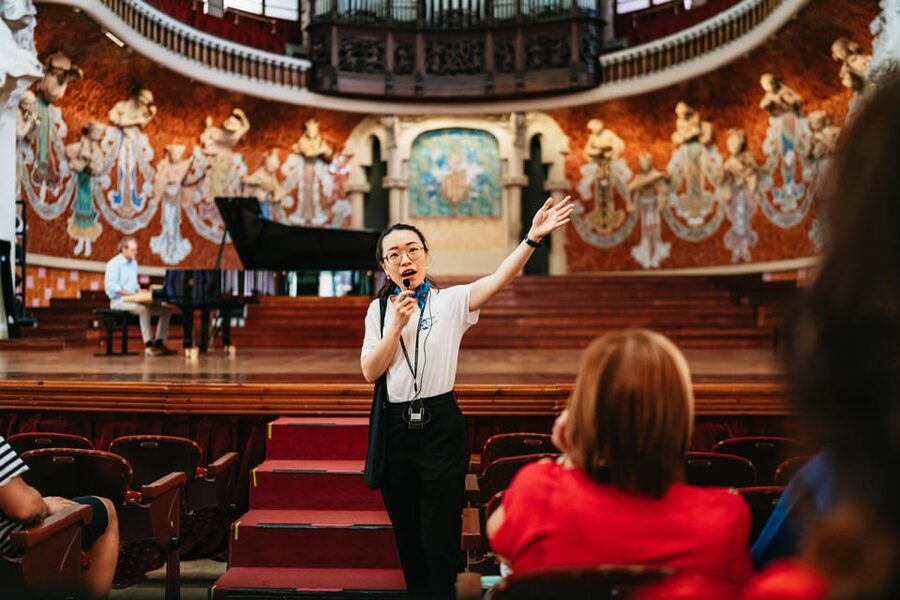
A guided tour matters here. You could admire the concert hall on your own, but you would miss much of the meaning behind the details. The guide explains how the building came to be, why certain materials and shapes were used, and how the Palau connects with Catalan cultural life.
The experience has earned a 4.7 rating from more than 3,200 bookings, and that matches the basic appeal: the building itself is exceptional, while the guide gives you a clearer way to read it.
A few more Spain trips worth a look
- Barcelona: Sagrada Familia Entry Ticket with Audio Guide
★ 4.6 · 105,312 reviews - Barcelona: Park Güell Admission Ticket
★ 4.4 · 76,534 reviews - Barcelona: Casa Batlló Entry with Self-Audioguide Tour
★ 4.7 · 25,359 reviews
Starting in the Orfeó Català rehearsal room
The first stop is the Rehearsal Hall of the Orfeó Català. The foundation stone was laid here in 1905, and the choir continues to rehearse in the room more than a century later.
That detail gives the tour a useful sense of continuity. This is not simply an old hall preserved behind glass. It remains connected to music and performance. If you happen to hear singing or rehearsal activity during your visit, the room suddenly feels less like an architectural exhibit and more like a working cultural institution.
The opening explanation also helps place the Palau in context. You learn about the building’s origins and the role of the Orfeó Català before reaching the more spectacular spaces. That order makes sense. It gives you a reason to care about the decoration beyond its visual appeal.
The room itself is not likely to produce the same immediate gasp as the Concert Hall. Still, I consider it an important beginning. It anchors the building in real use and gives the rest of the tour a human scale.
Taking your time on the grand staircase
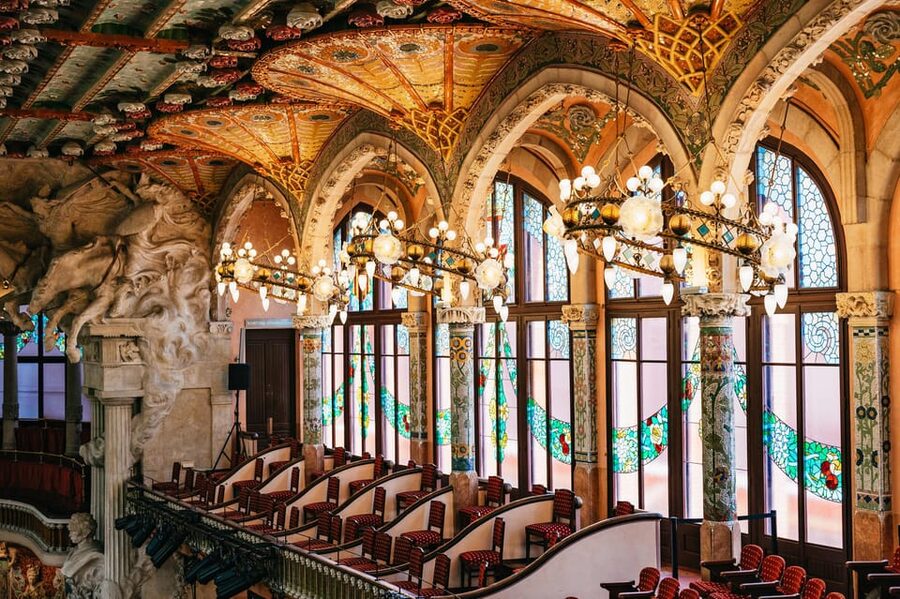
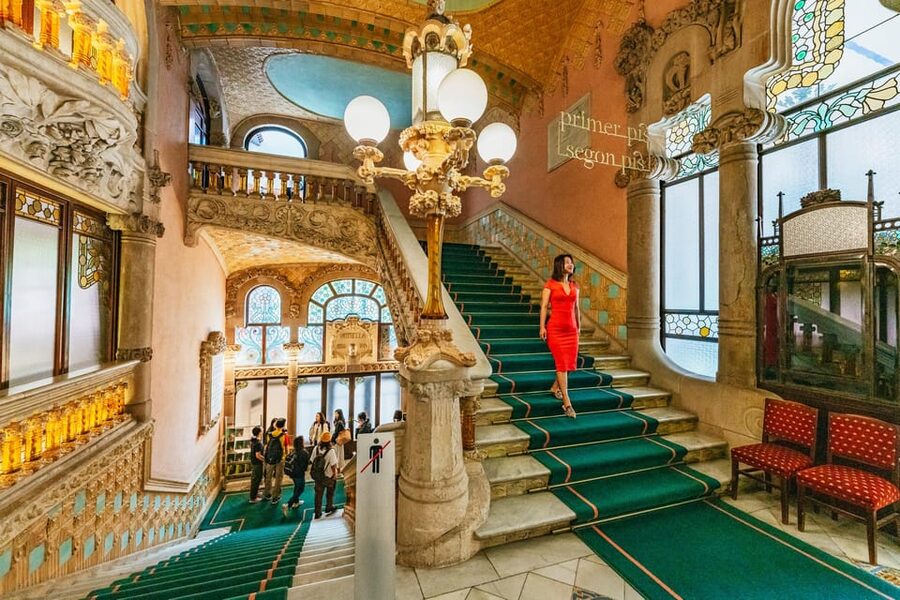
The grand staircase is one of the first places where the Palau’s decorative ambition becomes impossible to miss. Flowers, flags, and varied materials cover the space, turning a practical staircase into a formal introduction to the building.
Your guide will point out details that are easy to miss when you are simply walking upward. I recommend looking at the different textures and the way the decoration is arranged around the movement of the staircase. The Palau does not ask you to admire one isolated object. It asks you to notice how architecture, sculpture, color, and natural forms work together.
This is also a good place for photographs. Bring a camera or keep your phone ready, but remember that the group continues moving. You may have time to take pictures, yet the visit is not designed as a long, unstructured photo stop.
The staircase can feel crowded if several groups or general admissions overlap. One person reported difficulty taking pictures because too many people were gathered around. If photography is central to your visit, try to stay near the guide without blocking the group, and use the pauses efficiently.
The Lluís Millet Hall and its balcony
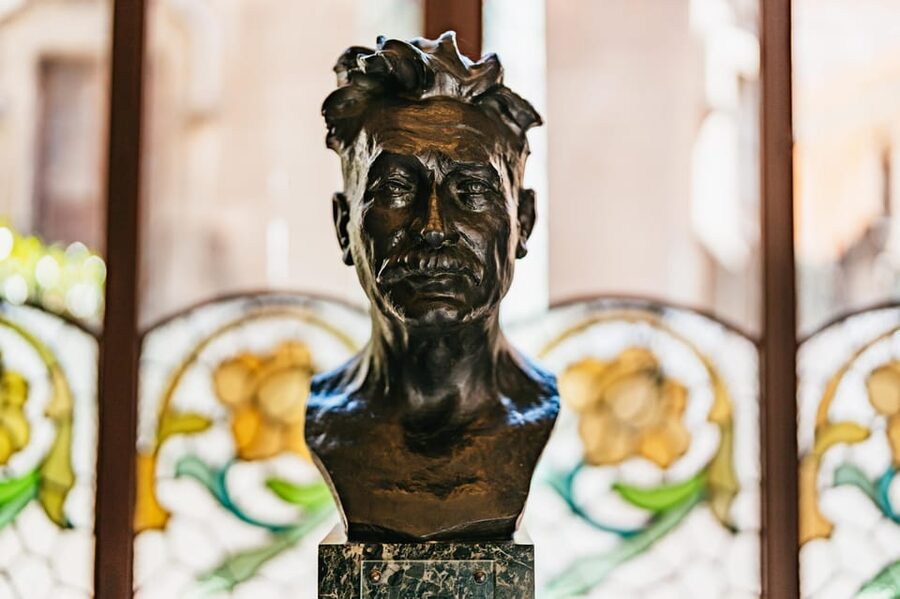
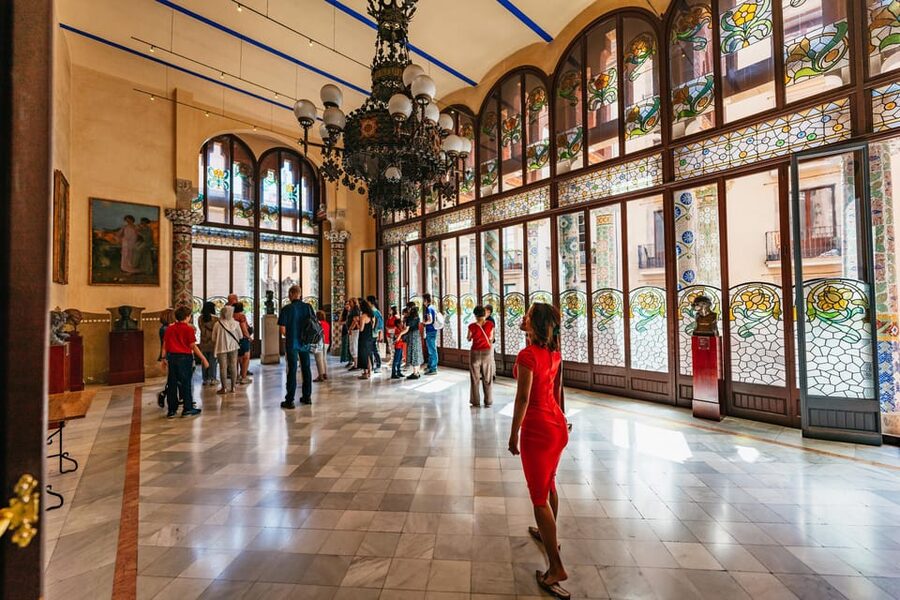
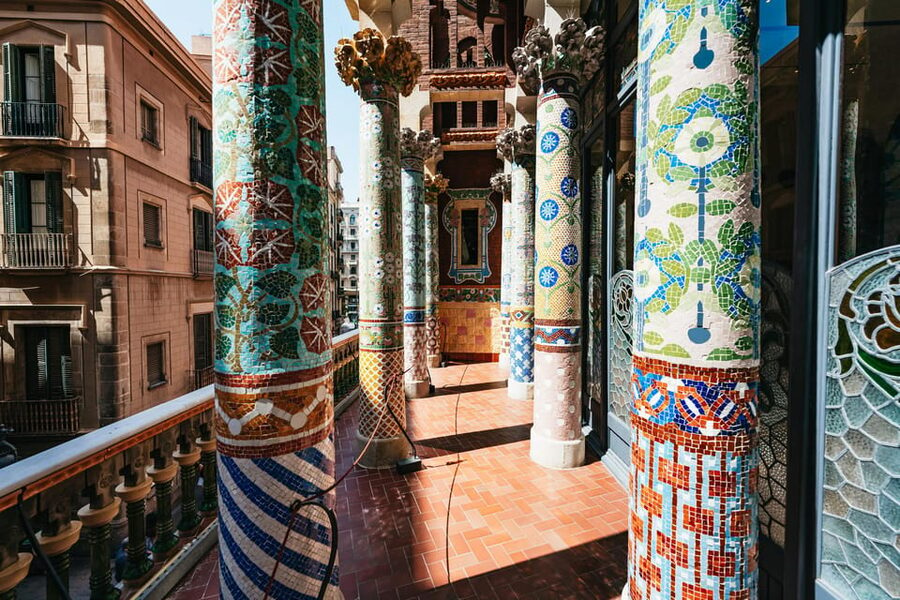
Next comes the Lluís Millet Hall, named after the founder of the Orfeó Català. The hall includes a large balcony lined with columns whose shapes refer to nature.
This is one of the tour’s best moments for understanding the building’s design language. The natural forms are not limited to painted flowers. They appear in the columns, decorative patterns, and the relationship between the inside and outside areas.
The balcony is especially useful because it lets you look closely at the details from a different angle. You are not only walking through rooms at eye level. You are also looking across and upward, seeing how the building creates layers of ornament.
A good guide makes this stop much better. Juan was praised for putting real effort into his explanations, while Axel was singled out for making the history engaging. Yu received especially warm praise for combining information with humor. Guide quality can vary, but the best guides help you notice things you would otherwise walk past.
A completely different kind of day out in Barcelona:
- Barcelona: 24 or 48-Hour Hop-On Hop-Off Bus Tour
★ 4.4 · 20,872 reviews - Barcelona: Park Guell Guided Tour with Skip The Line Entry
★ 4.7 · 17,563 reviews - Barcelona: La Pedrera-Casa Milà Ticket & Audio Guide Option
★ 4.7 · 15,099 reviews - Barcelona in 1 Day: Sagrada Familia, Park Guell,Old Town & Pickup
★ 5.0 · 13,541 reviews
Entering the Concert Hall
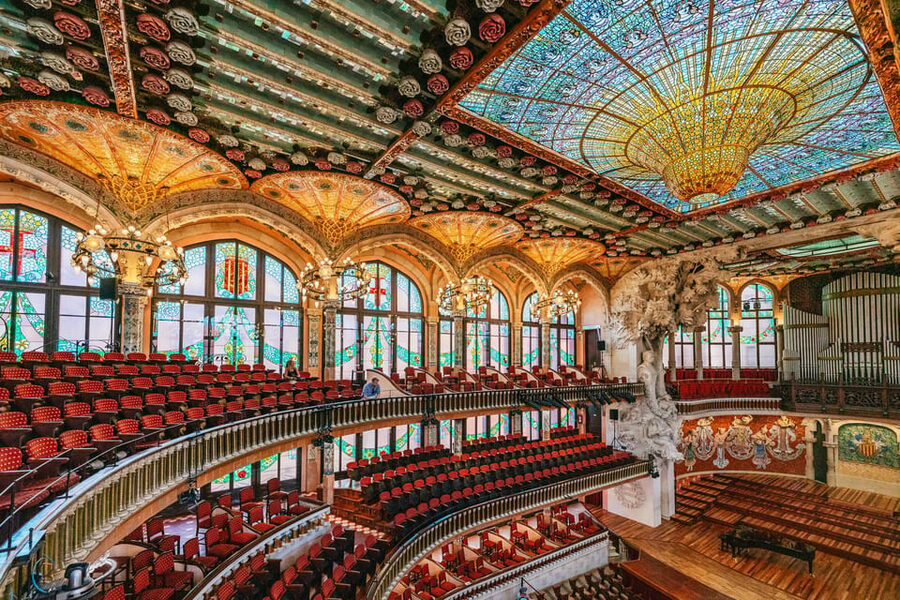
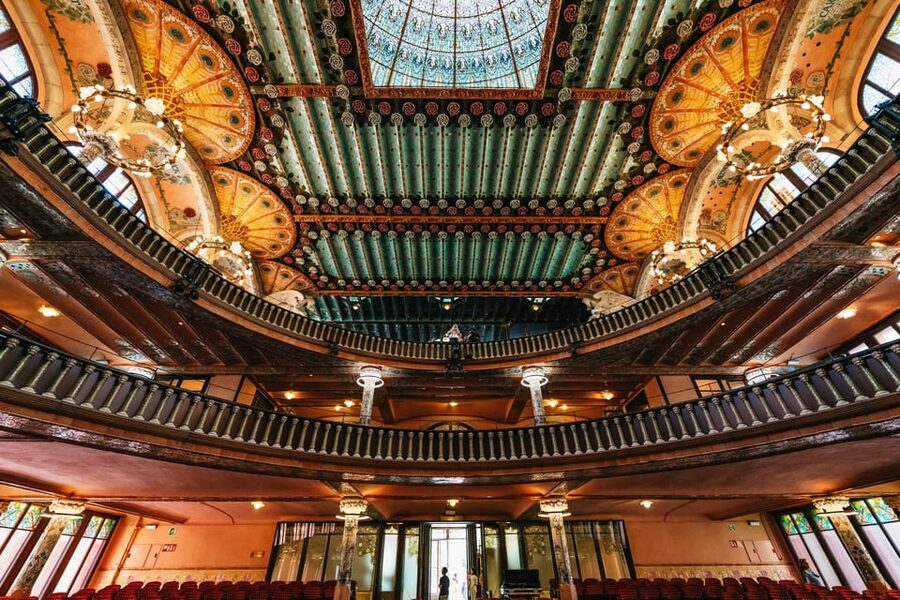
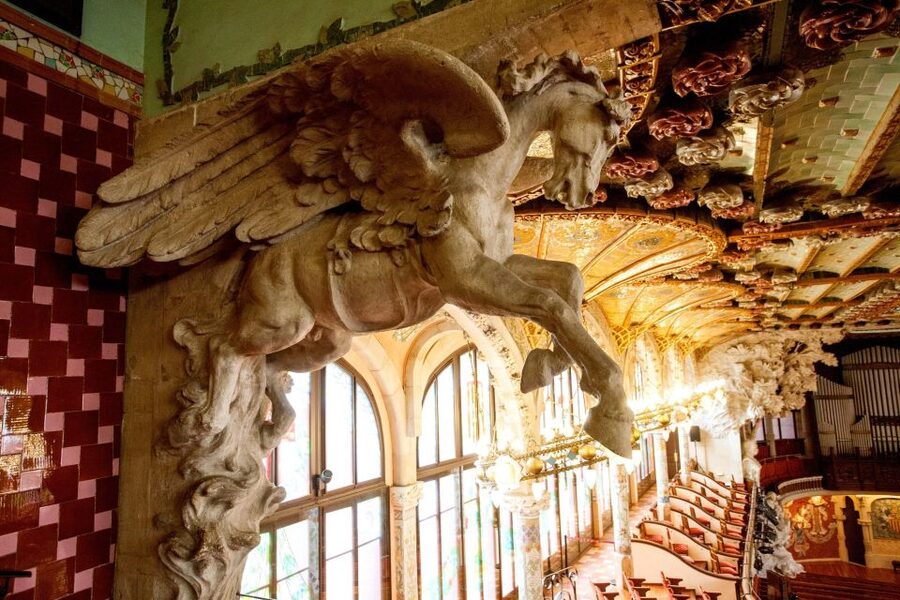
The Concert Hall is the emotional high point of the tour. The change is immediate: color, shapes, light, sculpture, and decorative detail fill the room from floor to ceiling.
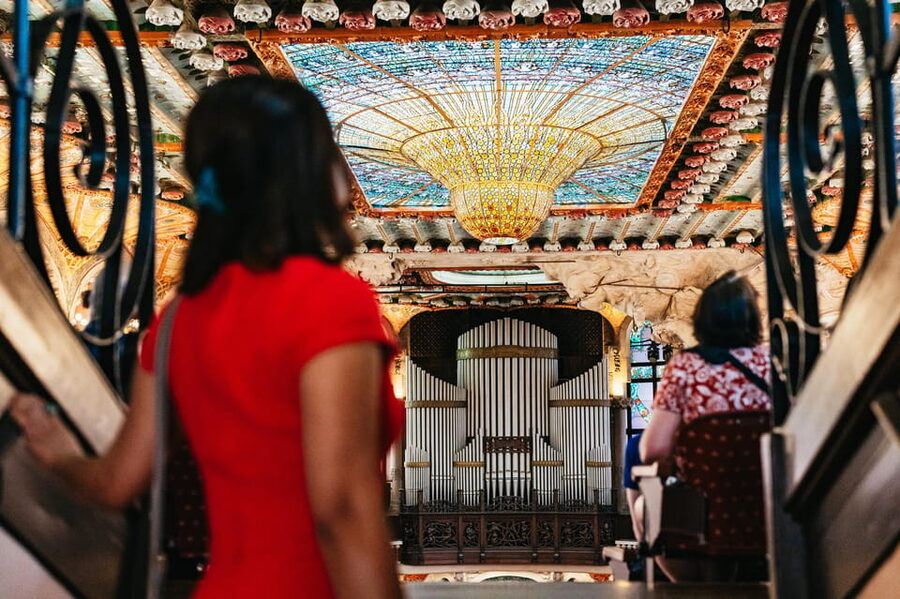
The Palau’s famous skylight hangs over the auditorium like a glowing centerpiece. From the second floor, you get a particularly useful view of it. This elevated angle helps you understand how much work went into the ceiling and how the natural light shapes the room.
I would not rush this part. The main hall is the place to look in every direction. Notice the balconies, the columns, the stage area, and the way the decoration frames the performance space. The room was made for music, but it is also a work of art that happens to host concerts.
The hall can be busy, especially when another group or activity is taking place. One January visit was affected by construction noise, and another report described difficulty hearing because of overlapping groups. Those problems may not occur on your date, but they are worth keeping in mind. The building is an active venue, not a silent museum.
You may also get an unexpected bonus. Some tour times have coincided with choir practice, orchestral rehearsal, or a school concert. Hearing musicians in the hall gives you a stronger sense of its purpose, though it is not guaranteed and should not be treated as part of the scheduled tour.
The organ performance at the end
The tour ends with a short performance from the Palau’s organ. It is a simple addition, but it leaves the visit on a high note.
For many people, this is the most memorable part of the experience. After hearing about the architecture and seeing the hall, you get to hear music in the space itself. Even a brief piece helps connect the building’s appearance with its original purpose.
You should not assume that the organ demonstration will always be played live. One particularly enthusiastic guide was jokingly credited with playing it, although the music appeared to be a recording. The presentation can still feel convincing and atmospheric, but expectations matter.
If you are lucky enough to hear a live rehearsal or concert during your visit, the effect will be stronger. The tour does not include concert tickets, so attending an evening performance requires a separate booking. That is worth considering if you care about acoustics as much as architecture.
How good are the guides?
The guide is a major part of the value. The Palau contains enough visual detail to keep you busy, but a plain walk through the rooms would leave many questions unanswered.
The strongest guide reports describe clear speech, useful historical context, humor, and enough time to take photographs. Some guides also checked in with the group and provided translations as they moved from one area to another. Fei Fei was praised for mixing humor with plenty of information, and Marco was described as friendly and thorough.
The tour is offered in Italian, French, English, Chinese, Catalan, and Spanish. Check the language attached to your chosen time rather than assuming every departure offers every language.
Audio equipment can be a weak point. One person found the earpiece very useful because it allowed listening while taking pictures, while another described the sound as crackly and difficult to understand. If your device is unclear, tell the guide early instead of struggling through the whole visit.
The overall pace is moderate. You receive explanations at each stop, and there is time to look around, but this is not a leisurely half-day exploration. Think of it as a focused introduction that helps you appreciate the building before you decide if you want to return for a concert.
Price, timing, and what you receive
At $28, the tour is not the cheapest short activity in Barcelona. Still, the price includes entry to the Palau and a guided visit of areas that may not be open during a simple self-directed admission.
That makes the cost easier to justify. You are paying for access, interpretation, and a structured route through a building where the details can be hard to understand without help. If you only want to see the main Concert Hall, a shorter visit might suit you better. If you want the story behind the rooms and the architecture, the guided format earns its price.
The 50-minute length is both a strength and a limitation. It fits neatly into a busy sightseeing day and works well before lunch, another tour, or an afternoon walk around central Barcelona. On the other hand, the Palau contains more detail than you can absorb in less than an hour.
The building is about a 10-minute walk from Plaça de Catalunya and Las Ramblas. That makes it easy to combine with the Gothic Quarter, Passeig de Gràcia, or other central sights. The meeting point can vary according to the option booked, so read your confirmation carefully. A clearer meeting point would help, since some people found the entrance arrangement confusing.
The meeting area may be behind the café when you enter through the main entrance, or accessible from the side near the outdoor seating. Arrive with your identification document, which is required at the box office to confirm the tour. Most importantly, confirm your arrival time with the supplier because availability can change by day.
Free cancellation up to 24 hours in advance and the option to reserve now and pay later make this easier to fit into a changing Barcelona schedule.
The café, restaurant, and concert option
The café and restaurant are not part of the tour price, but they can improve the outing. The on-site café has a pleasant reputation, and some people enjoy eating there before or after the guided visit. One lunch was described as delicious, while another person liked the café and shop enough to plan a return.
I would treat the café as a useful extra, not a reason to book the tour. The building is the main event. Still, having somewhere nearby for a drink or meal is handy, especially if you are planning the visit around a midday departure.
For music lovers, the best plan may be to combine the tour with an evening concert. The guided visit shows you the building’s visual side, while a performance lets you judge the acoustics and atmosphere for yourself. Concert tickets are separate, and you should reserve them independently.
You might also encounter a choir, orchestra, or school group rehearsing. These moments can feel special, but they depend on the day and time. I would welcome them as a bonus rather than build your schedule around the possibility.
Who will enjoy this tour most?
I recommend the tour to first-time visitors who enjoy architecture, music, design, or cultural history. It is also a good choice if you prefer to understand what you are seeing instead of simply photographing a beautiful room.
Families can manage the 50-minute duration, particularly if children like ornate buildings or music. The route is wheelchair accessible, which makes it suitable for many people with mobility needs, though you should still confirm the exact meeting arrangements for your booking.
This is less suitable if you dislike guided groups, need unlimited time for photography, or want a quiet, independent visit. The short schedule and active concert venue mean that crowding, construction, rehearsal activity, or imperfect audio can affect the experience.
For photographers, the tour offers excellent subjects but not unlimited control. You will have access to the main visual highlights, yet you must keep moving with the group. For serious photography, a separate visit or a concert may offer a different atmosphere, but concert access is not included here.
Is the Palau de la Música guided tour worth booking?
Yes, I would book it if the Palau is not already on your Barcelona plan. The building is spectacular, and the guide gives you the background needed to understand why the staircase, balcony, skylight, and Concert Hall matter.
The best reasons to go are the restricted areas, the clear architectural explanations, and the organ performance at the end. At $28, the price is fair for entry plus a structured 50-minute tour, especially when you consider how much detail would be easy to miss alone.
Confirm the time, check the language, bring identification, and leave room for a café stop afterward. If you want the full musical experience, add a concert on another evening. If you only have a short window in central Barcelona, this is one of the city’s more rewarding ways to spend it.
FAQ
How long is the Palau de la Música guided tour?
The guided tour lasts 50 minutes.
How much does the tour cost?
The listed price is $28 per person.
What does the tour include?
It includes a guided tour and entrance to the Palau de la Música Catalana.
Are concert tickets included?
No. Concert tickets are not included in the guided tour price.
Is the organ performance included?
Yes. A short organ performance is scheduled at the end of the tour.
Is the organ performance always live?
You should not assume so. The end-of-tour organ music may be presented as a recording rather than a live performance.
What languages are available?
Tours are offered in Italian, French, English, Chinese, Catalan, and Spanish. Availability depends on the selected option and time.
Where is the Palau located?
The Palau de la Música Catalana is about a 10-minute walk from Plaça de Catalunya and Las Ramblas.
Is the tour wheelchair accessible?
Yes. The activity is listed as wheelchair accessible.
Do I need identification?
Yes. You should present your ID at the box office to confirm the tour.
Can I cancel the tour?
You can cancel up to 24 hours in advance for a full refund.
Do I need to confirm my arrival time?
Yes. You should confirm your arrival time with the supplier because availability can vary by day.
Recently added around Barcelona
- Intro Segway Tour Barcelona 1h★ 4.9 · 166 reviews
- Barcelona: Bike or eBike Tour, Top Sights & Local Insights★ 4.9 · 166 reviews
- Instagram Photoshoot Tour in Barcelona★ 5.0 · 167 reviews
- Artisan Ceramic Making Experience★ 5.0 · 168 reviews
- Barcelona: Big Fun Museum Ticket★ 4.2 · 169 reviews
- Sagrada Familia Evening Private Tour with Expert Guide★ 4.5 · 170 reviews
- Gaudi’s Crypt in Colonia Güell with Audioguide★ 4.4 · 170 reviews
- Las Golondrinas Barcelona 60-min Boat Tour★ 4.0 · 170 reviews
Guided, compared.
Sagrada Familia Entry Ticket with Audio Guide
Read our review →La Pedrera-Casa Milà Ticket & Audio Guide Option
Read our review →
Caminito del Rey Guided Tour with Transportation
Read our review →
Caminito del Rey: Guided Tour and Entry Ticket
Read our review →
Skip-the-Ticket-Line Mosque-Cathedral Guided Tour
Read our review →
Cathedral, Giralda & Alcazar Entry With Guided Tour
Read our review →