
Review · VALENCIA TOURS
Valencia: Art & Architecture Guided Tour with Monuments Tickets
Valencia rewards a closer look. This three-hour walking tour links medieval gates, painted churches, the Silk Exchange, and the Cathedral in one compact route through Ciutat Vella. I like the mix of famous monuments and small architectural details, and I especially like that admission to San Nicolás, La Lonja de la Seda, and the Cathedral is included.
The tour also earns points for its small-group format, capped at 20 people, and for guides who bring local stories to life. Guides including Benito, Monika, Paulino, Carmen, Jorge, and Uriel have received warm praise for clear explanations and helpful food tips. The main consideration is pace: you cover about 2 to 3 miles, and there may not be much time to stop for photographs.
In This Review
- Key points at a glance
- Why this Valencia walking tour works well
- Starting with the Torres dels Serrans and medieval Valencia
- Palau de la Generalitat and the palaces of Barrio del Carmen
- San Nicolás, Valencia’s fresco-filled church
- La Lonja de la Seda and Valencia’s trading power
- Valencia Cathedral and the story of the Holy Chalice
- Ending at Plaça de la Mare de Déu
- How the three-hour pace feels
- The guides make or break the experience
- Who should book this tour?
- Should you book it?
- FAQ
- How long does the Valencia art and architecture tour last?
- What language is the tour offered in?
- What is the price?
- Which admission tickets are included?
- Is admission to Palau de la Generalitat included?
- Where does the tour start and end?
- How much walking is involved?
- What is the maximum group size?
- Can I cancel for a full refund?
Key points at a glance
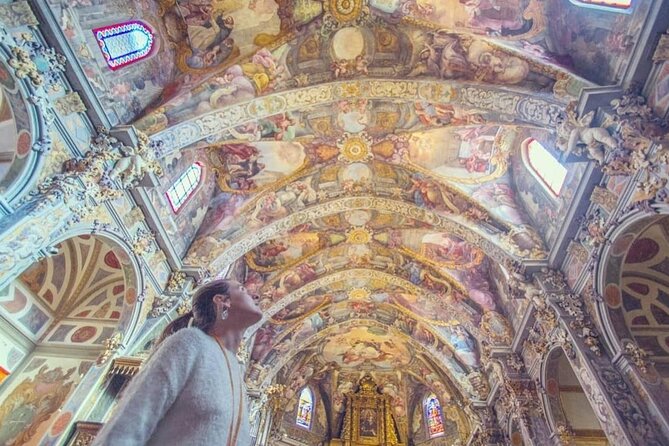
- San Nicolás is the visual highlight: See nearly 2,000 square meters of restored frescoes in the church often called Valencia’s Sistine Chapel.
- Three major admission tickets are included: Your guide takes you inside San Nicolás, La Lonja de la Seda, and Valencia Cathedral.
- The route covers the heart of old Valencia: Walk from the Torres dels Serrans area through Barrio del Carmen and the central historic quarter.
- Expect a history-led tour: Roman foundations, medieval walls, Gothic trade, Baroque decoration, and the Holy Chalice all fit into the three-hour visit.
- Small groups make a difference: The maximum group size is 20, though some departures may be much smaller.
- Check the meeting instructions carefully: The booking information gives Plaça de la Verge as the start and end point, while the walking sequence begins at Torres dels Serrans.
Why this Valencia walking tour works well
I see this as an orientation tour with real substance. You are not simply led past grand façades while someone recites dates. The route takes you into three important monuments, which gives the history a physical setting: painted vaults overhead, Gothic columns around you, and religious treasures inside the Cathedral.
The $66.54 price needs to be judged against what is included. Three entrance tickets, an English-speaking art historian, and roughly three hours of guided sightseeing make the cost reasonable if you plan to visit these places anyway. It is less attractive if you prefer to explore slowly, take many photographs, or spend a long time in each church.
The format is most useful early in your Valencia stay. It gives you a strong sense of the old center, explains how different periods overlap, and points you toward places to revisit alone. Several guides have also offered suggestions about local food and drinks, a useful bonus when you are still finding your way around town.
A few more Spain trips worth a look
- Valencia: Oceanogràfic Entry Ticket
★ 4.7 · 9,893 reviews - Valencia: 24 or 48-Hour Hop-on Hop-off Bus Ticket
★ 3.9 · 5,611 reviews - Valencia: Palosanto Flamenco Show Ticket
★ 4.8 · 3,876 reviews
Starting with the Torres dels Serrans and medieval Valencia
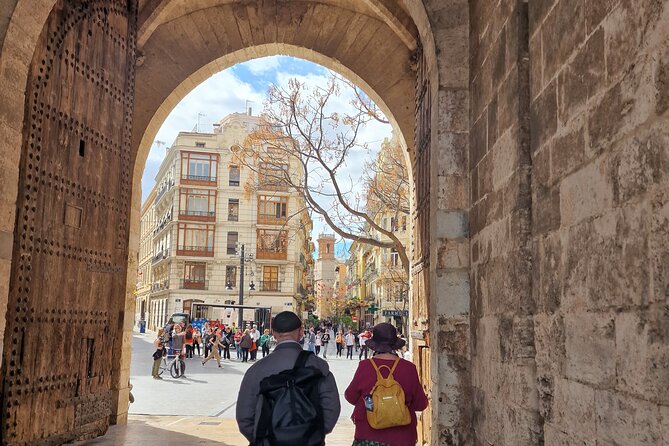
The Torres dels Serrans make a fitting opening. These stone towers were once part of Valencia’s medieval wall and served as one of the main entrances into the city. Your guide uses the site to explain Valencia’s older defenses, the former route of the Turia River, and the different walls that protected the city over time.
You receive about 20 minutes of introduction here. That may sound brief, but it is enough to give the rest of the walk a useful frame. You begin to see Valencia not as a collection of unrelated monuments, but as a city shaped by Roman, Islamic, medieval Christian, and later artistic periods.
The meeting information requires a little care. The published start and end point is Plaça de la Verge, while the first sightseeing stop is Torres dels Serrans. Follow the exact instructions on your confirmation and arrive early enough to locate the guide. The area is near public transport, and the tour does not provide hotel pickup.
Palau de la Generalitat and the palaces of Barrio del Carmen
The next part moves toward the Palau de la Generalitat and the old quarter known as Barrio del Carmen. The focus here is not just one building. Your guide explains why Valencia has so many palaces and how the district grew around civic, religious, and aristocratic power.
This is one of the places where a guide adds real value. From ground level, old streets can look like a jumble of façades from different centuries. A good explanation helps you identify the layers: a medieval street plan, later palace fronts, religious buildings, and changes made as the city expanded and changed its priorities.
The Palau de la Generalitat itself is not included as an admission visit, so you should expect exterior commentary rather than a full interior tour. That is worth knowing if you are mainly interested in entering buildings. Still, this stop helps connect the grand monuments later in the walk with the people and institutions that shaped Valencia.
San Nicolás, Valencia’s fresco-filled church
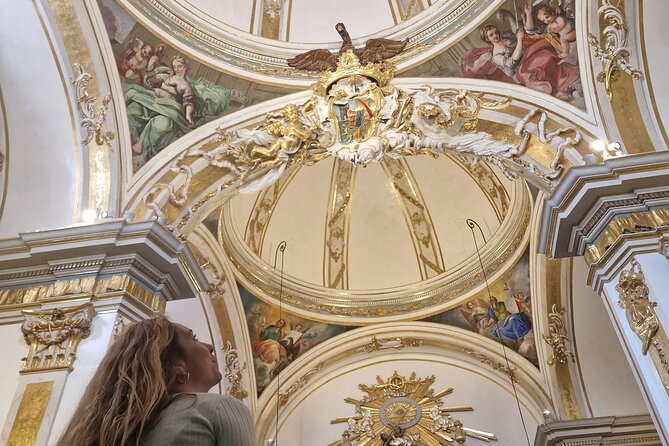
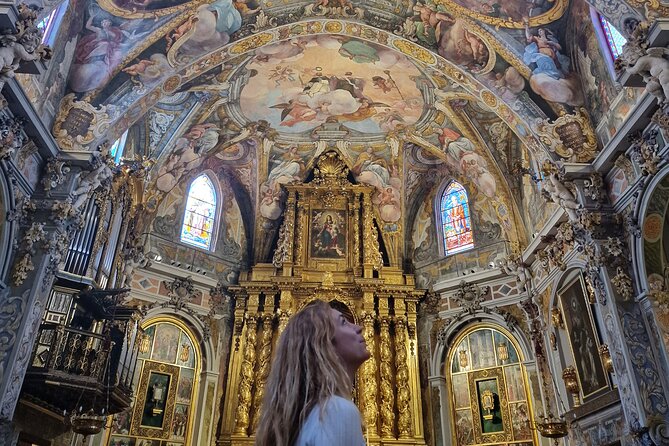
San Nicolás de Bari and San Pedro Mártir is the tour’s most dramatic interior. The church is often called the Valencian Sistine Chapel because its restored ceiling frescoes cover nearly 2,000 square meters. The paintings are so extensive that the decorated surface is described as roughly twice the area of the frescoes in Rome’s Sistine Chapel.
The comparison is catchy, but the church has its own character. The structure is more than 700 years old and reflects several stages of Valencia’s past. It was a place of worship in Roman times, later became a mosque, and was then used as a Christian church. Inside, a Gothic framework carries an exuberant Baroque decorative program.
You have about 30 minutes here, with admission included. That is enough to look up, understand the basic story, and appreciate the contrast between the restrained Gothic structure and the richly painted vault. The lighting presentation set to music is frequently singled out as a memorable part of the visit, so ask your guide how it fits into the day’s schedule.
San Nicolás is also a good example of why this works better as a guided tour than as a quick photo stop. Without context, you might notice only an enormous painted ceiling. With an explanation, you can look for the relationship between architecture, religious imagery, restoration, and the church’s long life.
A completely different kind of day out in Valencia:
- Valencia: Catamaran Cruise with Sunset Option
★ 4.0 · 3,566 reviews - Valencia Old Town Tour with Wine & Tapas in 11th Century Historic Monument
★ 5.0 · 3,234 reviews - Valencia: Oceanogràfic, Hemisfèric & Science Museum Combo
★ 4.4 · 2,959 reviews - Valencia: City Highlights Guided Bike Tour
★ 4.7 · 2,373 reviews
La Lonja de la Seda and Valencia’s trading power
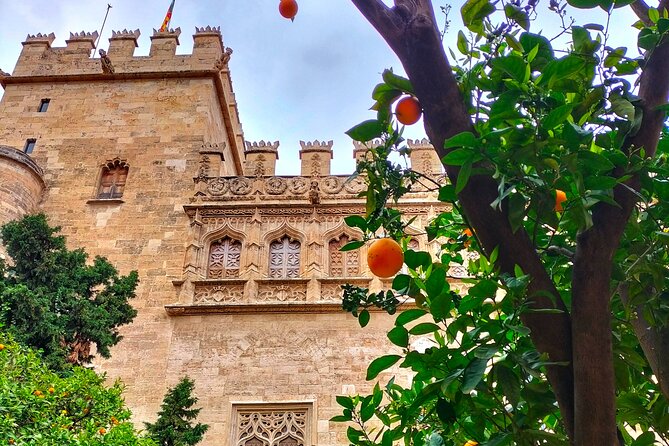
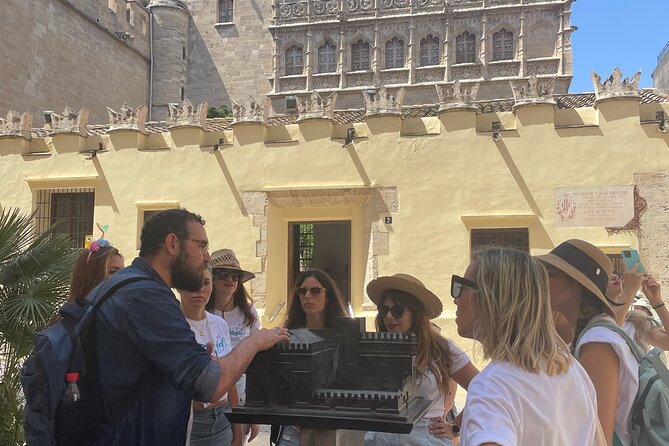
From San Nicolás, the tour continues to La Lonja de la Seda, or the Silk Exchange. This Gothic building is one of Valencia’s essential sights and a UNESCO World Heritage Site. It was built in the 15th century in only 15 years, a striking reminder of the money and organization behind Mediterranean commerce at the time.
La Lonja matters because it is a civil Gothic building rather than a cathedral. Gothic architecture is often associated with churches, but here the soaring rooms and carved details served merchants and trade. Your guide explains why silk was so important and how the exchange reflected Valencia’s place in Mediterranean business.
The visit lasts about 30 minutes, and the entrance ticket is included. Make sure you look beyond the main hall. The building’s elaborate ceiling on the second floor has made a strong impression on past participants, especially when the guide explains what the rooms were used for and why the design mattered.
This stop gives the tour a welcome change of subject. San Nicolás is about worship and painted decoration. La Lonja is about contracts, commerce, and civic ambition. Together, they show two sides of Valencia in the late medieval and early modern period.
Valencia Cathedral and the story of the Holy Chalice
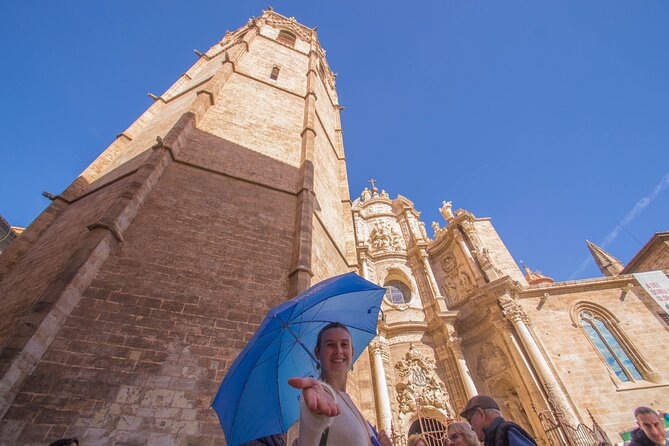
Valencia Cathedral brings several centuries together under one roof. Construction began in the 13th century on the site of an earlier Roman temple and mosque. Later changes added Romanesque, Gothic, Renaissance, and Baroque elements, so the building is best understood as a record of changing styles rather than one single architectural statement.
The Cathedral visit lasts around 30 minutes and includes admission. Your guide can help you sort out the different periods, which is useful because the changes are not always obvious during a first visit. History and art share the same space here, and the route gives attention to both.
The Cathedral holds the Holy Chalice, a relic associated with the Last Supper. The Valencia chalice is regarded by many studies as a possible candidate for that object, and Popes John Paul II and Benedict XVI used it during Eucharistic celebrations in Valencia. You do not need to settle the question of authenticity to understand why the relic has such a strong place in the city’s religious life.
Another important feature is the Renaissance fresco work on the high altar. These paintings were rediscovered when a later Baroque vault was removed. That detail gives you a useful lesson in how buildings change over time: one artistic layer can hide another for centuries.
The Cathedral is a place where the guide’s communication matters most. One piece of feedback praised a guide’s historical skill but found group management weak after a misunderstanding outside a cathedral. That appears to have been an isolated problem, but you should listen closely to meeting instructions and keep the group in sight, especially during transitions.
Ending at Plaça de la Mare de Déu
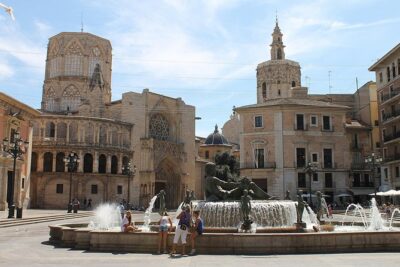
The tour finishes at Plaça de la Mare de Déu, also called Plaça de la Verge. The square brings the Cathedral and Basilica together in one view, making it a sensible place to pause after the indoor visits.
This final stop is not simply a place to take a quick photograph. It gives you a chance to see how religious buildings shaped the central public spaces of Valencia. After walking through individual monuments, you can step back and understand their relationship to one another.
The published end point is the same square listed for the meeting point. That makes the tour convenient if you want to continue exploring on foot afterward. You are already in the historic center, close to more streets, cafés, and sights in Ciutat Vella.
How the three-hour pace feels
Three hours is a good length for a first look at central Valencia. The walking is not described as strenuous, but you should be ready for around 2 to 3 miles on city streets. There are several indoor stops, which breaks up the walking, but the route still moves at a steady pace.
The schedule gives roughly:
- 20 minutes at Torres dels Serrans
- 20 minutes around Palau de la Generalitat
- 30 minutes inside San Nicolás
- 30 minutes at La Lonja de la Seda
- 30 minutes in Valencia Cathedral
- 20 minutes at Plaça de la Mare de Déu
The remaining time is used for walking and explanations along the route. I like this structure because you see a lot without spending the whole day on one monument. The tradeoff is that photography and personal wandering are limited. One participant specifically wished for a few extra minutes at each stop for pictures.
Summer heat is another practical concern. A guide has been praised for keeping the group in the shade where possible and stopping so people could buy water. Even so, carry water yourself, wear comfortable shoes, and remember that the streets and squares may offer little shade.
The guides make or break the experience
The strongest part of this tour is the human element. Benito has been praised for his command of Valencia’s past and his easy manner. Monika has received credit for pointing out small details, recommending food and drinks, and giving extra attention when the group was tiny.
Paulino has been appreciated for handling side questions and telling stories about the Holy Grail, San Nicolás, and the Roman era. Carmen has been praised for making the three hours pass quickly and for sharing food advice. Uriel has been noted for putting the monuments into a broader historical setting, while Jorge has made a strong impression through his grasp of the city and its churches.
The English experience can vary by guide. Most feedback describes clear, easy-to-follow explanations, but one person felt the guide struggled with English. If detailed architectural vocabulary matters to you, keep your questions short and specific, and ask for clarification when needed.
The maximum group size is 20. That is small enough for a personal feel compared with a large coach tour, though some departures may be much smaller. In one case, cancellations left a couple with what was effectively a private tour at no additional cost. You should not count on that, but a smaller group makes it easier to ask questions and keep pace.
Who should book this tour?
I would choose this tour if you are visiting Valencia for the first time, have only a half-day, or want a clear introduction before exploring alone. It is especially good for people who care about church interiors, art, medieval buildings, and the way several cultures and periods overlap in one city.
It also suits you if you value included admission and dislike wasting time in ticket lines. Several participants praised the guide’s ability to get the group into the monuments without long waits. That convenience matters when your schedule is tight.
You may want another format if you want a specialist architecture seminar, long museum visits, or plenty of time for photographs. The tour is about the main historic sights and the stories connecting them, not a detailed study of every façade or a slow art workshop.
Children can participate, but children must be accompanied by an adult. Most people can take part, and the activity runs near public transportation. The tour is offered in English and requires good weather. If poor weather or low enrollment causes cancellation, you are offered another date or experience, or a full refund. You can cancel for a full refund up to 24 hours before the start time.
Should you book it?
Book it if you want Valencia’s historic center explained in one efficient morning or afternoon. San Nicolás alone is a strong reason to go, while La Lonja and the Cathedral give the walk breadth and substance. The included tickets improve the $66.54 value, especially if you would pay to enter all three sites anyway.
I would book this near the start of your visit, then return to whichever monument deserves more time. Just arrive prepared to walk, protect time for the key interiors rather than casual photography, and follow the guide’s meeting instructions carefully. For a first look at old Valencia with an art-focused guide, this is a well-balanced choice.
FAQ
How long does the Valencia art and architecture tour last?
The tour lasts approximately three hours, including walking time and visits to the monuments.
What language is the tour offered in?
The tour is offered in English.
What is the price?
The listed price is $66.54 per person.
Which admission tickets are included?
Admission to San Nicolás Church, La Lonja de la Seda, and Valencia Cathedral is included.
Is admission to Palau de la Generalitat included?
No. Admission to Palau de la Generalitat is not included in the tour details.
Where does the tour start and end?
The published meeting and ending point is Plaça de la Verge in Ciutat Vella, Valencia. The sightseeing sequence also includes Torres dels Serrans, so follow the exact meeting instructions in your booking confirmation.
How much walking is involved?
The experience is a walking tour, and one description advises preparing to walk about 2 to 3 miles.
What is the maximum group size?
The tour accepts a maximum of 20 participants.
Can I cancel for a full refund?
Yes. You can cancel at least 24 hours before the experience start time for a full refund. Cancellations or changes made less than 24 hours before the start are not refunded.
Recently added around Valencia
- Valencia: Top 25 Highlights Guided Bike Tour★ 5.0 · 175 reviews
- Valencia Private Walking Tour with Official Valencian Guide★ 5.0 · 176 reviews
- Valencia: Pobla de Farnals JetSki Rental, photos &BeachClub★ 4.8 · 179 reviews
- From Valencia: Caves of San José Guided Tour & Boat Ride★ 4.5 · 179 reviews
- From Valencia: Montanejos Thermal Spring & Girlfriend Waterfall★ 4.5 · 182 reviews
- Valencia: Port Saplaya Boat Tour with Free Drink & Swimming★ 4.4 · 183 reviews
- Pub Crawl Tour in Valencia★ 5.0 · 183 reviews
- City of Arts and Sciences Private Segway Tour★ 5.0 · 196 reviews
Valencia Tours, compared.


Valencia Old Town Tour with Wine & Tapas in 11th Century Historic Monument
Read our review →
Oceanogràfic, Hemisfèric & Science Museum Combo
Read our review →

Sunset or Daytime Catamaran Cruise with Drink
Read our review →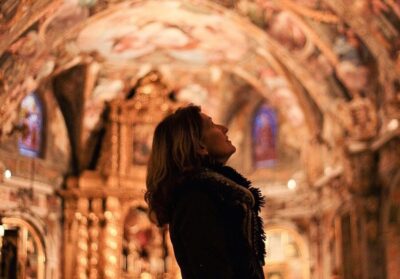
Old Town Tour, Wine & Tapas in an 11th c. Monument
Read our review →Browse the lists this tour appears in