
Review · CYCLING TOURS
Seville: Relaxing City Bike Tour with a Tour Guide
Seville is made for two wheels. I like that this tour joins the old quarter, royal gardens, riverfront, Triana, and the city’s best-known monuments in one easy ride, while the small-group format keeps the experience personal. I also like the relaxed pace, with regular stops and a guide who adjusts speed to the group. The main consideration is traffic and crowds in the historic center, where cycling can feel less carefree than the peaceful title suggests.
For $35 per person, you get a bike, optional helmet, bottled water, insurance, and a local guide for roughly two and a half to three hours. Guides such as Carmen, Juan, Daniel, Pablo, and Alvarito have earned especially warm praise for their stories, humor, local suggestions, and care with mixed-ability groups. I would take this tour early in your stay, then use the route as a map for the rest of your Seville visit.
In This Review
- Key things to know before you pedal off
- Starting behind the orange trees in Barrio Santa Cruz
- Jardines de Murillo: an easy introduction to Seville
- Parque María Luisa and Plaza de España
- From the former tobacco factory to the river
- Crossing into Triana
- The Cathedral, Giralda, and Las Setas
- How relaxing is the cycling?
- The guides make the difference
- Price, timing, and practical value
- Who should book this Seville bike tour?
- Should you book it?
- FAQ
- Where does the Seville bike tour start?
- How long does the tour last?
- How far do you cycle?
- Is the bike tour suitable for beginners?
- What is included in the price?
- Which languages are available?
Key things to know before you pedal off
- About 10 kilometers on mostly flat ground: This is a sightseeing ride, not a fitness test, and the guide sets the pace for the group.
- A wide sweep of Seville: You pass Barrio Santa Cruz, the Jardines de Murillo, Plaza de España, Parque de María Luisa, the Guadalquivir, Torre del Oro, Triana, the Cathedral, Giralda, and Las Setas.
- Small groups up to 15 people: A smaller group makes it easier to hear the guide and stay together at crossings.
- Strong local guiding: Carmen is often praised for her friendliness and calm pace, while Juan and Daniel are known for lively stories and practical food and flamenco advice.
- Mostly easy cycling, with busy patches: Seville is flat, but crowded tourist streets and occasional more challenging sections can require care.
- Check the departure time and language: The information gives several departure times, including 10:00, 10:30, and 14:00, so confirm your exact slot when booking.
Starting behind the orange trees in Barrio Santa Cruz
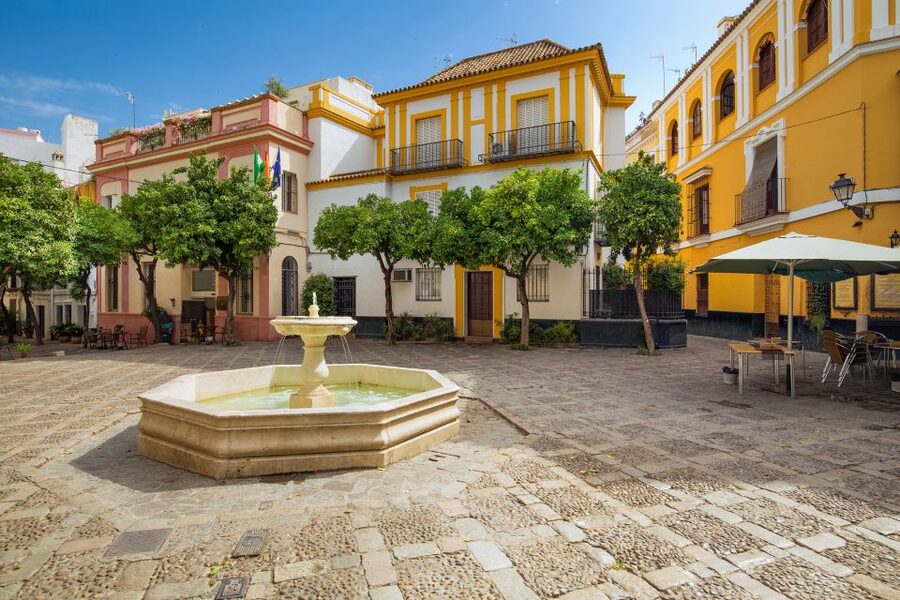
The meeting point is Plaza de Santa Cruz 4, behind the Jardines de Murillo. That puts you right in the historic quarter, rather than at a remote shop on the edge of town. It is a sensible place to begin because the first few minutes introduce you to Seville’s old streets before the route opens into wider gardens and avenues.
Barrio Santa Cruz is a maze of narrow lanes, whitewashed buildings, small squares, and cobblestones. On a bike, you cover more ground than you would walking, but this is also where you need to pay the most attention. The streets can be crowded, and you may need to slow down, stop, or walk the bike briefly.
That tradeoff matters. A bike lets you connect separate sights quickly, but it does not mean you race through the old quarter. The guides generally make frequent stops, and several praised experiences specifically noted that the pace was gentle rather than hurried.
You should arrive ready to ride, not dressed for a long athletic outing. Comfortable clothing, sunscreen, and identification are recommended. A helmet is available, though it is listed as optional. People who cannot ride a bike should choose a different way to see the city.
More Bike Tours in Seville
- Seville Highlights Bike Tour (English)
★ 5.0 · 2,225 reviews - Seville: Highlights City Bike Tour
★ 4.8 · 2,168 reviews - Seville: City Sightseeing and Local Culture Bike Tour
★ 4.9 · 1,120 reviews
Jardines de Murillo: an easy introduction to Seville
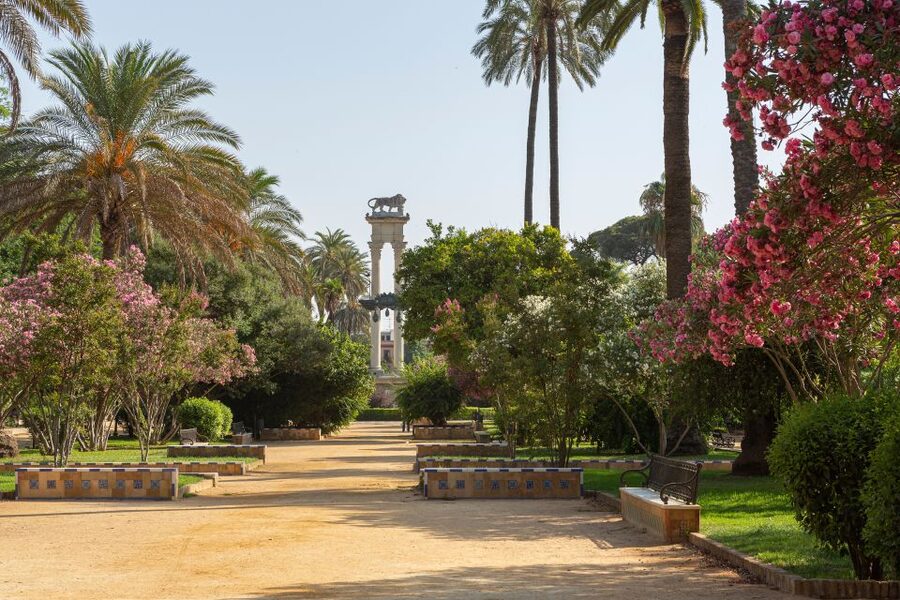
From Santa Cruz, the route moves into the Jardines de Murillo. The change is immediate: the tight old lanes give way to leafy paths, orange trees, palms, and open garden space. This is one of the most pleasant parts of the ride because you can settle into the bicycle without dealing with constant traffic.
The garden section also shows why a bike works well in Seville. You can move between the old quarter and the larger southern sights without spending much of your morning on foot. You still stop often enough to hear about the places around you, so this is not simply a ride from one photo stop to another.
The guide’s role is important here. A good leader keeps the group together, points out details you could miss, and avoids turning the ride into a lecture. Carmen was repeatedly praised for checking that everyone was comfortable, while other guides were noted for adding useful background on architecture, politics, religion, art, and local customs.
If you have not cycled for years, do not assume you need to be especially fit. The route is described as suitable for all levels, and the guide adapts the pace. Still, you should be comfortable starting, stopping, steering, and riding around other people.
Parque María Luisa and Plaza de España
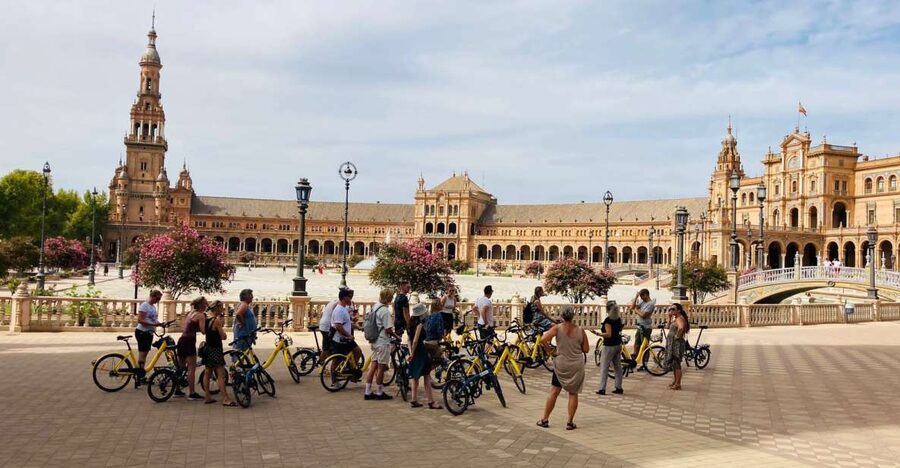
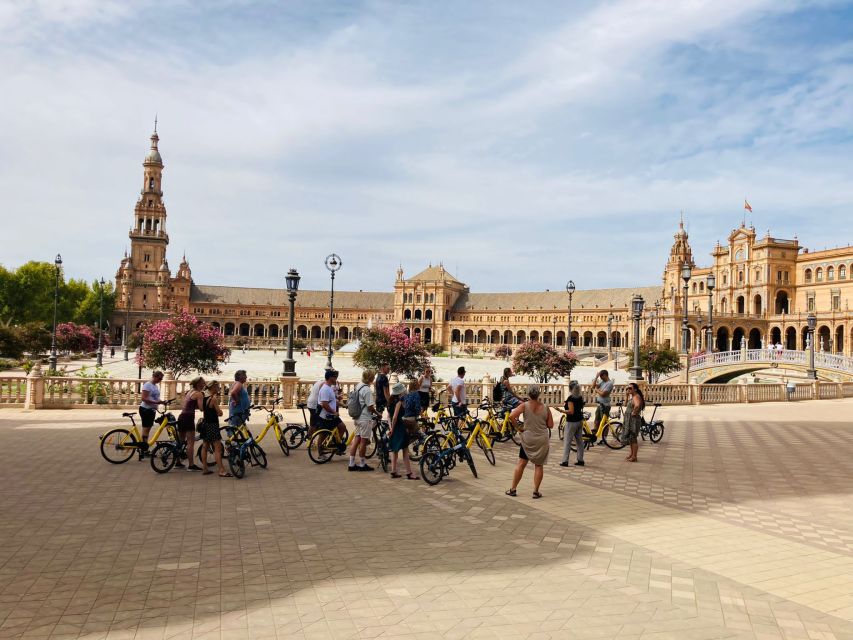
The route then reaches Parque María Luisa, Seville’s large central park and one of the ride’s most rewarding stretches. You get shade, gardens, broad paths, and a welcome break from the harder surfaces of the old quarter. In warm weather, this portion can make the whole activity feel much easier than a walking tour under the Andalusian sun.
Plaza de España is the visual centerpiece. Built for the 1929 Iberian-American Exposition, it is known for its long semicircular design, waterways, bridges, and colorful tiled alcoves representing Spain’s provinces. The mosaic work gives you plenty to examine during a stop, and the scale of the plaza makes it one of Seville’s best places for photographs.
A bike tour cannot replace time spent exploring the plaza on foot. You will want to get off the bike, look closely at the tiles, and take in the building from different angles. The value here is that the tour gets you to the site efficiently, then gives you enough time to see why it matters.
Parque María Luisa is also a practical stop for families and older riders. The paths and flat terrain are less demanding than a long walk between monuments. One family with children aged seven and nine particularly valued the guide’s ability to keep the ride enjoyable and informative in the heat.
From the former tobacco factory to the river
The Antigua Fábrica de Tabacos adds another layer to the city’s story. This imposing former royal tobacco factory is now associated with the University of Seville, but its original scale and formal architecture still make it an important stop. It is a useful reminder that Seville’s grand buildings were built for work, trade, government, and industry, not only for royal display.
Your guide may connect the building to the city’s wider political and economic past. That variety is one of the better features of this experience. Instead of seeing only famous facades, you get a broader picture of how Seville developed and how its buildings changed use over time.
The route continues toward the Guadalquivir Riverside and the Torre del Oro. The riverfront opens up the views and gives you a chance to ride with fewer visual distractions. The Torre del Oro, a compact defensive tower beside the water, is one of Seville’s most recognizable landmarks.
This part can feel more open and relaxed, but you are still riding in a city. Keep space between bikes and listen for instructions at crossings. One useful point from the tour information is that guides are expected to keep the group together through busier sections. That simple habit makes a real difference when a group includes children, older riders, or people who are less confident on a bike.
More bike tours:
- Seville Electric Bike Tour – Small Group
★ 5.0 · 841 reviews - Seville: Guided Tour by Electric Bike
★ 4.8 · 712 reviews - Sunset Guided Bike Tour in Seville
★ 5.0 · 438 reviews - Seville: Guided Sunset Bike Tour
★ 4.9 · 332 reviews
Crossing into Triana
Triana lies across the river and offers a different feel from Barrio Santa Cruz and the monumental center. It is closely linked with flamenco, traditional ceramics, and the everyday life of Seville. The change of district gives the ride more character than a route that simply circles the cathedral and palace.
This is a good point to ask questions. Guides have been praised for knowing more than dates and building names, with some offering useful suggestions for flamenco shows, tapas bars, restaurants, and later evening plans. Juan, in particular, is noted for combining local history with advice on where to eat and hear music.
The ride through Triana may also be one of the places where you encounter more ordinary city movement rather than a string of major monuments. That is a benefit if you want context, though it means the route is not always quiet or photo-perfect. You should expect to share space with pedestrians and other cyclists.
The tour does not appear to include entry into museums, palaces, or the Cathedral. You see the major sites from outside and learn how they fit together. That keeps the cost low and the route moving, but you will need separate tickets and time if you want to go inside the Royal Alcázar, Cathedral, or Giralda.
The Cathedral, Giralda, and Las Setas
The final part of the route brings you back among Seville’s most famous architectural sights. The Cathedral and Giralda are impossible to miss, and seeing them after the quieter gardens and riverfront helps you understand how tightly the city’s different eras sit beside one another.
The Giralda began as a minaret and later became the bell tower of the Cathedral. Your guide can give you the basic story and point out details that are hard to notice from a quick walk through the square. For a first look at Seville, this kind of orientation is valuable because the old quarter can otherwise feel like a collection of beautiful but disconnected streets.
Las Setas, or Metropol Parasol, offers a sharp contrast. Its modern wooden structure rises above the older city and has become one of Seville’s most recognizable contemporary landmarks. The contrast between the Cathedral, the Giralda, and Las Setas gives the tour a clear visual ending: medieval and early modern Seville on one side, present-day Seville on the other.
You should think of the tour as a preview, not a full visit to every sight. I like this approach for a first day because it helps you decide where to return. You may want a longer visit to Plaza de España, a Cathedral ticket, an Alcázar tour, or an evening in Triana after learning which areas interest you most.
How relaxing is the cycling?
The route covers approximately 10 kilometers and is described as flat and suitable for all levels. Many people find it easy because the ride is broken into short stretches, with stops every few minutes in some sections. The bikes are described as comfortable, and bottled water is included.
The word relaxing needs a little qualification. Seville’s flat terrain is a real advantage, but a city bike tour still involves steering, braking, and watching the road. The historic center can be crowded, and one direct account warned that some tourist areas felt tricky to cycle through. Another family found a few sections more challenging because of hills, so do not assume every meter is perfectly flat.
The strongest pattern is the guide’s attention to pace. Carmen was praised for looking after older riders, children, and people with different abilities. Other guides were noted for stopping to make sure the whole group was together. That makes the tour more approachable than a fast-moving cycling excursion.
If you are nervous, tell the guide at the start. You are not expected to prove anything. The point is to see more of Seville without exhausting yourself.
The guides make the difference
The route is good, but the guide determines how much you take away. The most praised guides use humor, personal interest, and clear explanations rather than simply reciting dates. Carmen is frequently described as friendly, down to earth, attentive, and especially good at finding the right speed for the group.
Juan is praised for his energy, local knowledge, and broad interests, including flamenco, art, philosophy, and city history. Daniel is noted for his smiles, jokes, and useful recommendations. Alvarito Garsia is singled out for his passion and his ability to connect with children. Pablo has made a special effort to speak French, while other guides have led tours in several European languages.
The guide may also add small route changes when the group is small. That can make the experience feel more personal, though the exact path and amount of time at each stop will vary. If your tour has only a few people, it is worth asking questions and mentioning what you most want to see.
Language choices require a quick check. The main details list Spanish, English, French, Italian, and Dutch, while the additional information also names German, Russian, and Portuguese. Specify your preferred language and confirm that the selected departure offers it.
Price, timing, and practical value
At $35, this is a reasonable way to cover a large part of Seville in one outing. A bike rental alone would not give you the route planning, historical context, safety support, or restaurant and flamenco suggestions that come with a guide. You also save energy for the sights you want to visit properly later.
The best value comes when you take it near the start of your stay. You see where the Cathedral, river, gardens, Triana, and Las Setas sit in relation to one another. That makes later planning much easier, especially if you have only a day or two in the city.
Departure information is not fully consistent. The details list 10:00 and 14:00 departures, another note says tours leave daily at 10:30, and the activity page says to check availability. Confirm the actual time before you set your morning or afternoon plans.
A morning ride may be preferable if you want fewer people in the streets. One experienced rider specifically found the 10:00 slot calmer. Afternoon departures may work better with your sightseeing schedule, but the historic center can feel more crowded, and summer heat may be a factor.
Free cancellation up to 24 hours before departure and reserve-now, pay-later booking add flexibility. Bring your passport or ID card, wear comfortable clothes, and use sunscreen. The bike, optional helmet, bottled water, guide, and liability insurance are included.
Who should book this Seville bike tour?
I would recommend it to first-time visitors, couples, families with bike-capable children, and anyone who wants a broad introduction without spending hours walking. It is particularly useful if you want practical suggestions for food, flamenco, and places to revisit.
It also suits older riders or people who worry about the distance between Seville’s major sights. The route is flat for the most part, and the guide can slow down. You still need basic bike control and comfort around pedestrians.
I would think twice if you dislike cycling in crowds, cannot ride confidently, or want extended indoor visits to the Cathedral and Alcázar. This tour shows you those places but does not replace a dedicated entry tour.
Should you book it?
Book this tour if you want a relaxed first look at Seville, especially early in your visit. The combination of gardens, historic streets, river views, Triana, and major monuments gives you a useful mental map for $35.
Choose a morning departure if available and ask for your preferred language. Tell the guide about any concerns with pace or cycling confidence. For most visitors who can ride a bike, this is an efficient, friendly way to see a lot of Seville while leaving enough energy for tapas, flamenco, and a closer look at the sights that catch your eye.
FAQ
Where does the Seville bike tour start?
The meeting point is Plaza Santa Cruz 4 in Barrio Santa Cruz, behind the Jardines de Murillo.
How long does the tour last?
The activity is described as lasting about two and a half hours, while the detailed tour information gives a duration of three hours. Check the confirmed duration when you select your departure.
How far do you cycle?
The route covers approximately 10 kilometers on generally flat terrain.
Is the bike tour suitable for beginners?
It is described as suitable for all levels, and guides adapt the pace to the group’s abilities. You must be able to ride a bike.
What is included in the price?
The price includes a city bike, helmet, local guide, bottled water, and liability insurance.
Which languages are available?
The main information lists Spanish, English, French, Italian, and Dutch. Additional information also lists German, Russian, and Portuguese, so specify your preferred language and confirm availability when booking.
Recently added around Seville
- Art and Wine in Sevilla★ 5.0 · 165 reviews
- Seville: Cathedral and Alcázar Guided Tour★ 4.6 · 167 reviews
- From Seville: White Villages and Ronda Full-Day Trip★ 4.2 · 168 reviews
- Guided Tour Sevilla Cathedral★ 4.5 · 169 reviews
- Cathedral and Real Alcàzar in Italian★ 5.0 · 170 reviews
- Seville: Guadalquivir River Cruise with Lunch or Dinner★ 4.5 · 170 reviews
- White Villages and Ronda: Day trip from Seville.★ 4.7 · 171 reviews
- Private Walking Tour Alcazar and Cathedral in Sevilla★ 5.0 · 172 reviews
Cycling Tours, compared.

Quad Bike Tour, Snorkeling, and Cliff Jumping
Read our review →

Barcelona 3-hour Bike or E-Bike Tour: Highlights and Hidden Gems
Read our review →
Best of Madrid: 3-Hour Guided Bike Tour in Small Groups
Read our review →
Highlights Bike Tour with Optional E-Bike or Tapas
Read our review →Browse the lists this tour appears in