
Review · SEVILLE TOURS
Seville: Casa de Pilatos Ground Floor Entry Ticket
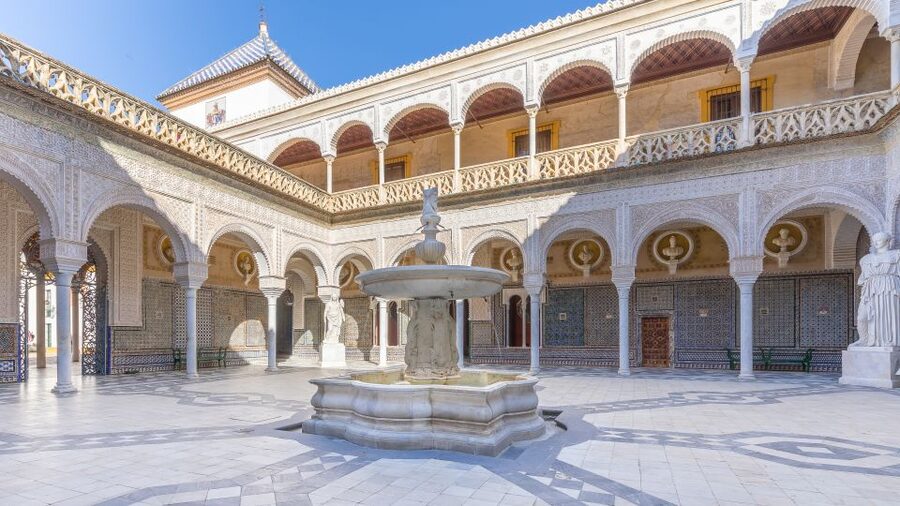
Seville keeps a quieter palace up its sleeve. Casa de Pilatos brings together Mudejar-Gothic tilework and Renaissance design in one compact, graceful residence, with Roman busts, carved stone ornaments, peaceful courtyards, and gardens to explore at your own pace. I especially like the beautiful glazed tiles and the calm central courtyard. The audio guide adds useful context without forcing you into a group schedule.
The main consideration is simple: this $14 ticket covers the ground floor only. The upper floor requires a separate tour, and several visitors wished they had added it. Still, the ground floor offers plenty to see, particularly if you want a quieter alternative to Seville’s Royal Alcázar.
In This Review
- Key points to know before you go
- Why Casa de Pilatos deserves a place in your Seville plans
- Entering through the Renaissance marble gate
- The central courtyard and its 24 Roman busts
- Tilework that rewards a slow walk
- The Chapel of Flagellation, the palace’s oldest section
- Pallas Pacifera and the palace’s Classical symbols
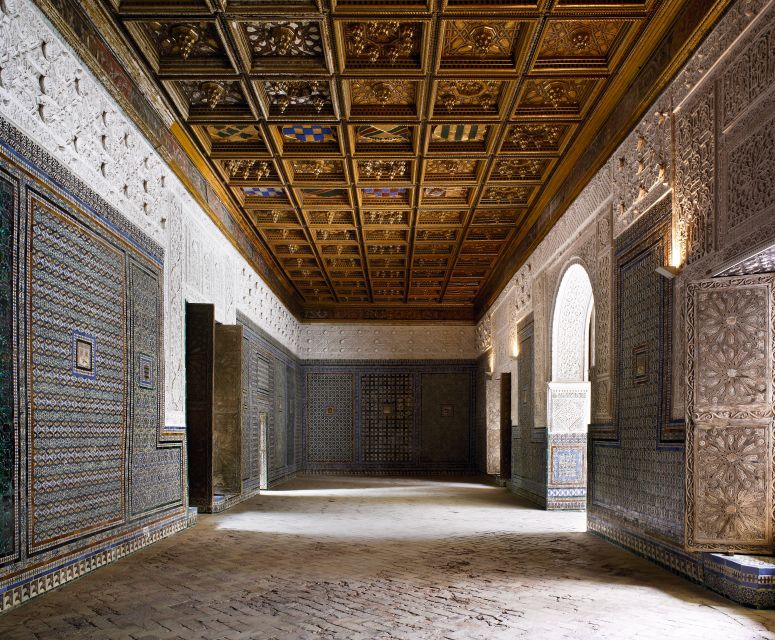
- The Salón del Pretorio and its coffered ceiling
- Drawing rooms, fountains, and smaller discoveries
- The gardens provide a quiet finish
- How long should you allow?
- Is $14 good value for the ground floor?
- Audio guide strengths and weak spots
- Who will enjoy Casa de Pilatos most?
- Practical booking advice
- Should you book this Seville palace ticket?
- FAQ
- What does the Casa de Pilatos ticket include?
- Is the upper floor included?
- Which languages are available for the audio guide?
- Is there a live guide included?
- When is the last entry?
- Can I enter for free on Monday?
Key points to know before you go
- The ground floor is built around a classic Andalusian courtyard, with fountains, tiled walls, and 24 busts of Roman emperors.
- The Chapel of Flagellation is the oldest part of the palace, showing Christian, Islamic, Mudejar-Gothic, and Renaissance influences side by side.
- The palace gardens are included, and they provide a welcome change from the decorated interior rooms.
- The audio guide is self-guided and available in seven languages, including English, Spanish, French, Portuguese, German, Japanese, and Italian.
- The visit is usually quieter than the Royal Alcázar, especially in the morning or around 2 PM, based on timing reported by recent ticket holders.
- The $14 ticket excludes the upper floor, so check what you want to see before booking.
Why Casa de Pilatos deserves a place in your Seville plans
Casa de Pilatos is not Seville’s largest palace. That is part of its appeal. The Royal Alcázar can feel grand and ceremonial, while Casa de Pilatos feels more personal, like an aristocratic home designed for daily life as well as display.
The Enríquez de Ribera family developed the palace in the 15th century, and it later became the largest private residence in Seville at the time. Its rooms show how wealthy families used architecture to announce taste, learning, faith, and political connections.
I like the way the building tells that story through details rather than huge rooms. You move from a tiled courtyard to a chapel, then into drawing rooms with decorated ceilings and Renaissance art. Each space is different, but the palace still feels coherent.
The design also reflects Seville’s position between cultures. Mudejar-Gothic forms sit beside Italian Renaissance ideas. Ceramic tiles cover walls and floors, while Classical sculptures bring in the world of ancient Rome and Greece. This mixture is not a small decorative touch. It is the reason the palace feels so distinctly Sevillian.
A few more Spain trips worth a look
- Seville: Royal Alcázar Entry Ticket
★ 4.6 · 28,378 reviews - Seville: Live Flamenco Dancing Show Ticket at the Theater
★ 4.7 · 16,396 reviews - Seville: 1-Hour Guadalquivir River Sightseeing Eco Cruise
★ 4.2 · 10,281 reviews
Entering through the Renaissance marble gate
Your visit begins at a detailed marble entrance in Renaissance style. It gives you an early clue about the family’s ambitions. This was not simply a comfortable house. It was a statement made in stone.
From there, the ground-floor route leads into the palace’s central areas. The layout is easy to follow, and the signs match the audio guide stops. A QR code system lets you listen as you move through the rooms, though you should expect a fairly detailed explanation rather than a short collection of quick facts.
That detail can be useful if you enjoy architecture and family history. I found it helps explain why the palace combines so many styles instead of treating the design as a series of pretty surfaces. If you prefer to look quietly, you can skip sections and continue at your own pace.
The self-guided format is one of the ticket’s strengths. You are not tied to a fixed group, and you can pause in a courtyard or spend extra time with a ceiling, sculpture, or tile panel. One visitor even spent several hours reading quietly in a window sill, which tells you something about the relaxed character of the place.
The central courtyard and its 24 Roman busts
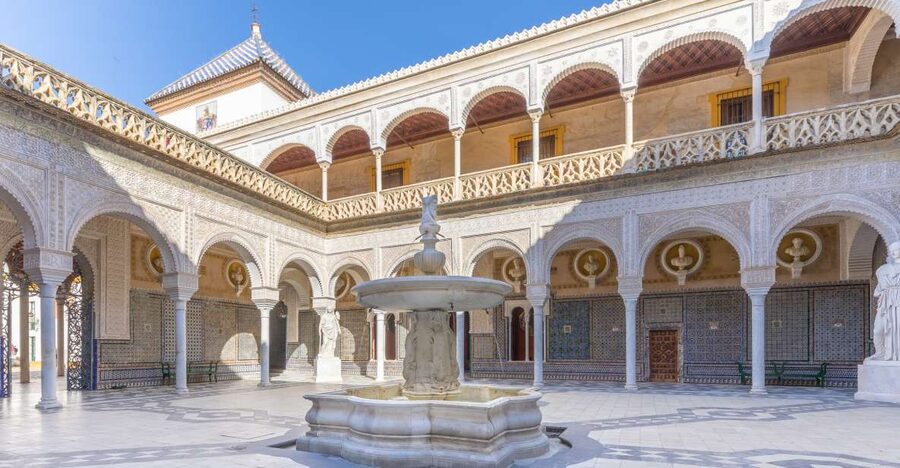
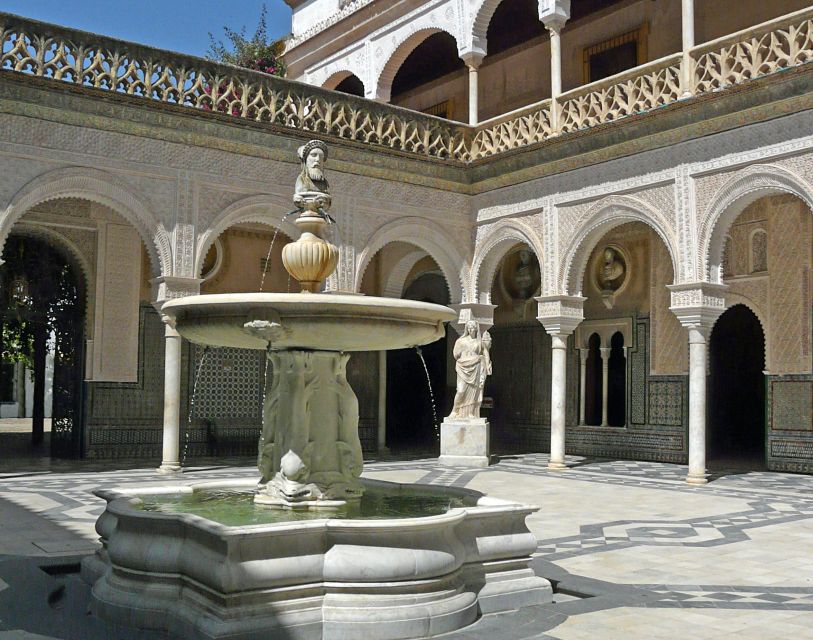
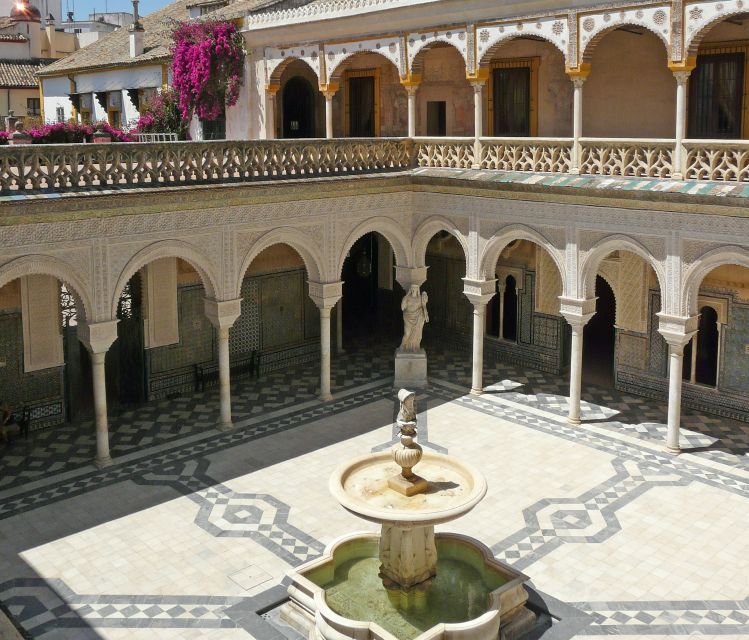
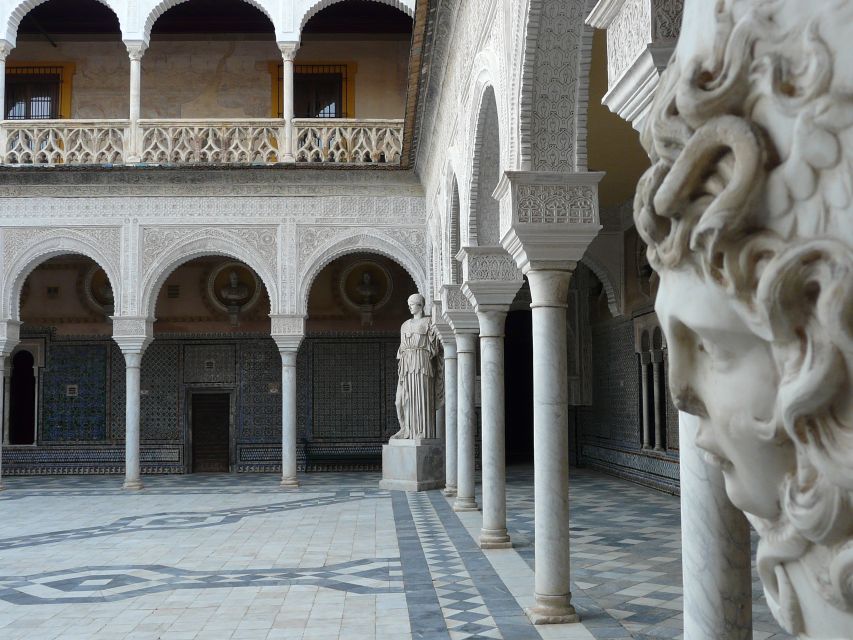
The main courtyard is the visual heart of Casa de Pilatos. It follows the familiar Andalusian pattern of an open space framed by columns, sculpture, water, and richly decorated surfaces.
The fountains help give the courtyard a cool, restful feel. Around it, you will see 24 busts of Roman emperors, a collection that gives the space the air of a private Classical museum. Among the named works are busts of Emperor Hadrian, Aphrodite, and Apollo, the god associated with music, poetry, and art.
This is a good place to slow down. The sculptures are not isolated in a modern gallery. They sit within the architecture, where stone, water, shadow, and patterned tile all work together. You can see how the family used ancient art to present itself as educated and connected to the wider European world.
The courtyard also makes a strong first impression because it brings several influences together at once. Gothic and Mudejar details meet Renaissance symmetry, while the tilework adds the color and pattern that many people associate with Andalusian palaces.
Tilework that rewards a slow walk
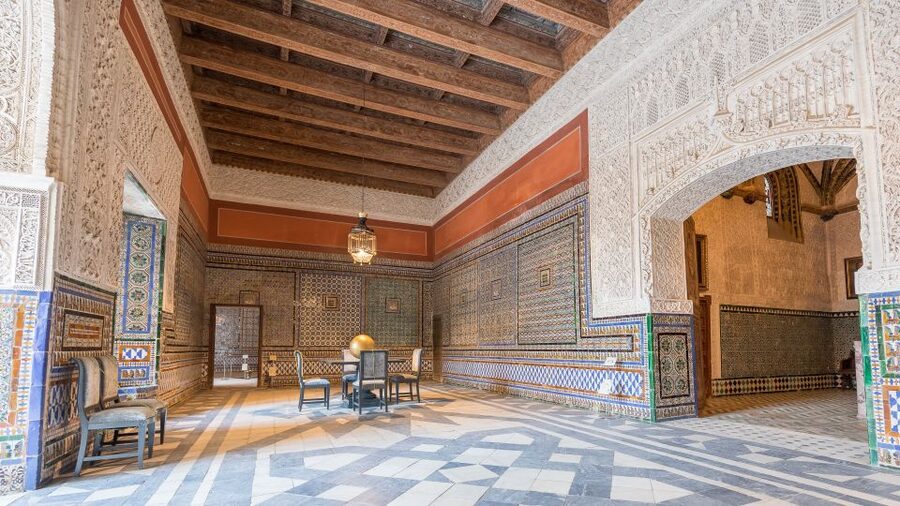
The glazed tiles are among the best reasons to buy this ticket. They appear on walls and floors throughout the palace, with changing patterns that reward close attention.
You will see traditional ceramic decoration in courtyards, passages, and rooms. Some areas feel formal and ordered, while others have more intricate geometric work. The tile surfaces are not just background decoration. They help tie the rooms together and show the importance of ceramic craft in Seville.
I recommend looking at the tiles from a distance first, then stepping closer to study the small changes in pattern. At a quick pace, you may simply register a beautiful wall. With more time, you can see how the repeated forms create rhythm across the building.
The palace is also significant because it helped introduce Renaissance style to Seville. That does not mean every room looks Italian. Instead, you see Renaissance ideas adapted to local materials and older Iberian traditions. This combination is much more interesting than a palace built in one clean style.
A completely different kind of day out in Seville:
- Seville: Cathedral, Giralda, and Royal Alcázar Guided Tour
★ 4.7 · 9,165 reviews - Seville: Setas de Sevilla Entry Ticket
★ 4.6 · 8,901 reviews - Seville: Cathedral, Giralda & Alcazar Entry With Guided Tour
★ 4.6 · 8,560 reviews - Seville: Priority Access Cathedral, Giralda & Alcázar Tour
★ 4.8 · 7,563 reviews
The Chapel of Flagellation, the palace’s oldest section
The Chapel of Flagellation is the oldest part of Casa de Pilatos. It is a small but important stop because it shows the building’s cultural crossover in a concentrated form.
Look for the ornate basket-handle arch and the mixture of Christian and Islamic influences. Mudejar-Gothic and Renaissance elements appear together, giving the chapel a layered appearance rather than a single unified style.
This is the kind of room where the audio guide earns its place. Without context, you might notice the arch and decoration but miss why the room matters. The explanation helps connect the palace’s early construction with the later Renaissance additions.
I would not rush through the chapel simply because it is smaller than the courtyard or drawing rooms. Its importance comes from its age and design. It shows that Casa de Pilatos was shaped over time, with later owners adding new ideas to an existing family residence.
Pallas Pacifera and the palace’s Classical symbols
The palace’s sculpture collection includes more than portrait busts. You will also see war ornaments associated with Pallas Pacifera, including a shield and helmet carved from stone.
These pieces bring a different mood to the visit. The Roman busts suggest learning and imperial authority, while the carved weapons refer to protection, strength, and the controlled use of power. The palace uses sculpture to communicate ideas about the family as much as to decorate the rooms.
Apollo, Aphrodite, Hadrian, and Pallas Pacifera all help create a Classical vocabulary across the building. You do not need specialist art knowledge to enjoy it, but the audio guide can help you understand why these figures were chosen.
The collection is a strong point for anyone who likes sculpture. If your main interest is only gardens or tilework, you can still appreciate the palace, but the statues add much of its intellectual character.
The Salón del Pretorio and its coffered ceiling
One of the most memorable interior stops is the Salón del Pretorio. Look upward here. The coffered ceiling is decorated with ornamental bows and carefully arranged details that are easy to miss if you keep your eyes at wall level.
This is a good room for taking your time. The palace’s lower floor is not a long procession of enormous halls. Its pleasure comes from collecting smaller discoveries, and the ceiling is one of them.
The audio guide provides information about the room and its decoration. Some people will appreciate the amount of detail, while others may find the narration too long or occasionally confusing. I suggest listening to the main explanation first, then deciding how much of the extra material you want.
The self-guided format works well here. You can stand beneath the ceiling without needing to keep pace with a group. That freedom matters in a building where looking upward is half the point.
Drawing rooms, fountains, and smaller discoveries
The drawing rooms continue the palace’s blend of domestic comfort and public display. These rooms help you understand that Casa de Pilatos was not designed only for formal ceremonies. It was also a home, and the arrangement around courtyards gives the building a more intimate scale.
Fountains appear in the courtyards, and sculpture is placed where it can be seen as part of everyday movement through the house. The effect is calmer than a palace filled with crowds and grand ceremonial spaces.
I like this part of the visit because it lets you compare the rooms rather than simply pass through one major attraction. The walls, ceilings, ceramics, and sculptures keep changing, so the ground floor feels more varied than its size might suggest.
The route is suitable for visitors who enjoy independent sightseeing. You can follow the signs and listen to the matching audio stops, or simply use the guide selectively. The system is generally easy to use, although you may need a moment to get used to moving between the QR codes and the correct sections.
The gardens provide a quiet finish
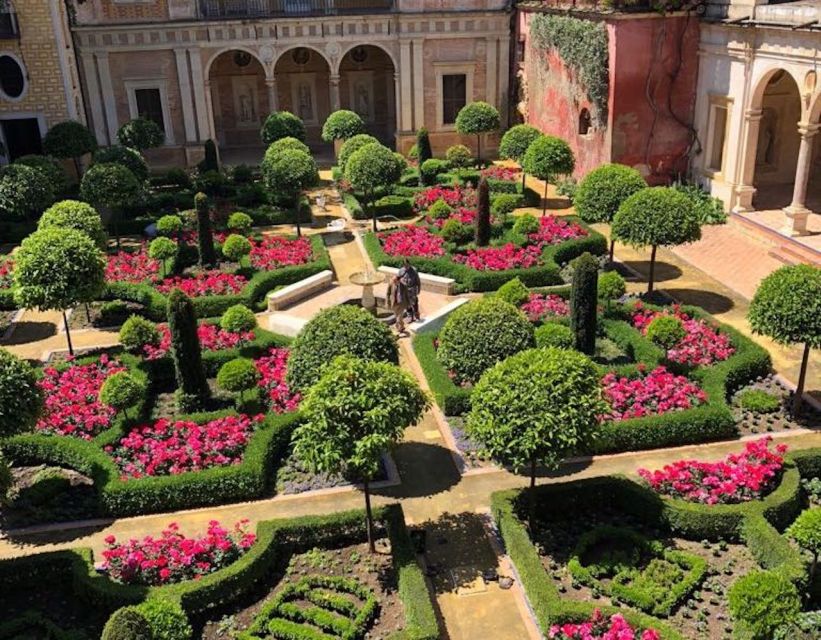
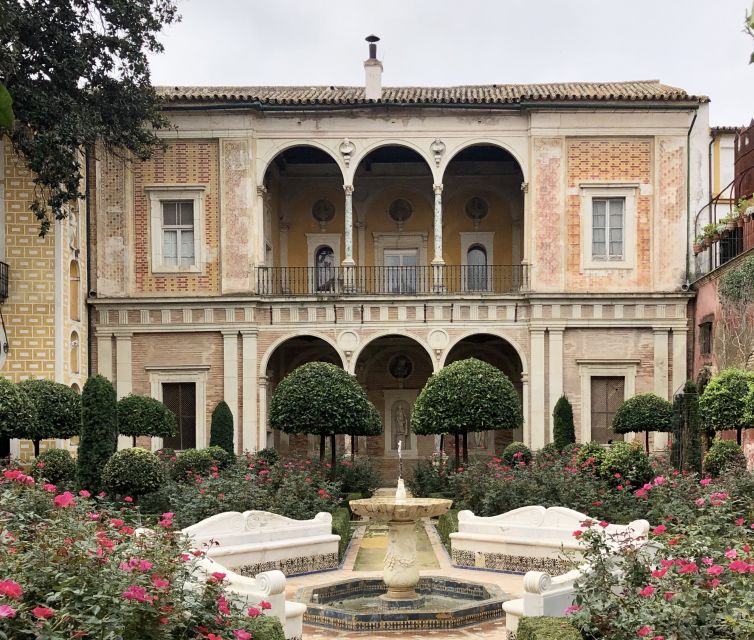
The palace gardens are included with the ground-floor ticket. They are designed in the Renaissance style and provide a welcome pause after the decorated interiors.
You can stroll among sculptures, planting, and garden features before returning toward the palace rooms. The gardens are not presented as a huge park. Their strength is the contrast they offer: after walls covered with tiles and rooms filled with art, you get open air, greenery, and space to breathe.
The gardens are particularly useful if you want a slower visit. Several people found Casa de Pilatos peaceful, and the garden areas are a major reason. They also give you a chance to look back at the palace as a whole rather than focusing only on individual objects.
If you are visiting Seville in August, keep the heat in mind. One visitor arrived around 3 PM and found the palace quiet, which made it easy to look around slowly, but the afternoon heat was intense. In warmer months, an early visit may be more comfortable.
How long should you allow?
The ticket is valid for one day, but that does not mean you need a full day at Casa de Pilatos. The time you spend depends on how carefully you use the audio guide and how long you pause in the courtyard and gardens.
A quick visit could cover the main rooms, sculptures, chapel, and gardens. If you enjoy architecture, you can easily stay much longer. The palace rewards an unhurried pace because the important details are on ceilings, tiles, arches, and carved objects.
Morning visits tend to be a good choice if you want a quieter experience. Early afternoon can also work well, particularly around 2 PM according to recent timing reports. Crowds may increase later in the afternoon when organized groups arrive.
The last entry from Tuesday through Sunday is at 5:30 PM. On Mondays, entry is free between 3 PM and 5:30 PM, so check the current conditions before paying for a Monday ticket.
Is $14 good value for the ground floor?
At $14 per person, the ticket is reasonably priced for a major historic residence, especially if you take time with the art, architecture, audio guide, and gardens. The palace offers more than a single photogenic courtyard.
The value becomes less clear if you expect access to the complete building. The upper floor is not included, and at least one visitor wished this had been clearer before arriving. Another added the upstairs visit on arrival and recommended seeing it, even though the available tour was in Spanish.
For many people, the ground floor is enough. It includes the palace’s most immediately appealing features: the central courtyard, tilework, sculpture, chapel, drawing rooms, ceilings, and gardens. If family history and a fuller view of the residence matter to you, ask about the upper-floor option when you arrive.
Compared with Seville’s larger and often busier monuments, Casa de Pilatos offers good value for a quieter visit. It is also a useful choice when you want a cultural stop that does not require a full morning.
Audio guide strengths and weak spots
The audio guide is included and can be used in Spanish, French, English, Portuguese, German, Japanese, and Italian. It covers the construction, rooms, artwork, and history of the palace in considerable detail.
I like having that information available because Casa de Pilatos is full of references that are easy to miss. The guide can explain a sculpture, identify a room, and connect the palace’s styles to Seville’s development.
The main weakness is length. Some sections are so detailed that you may lose track of what you are looking at. A few people found the commentary difficult to follow, while others considered it excellent and informative.
My practical advice is to treat it as a menu, not a lecture. Listen to the opening explanation for each area, pause when you want to look, and skip material that starts to feel too technical. The signs and QR codes make it possible to move through the palace without listening to every word.
Who will enjoy Casa de Pilatos most?
I recommend this experience to anyone who likes historic homes, decorative arts, sculpture, or architecture. It is especially good for you if the Royal Alcázar is crowded and you want a more measured visit with time to look closely.
Families and independent visitors may appreciate the flexible format. You are not required to stay with a guide, and the route is straightforward. People who prefer a live explanation may find the audio guide less satisfying, since no live guide is included with this ticket.
Photography-minded visitors should consider a morning or early afternoon time when the palace is quieter. The tiled courtyards, fountains, gardens, and ceilings offer plenty of attractive details without requiring a large site or a long walk.
I would pair Casa de Pilatos with the Royal Alcázar on the same day only if you have enough energy for two palaces. The contrast can be useful: Casa de Pilatos gives you a smaller private residence, while the Alcázar offers a larger royal setting.
Practical booking advice
You can cancel up to 24 hours in advance for a full refund, and the reserve-now, pay-later option keeps your plans flexible. The ticket has a one-day validity, with entry times depending on availability.
The host or greeter language is Spanish, but the audio guide covers the seven listed languages. This distinction matters if you expect a live introduction at the entrance.
For Monday visits, check the free entry period from 3 PM to 5:30 PM before booking a paid ticket. From Tuesday through Sunday, plan to arrive before the 5:30 PM last entry.
Should you book this Seville palace ticket?
Yes, if you want a beautiful, manageable palace with exceptional tilework, Classical sculpture, gardens, and a quieter mood than the Royal Alcázar. The $14 price is fair for the ground floor, and the audio guide gives you enough background to understand what you are seeing.
I would hesitate only if you specifically want the full residence or a live guide. In that case, ask about the upper floor before you enter. For everyone else, Casa de Pilatos is an easy addition to a Seville itinerary and one of the city’s most rewarding smaller sights.
FAQ
What does the Casa de Pilatos ticket include?
The ticket includes access to the ground floor of Casa de Pilatos and an audio guide.
Is the upper floor included?
No. The ticket covers the ground floor only. Access to the upper floor requires a separate tour or additional arrangement.
Which languages are available for the audio guide?
The audio guide is available in Spanish, French, English, Portuguese, German, Japanese, and Italian.
Is there a live guide included?
No live guide is included with this ticket. The host or greeter language is Spanish, while the main explanation is provided through the audio guide.
When is the last entry?
From Tuesday through Sunday, the last entry is at 5:30 PM.
Can I enter for free on Monday?
Yes. Entry is free on Mondays between 3 PM and 5:30 PM, according to the stated visitor information.
Recently added around Seville
- Art and Wine in Sevilla★ 5.0 · 165 reviews
- Seville: Cathedral and Alcázar Guided Tour★ 4.6 · 167 reviews
- From Seville: White Villages and Ronda Full-Day Trip★ 4.2 · 168 reviews
- Guided Tour Sevilla Cathedral★ 4.5 · 169 reviews
- Cathedral and Real Alcàzar in Italian★ 5.0 · 170 reviews
- Seville: Guadalquivir River Cruise with Lunch or Dinner★ 4.5 · 170 reviews
- White Villages and Ronda: Day trip from Seville.★ 4.7 · 171 reviews
- Private Walking Tour Alcazar and Cathedral in Sevilla★ 5.0 · 172 reviews
Seville Tours, compared.


Live Flamenco Dancing Show Ticket at the Theater
Read our review →
Cathedral, Giralda & Alcazar Entry With Guided Tour
Read our review →
Priority Access Cathedral, Giralda & Alcázar Tour
Read our review →

Puro Flamenco Show with Optional Museum Ticket
Read our review →
Alcázar and Cathedral Entry Ticket and Guided Tour
Read our review →Browse the lists this tour appears in