
Review · WORKSHOPS
Playa del Inglés Maspalomas: High Quality Surf Classes
Catch your first wave in Gran Canaria. This four-hour lesson from Surf Canaries gives beginners a friendly, well-organized introduction to surfing beside the Maspalomas dunes, with theory, video instruction, equipment, water, fruit, and photos included. I especially like the mobile beach setup, which lets instructors choose the best beginner conditions, and the hands-on coaching, with help available in the water rather than from a distant shoreline.
The price is $68 per person, a fair deal for a full half-day that includes transport when needed and all surf gear. I also like that the school has taught since 2007 and keeps the mood relaxed without treating safety as an afterthought. The main caution is physical: four hours of surfing can be tiring, and carrying a board for 10 to 20 minutes along the sand is part of the outing when Playa del Inglés is the chosen beach.
In This Review
- Key points at a glance
- Starting beside the Maspalomas dunes
- Why the mobile beach matters
- Getting fitted with the right equipment
- From beach practice to your first wave
- What the four hours really feel like
- A family-friendly lesson with clear limits
- Safety, insurance, and the classroom atmosphere
- Water, fruit, and photos after the first session
- Is $68 good value?
- Timing, cancellation, and what to bring
- Who should book this surf class?
- Should you book Surf Canaries?
- FAQ
- Do I need previous surfing experience?
- Where does the activity start and finish?
- Is transport to the beach included?
- How long is the surf class?
- What equipment is provided?
- Who cannot take part?
Key points at a glance
- Beginner theory comes first: You get a simple lesson and video introduction before entering the water.
- The beach can change: Surf Canaries travels to the best spot for the day, with transport included if the waves are better elsewhere.
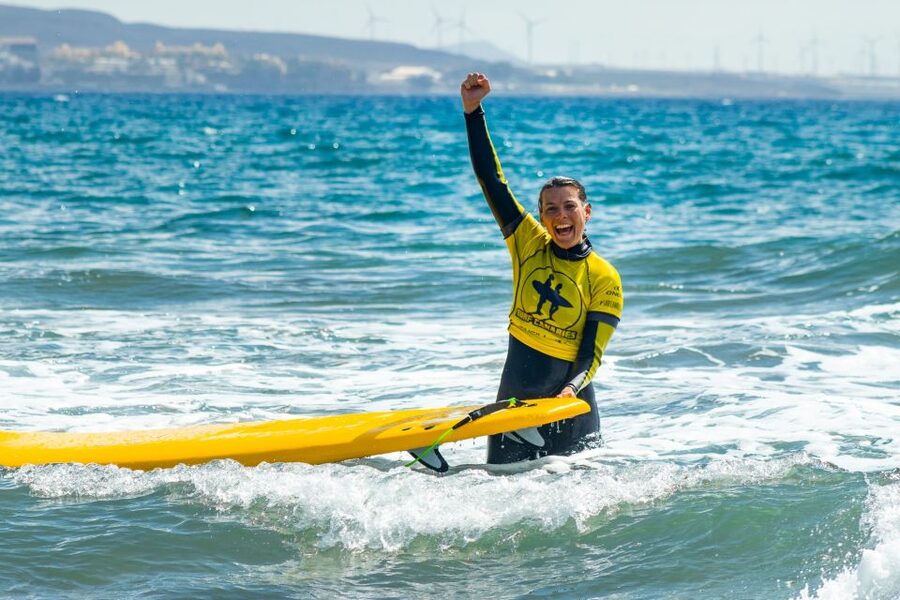
- First-day progress is realistic: Conditions are chosen for beginners, and many participants manage to stand on the board during their first session.
- Coaching stays personal: Small groups are available, and instructors work with you in the water throughout the lesson.
- Photos cost nothing extra: You receive surfing photos to take home, along with water and fruit after the first session.
- The workout is real: You should be reasonably fit, comfortable in the water, and ready to get thoroughly wet.
Starting beside the Maspalomas dunes
You begin at Surf Canaries Surf School on Alf. Provisionales, Anexo 2, in Playa del Inglés. The meeting point sits close to the famous Maspalomas sand dunes, so the setting feels more like a beach day than a formal sports appointment.
The first part takes place at the school. This is not a quick handover of a board followed by a dash to the water. You receive a theory session that covers the basic mechanics of surfing, followed by video tips that show how to position yourself and get up safely.
That preparation matters. For a first-time surfer, the hardest part is often knowing what to do before the wave reaches you. A clear demonstration gives you something to copy once you are wet, tired, and trying to remember which foot goes forward.
The tone is intended to be relaxed and entertaining. That helps if you arrive nervous. Surfing has a slightly comic first stage for almost everyone, with the board moving one way and your balance moving another. A good introduction lets you make those early mistakes with a better idea of what you are trying to achieve.
More surf lessons:
- Gran Canaria Maspalomas: Surf lessons all levels
★ 5.0 · 197 reviews - Group Surfing Lesson at Playa de las Américas, Tenerife
★ 5.0 · 1,072 reviews - Playa de las Américas: Private or Small-Group Surf Lesson
★ 4.8 · 980 reviews
Why the mobile beach matters
Surf Canaries does not promise to use one fixed beach every day. The instructors check the conditions and choose the spot that offers the most suitable waves. If another beach has better conditions, transport is included.
That flexibility is one of the strongest parts of the experience. Surfing depends on wind, swell, tide, and the shape of the beach. A school that can adjust its location has a better chance of finding manageable waves than one tied to a single stretch of sand.
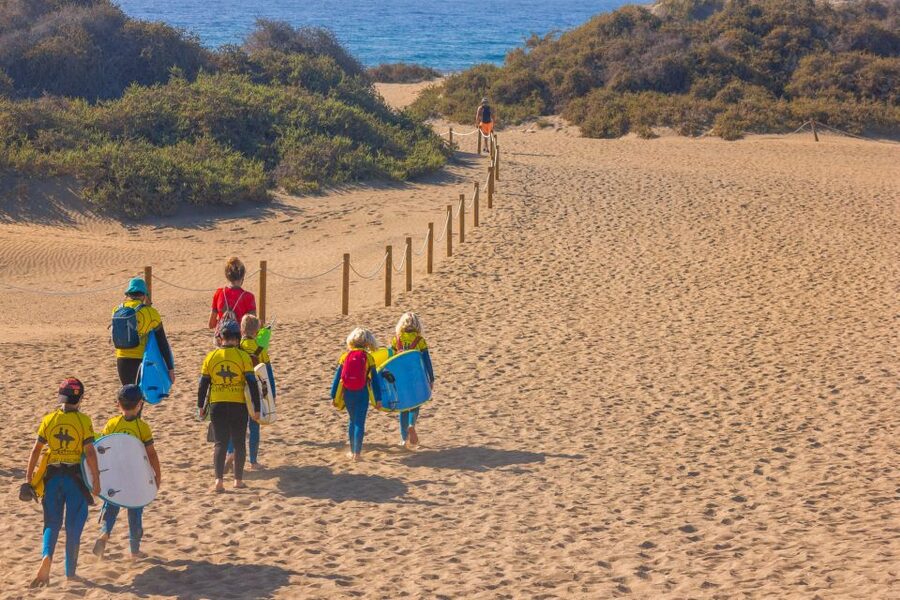
If Playa del Inglés has the right conditions, you walk there with your board. The walk can take 10 to 20 minutes, depending on where the waves are breaking. You carry the board across the sand, so this is not a free shuttle in every case. Most people in reasonable physical condition should manage it, but it is worth knowing before you book.
The walk is also a practical part of the lesson. You are not stepping from a changing room directly into the sea. You will carry equipment, cross sand, and spend a long period moving your body. Bring only what you need, use sunscreen, and expect the beach transfer to feel like part of the workout.
Getting fitted with the right equipment
The $68 price includes the main items you need:
- Surfboard and leash
- Rash vest
- Long or short wetsuit
- Surf instruction
- Third-party and accident insurance
- Water and fruit
- Photos of you surfing
- A 10 percent shop discount
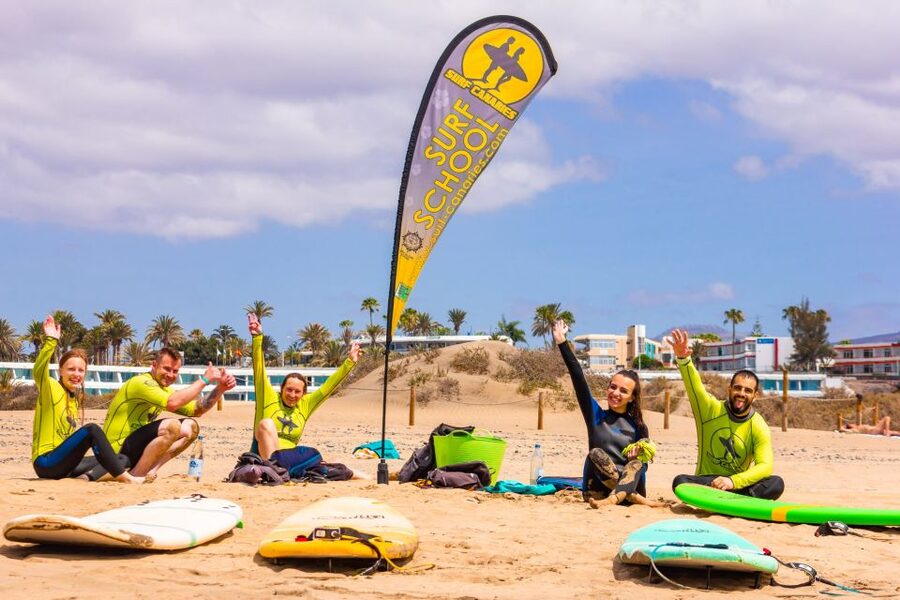
You do not need to pack your own board or wetsuit. The school supplies the equipment and fits you out before the water session. The rash vest helps identify the group and adds a small layer of protection, while the wetsuit makes a long session more comfortable.
The choice between a long or short wetsuit depends on the conditions and the equipment provided that day. You should bring swimwear to wear underneath, plus a towel for afterward. A hat, sunscreen, and passport or identity card, or a copy, are also required items to have with you.
The included photos add real value. Surfing is difficult to watch while you are doing it, and most first sessions pass in a blur of paddling, falling, standing, and trying again. Photos give you a record of the day, including the moments when your technique looks better than it felt.
From beach practice to your first wave
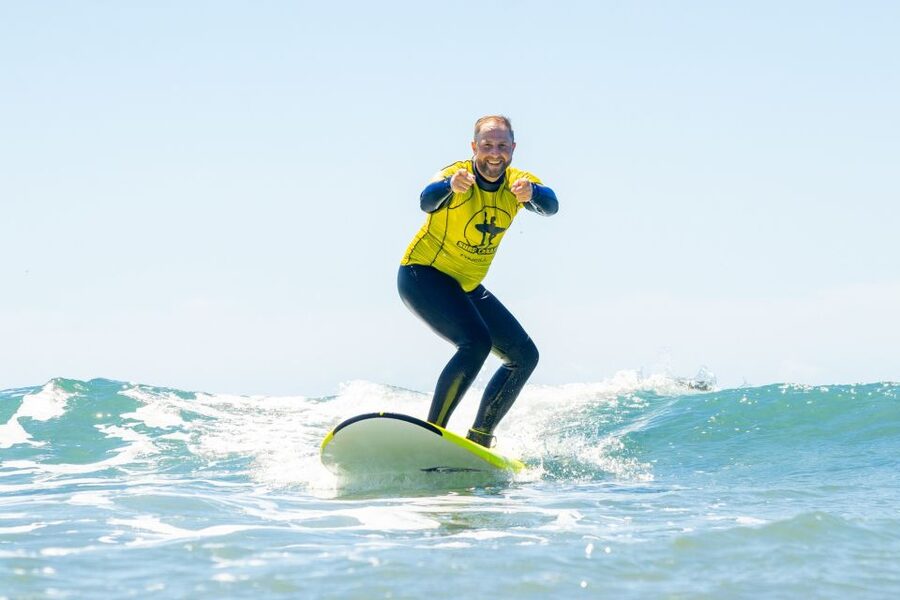
Before you enter the water, the instructors explain how to handle the board and how to move from lying down to standing. You practice the basic body position and the sequence needed to rise without losing the board beneath you.
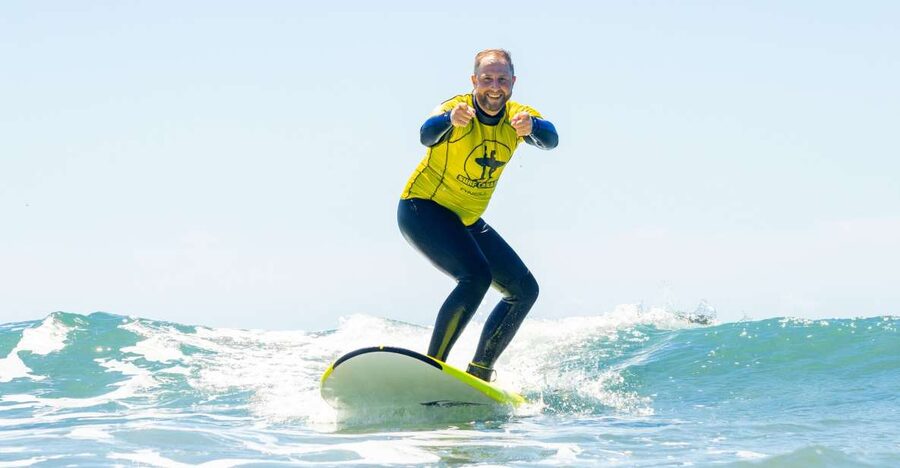
The goal is not to make you an expert in one morning. It is to give you a safe first taste and enough basic skill to catch a few small waves. The class is designed around beginner conditions, so you are not expected to paddle into powerful surf or manage a complicated lineup.
Once in the water, instructors remain close and help you choose the right moment. That personal attention is especially useful during the first attempts. You may understand the theory perfectly on the beach and still freeze when a wave lifts the board. A nearby instructor can give you a quick correction, encouragement, or push in the right direction.
The school’s most praised quality is its patience. Instructors explain techniques in simple terms, demonstrate them clearly, and continue helping during the water session. If you are in a small group, you should receive more individual feedback. Small groups are available, though the basic booking information does not promise that every session will have the same group size.
Many beginners manage to stand on the board on their first day. That is a reasonable hope, not a guarantee. Your result will depend on the conditions, balance, fitness, and how quickly you relax on the board. Even if you spend much of the session falling, you will still learn how to read the wave, control the board, and try again.
A few more Spain trips worth a look
- Barcelona Paella Cooking Class with Market Visit, Tapas & Sangria
★ 5.0 · 2,531 reviews - Spanish Cooking Class Paella Tapas and Sangria in Madrid
★ 5.0 · 1,340 reviews - Madrid: Paella and Sangria Workshop in the City Center
★ 4.9 · 1,264 reviews - Paella Cooking Class, Wine Tasting & Central Market in Valencia
★ 5.0 · 1,150 reviews
What the four hours really feel like
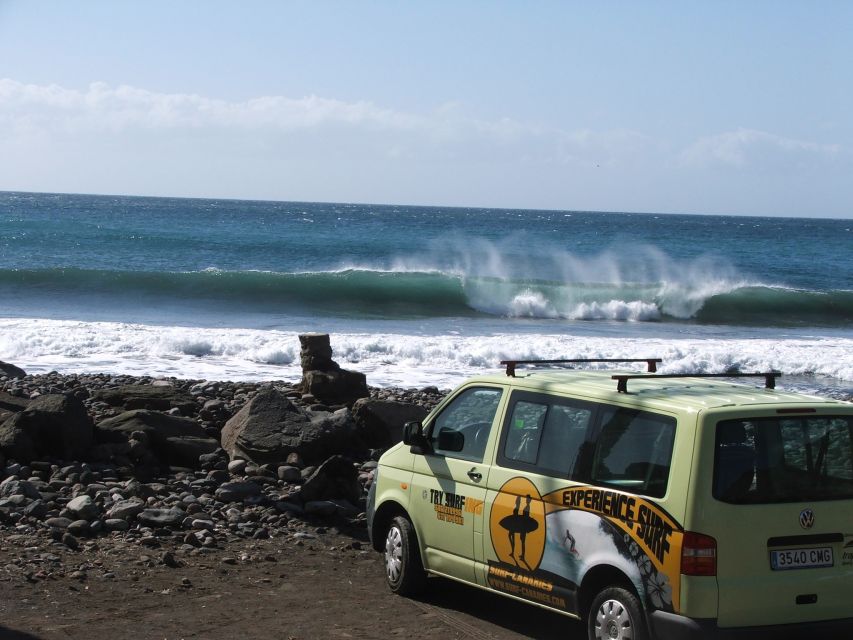
Four hours sounds generous, and it is. This is a full activity, not a brief 60-minute introduction added between beach lounging and lunch.
The time includes the school introduction, theory, video guidance, equipment preparation, the walk or transport to the beach, and the water lesson. You should expect the session to use most of the stated four hours from start to finish.
That length gives the instructors time to work with different ability levels. A complete beginner may need several attempts just to feel stable on the board. A child or older participant may need more rest and repeated demonstrations. A longer class allows for this without making the session feel rushed.
It also makes the class demanding. Surfing uses your arms, shoulders, stomach, legs, and back. Paddling through shallow water, pushing yourself up, standing, falling, and carrying the board all add up. One participant described the lesson as a serious workout, and that is useful advice rather than a complaint.
You should be in reasonable to good physical condition. The activity is not suitable for people with a low level of fitness, back problems, or a weight above 110 kilograms. It is also not suitable for non-swimmers, wheelchair users, or pregnant women.
A family-friendly lesson with clear limits
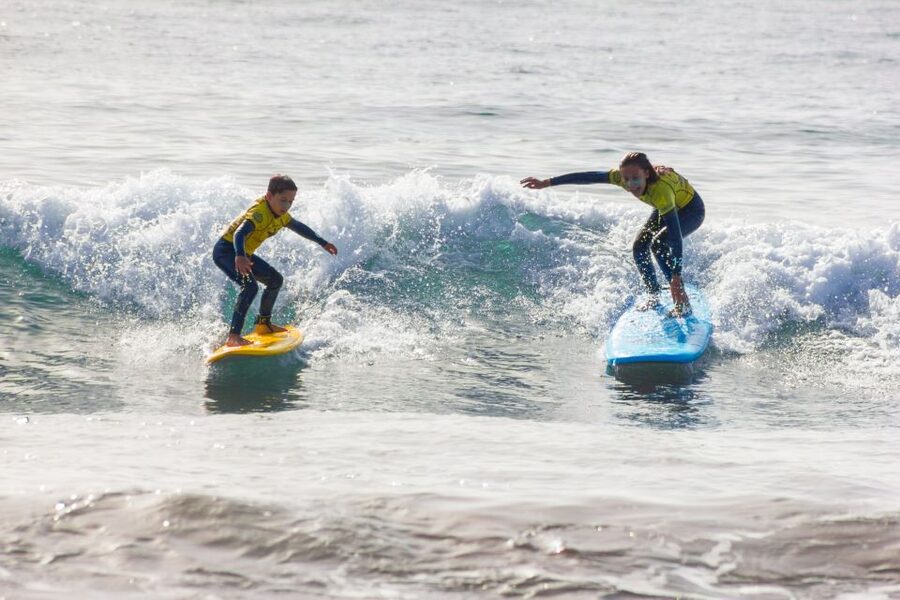
Children under seven cannot take part. Older children can join if they meet the physical and swimming requirements, and the class has worked well for families with children aged 10, 12, 13, and 14.
The teaching style is patient enough for younger first-timers. Parents should still remember that this is an active four-hour class, not a supervised beach play session. Children need to be able to follow instructions, manage the equipment, and cope with repeated falls in the water.
Adults should not assume the lesson is too physical for them. A fit 61-year-old participant completed the class and encouraged other older beginners to try it. Age alone is not the deciding factor. Comfort in the water, general fitness, and a willingness to keep trying matter more.
You may also collect a few bruises. That can happen during a first surf session as you learn how to move with the board. Wear the supplied equipment correctly, listen closely to the instructor, and accept that falling is part of the process.
Safety, insurance, and the classroom atmosphere
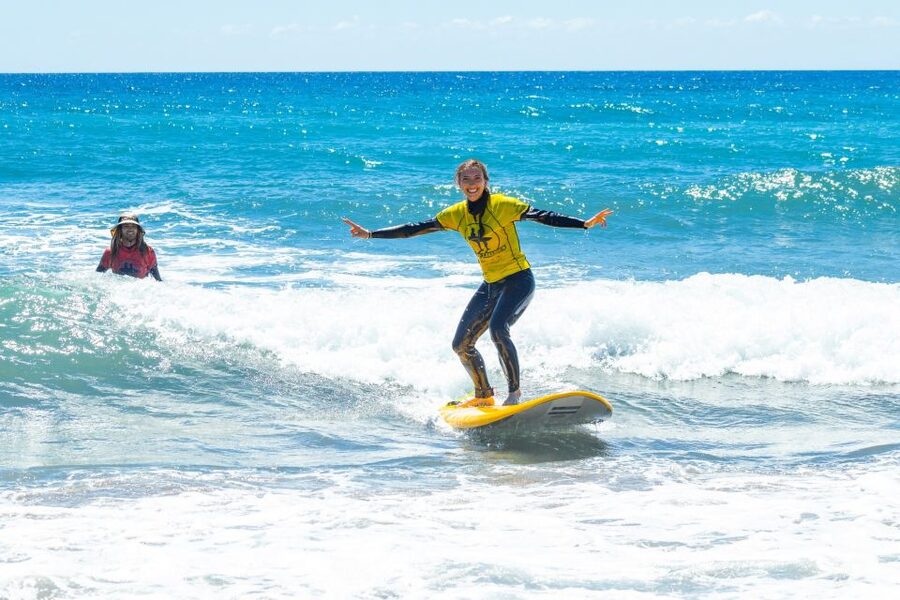
The experience includes third-party and accident insurance, but insurance does not replace sensible preparation. Tell the instructors if you have any relevant health concerns, and do not book if you cannot swim or have a condition that makes the physical work unsuitable.
The school’s approach combines safety with an upbeat atmosphere. Instructors stay involved in the water, rather than leaving you to figure things out after a short beach briefing. That is important for first-timers, since conditions can change quickly and beginners often lose track of the board when a wave arrives.
The school teaches in Spanish and English. The instruction is described as clear and simple, which helps if English is not your first language. The video introduction also gives you a visual reference instead of relying only on spoken directions.
Surf Canaries also has an environmentally responsible touch, including water served in glass bottles. It is a small detail, but it shows attention to how an outdoor activity affects the beach and the people using it.
Water, fruit, and photos after the first session
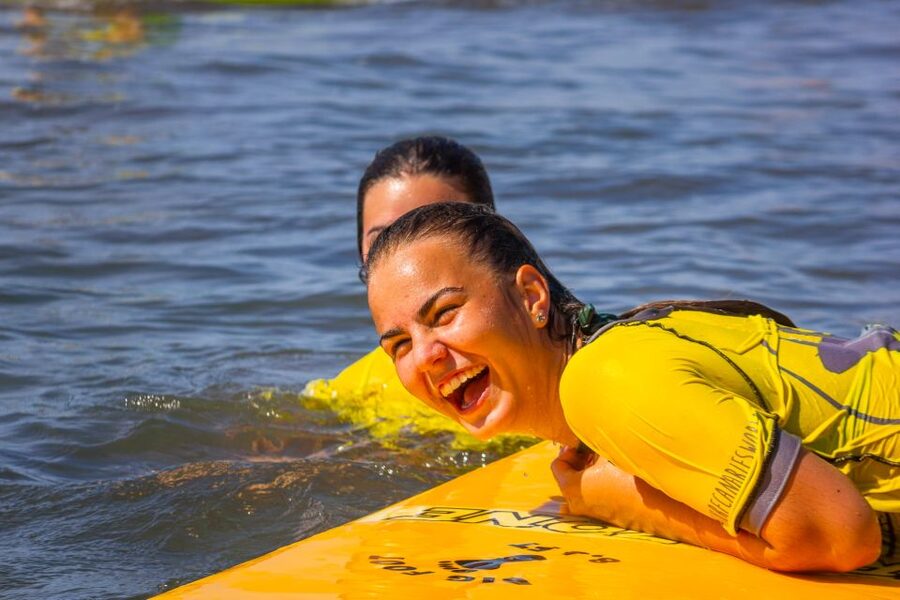
After the first session, the school provides water and a piece of fruit. That is welcome after several hours of exertion, though you should not treat it as a full meal. Have breakfast beforehand and plan what you will eat after the class.
The photos are another useful extra. You do not have to hold a phone near the water or ask a companion to miss the lesson while taking pictures. You can focus on the coaching and still leave with images of the experience.
The photos may capture the full range of the day, including wipeouts and awkward attempts. That is part of the fun. A first surf lesson is rarely polished, and the most memorable image may be the one just before you fall.
A 10 percent shop discount is included as well. You might use it for a cap or another small souvenir, but the discount should be treated as a bonus rather than a reason to book.
Is $68 good value?
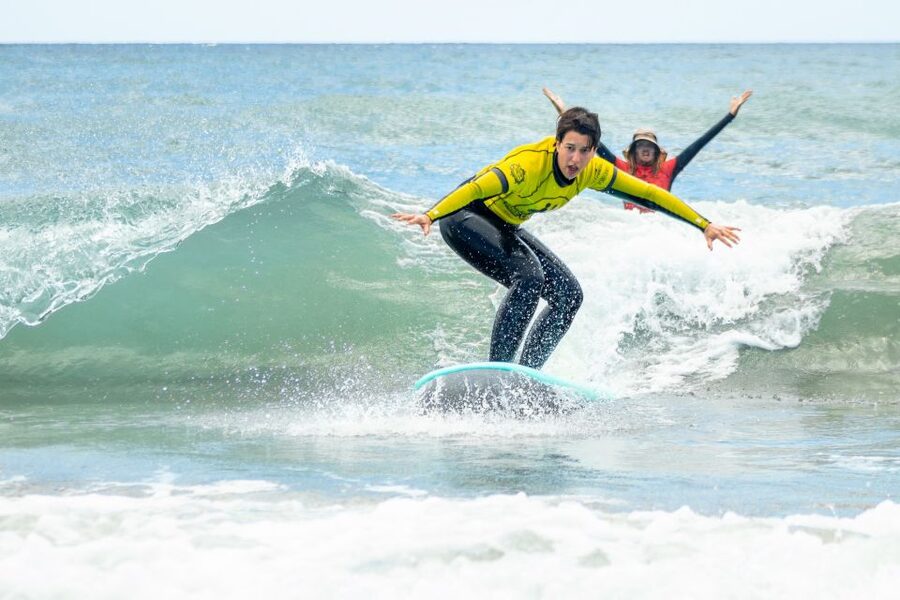
I consider $68 a solid price for this particular package. You receive four hours of instruction, all equipment, transport when the best beach is elsewhere, water, fruit, photos, insurance, and a shop discount.
The value improves if you are starting from zero. Renting equipment on your own would not give you the safety briefing, beach selection, or direct help catching waves. The school also saves you from guessing which board, wetsuit, or beach suits the conditions.
The price is less attractive if you want only a quick novelty activity or if you are unsure about committing half a day to a physical sport. You may spend much of the time falling, paddling, or waiting for the right moment. That is normal, but it can feel like hard work if you expected a relaxed excursion.
For someone who wants an active break from sunbathing and sightseeing, the cost is reasonable. The free photos and included gear remove several small expenses that can add up elsewhere.
Timing, cancellation, and what to bring
Starting times can vary slightly, so check the available time before booking and keep some flexibility in your holiday schedule. The surf day depends heavily on sea conditions, and the chosen beach may change.
You can cancel up to 24 hours in advance for a full refund. The reserve-now, pay-later option also helps if your plans are not fixed.
Bring:
- Swimwear
- Towel
- Hat
- Sunscreen
- Passport or identity card, or a copy
Wear practical clothing for the meeting point and avoid carrying valuables. You will be handling a board and spending time in the water, so simple preparation makes the day easier.
Who should book this surf class?
I would choose this class if you are a first-time surfer who wants proper instruction rather than a quick photo opportunity. It is also a good fit for couples, families with children over seven, and active older adults who can swim and handle a demanding four-hour session.
The experience suits you especially well if you like having a plan but still want conditions to guide the day. The mobile format means the instructors can move to a better beginner beach, while the school setting gives you a clear starting point.
I would hesitate if you have a low fitness level, back problems, trouble swimming, or limited mobility. I would also think twice if you dislike carrying equipment across sand or getting repeatedly knocked off a board.
Should you book Surf Canaries?
Book it if you want to try surfing properly during your Gran Canaria holiday. The strongest reasons are the beginner-focused theory, patient water coaching, flexible beach choice, and useful extras included in the price.
Go in expecting a workout, not a gentle beach pastime. If you arrive prepared to fall, laugh, listen, and try again, you have a good chance of standing on a board and leaving with both photos and a new skill to practice.
FAQ
Do I need previous surfing experience?
No. The class is designed for beginners and includes a theory lesson and video introduction before you enter the water.
Where does the activity start and finish?
You check in at Surf Canaries Surf School, Alf. Provisionales, Anexo 2, Playa del Inglés. The activity ends back at the same meeting point.
Is transport to the beach included?
Yes, transport is included if the best surf conditions are at another beach. If Playa del Inglés has the best waves, you walk there with your board.
How long is the surf class?
The full activity lasts four hours. Starting times can vary slightly, so check availability for the schedule on your chosen date.
What equipment is provided?
The school provides a surfboard, leash, rash vest, and either a long or short wetsuit. Instruction, accident and third-party insurance, water, fruit, and surfing photos are also included.
Who cannot take part?
The activity is not suitable for children under seven, pregnant women, people with back problems, wheelchair users, non-swimmers, people with a low fitness level, or anyone weighing over 110 kilograms.
Recently added around Gran Canaria
- Las Palmas: Private Old City Guided Walking Tour with Tapas★ 4.6 · 166 reviews
- 2-Hour Dolphin and Whale Watching in Gran Canaria★ 4.0 · 166 reviews
- Arucas, Teror, Viewpoint Roque Nublo – Highlights Gran Canaria★ 4.5 · 170 reviews
- Sioux City Park Entrance Ticket★ 4.5 · 171 reviews
- Firgas, Tejeda, Guayadeque – VIP Tour Gran Canaria★ 4.5 · 173 reviews
- Can-am Ryker three wheels tricycle Mountain Tour (Maspalomas)★ 5.0 · 175 reviews
- Sailing Trip and Snorkeling (max. 8 people)★ 5.0 · 181 reviews
- Guided Tour at Ron Arehucas Distillery★ 4.5 · 192 reviews
Workshops, compared.

Barcelona Paella Cooking Class with Market Visit, Tapas & Sangria
Read our review →
Spanish Cooking Class Paella Tapas and Sangria in Madrid
Read our review →
Paella and Sangria Workshop in the City Center
Read our review →
Paella Cooking Class, Wine Tasting & Central Market in Valencia
Read our review →
Group Surfing Lesson at Playa de las Américas, Tenerife
Read our review →

Paella Cooking Class in Madrid with Bottomless Wine Pairing
Read our review →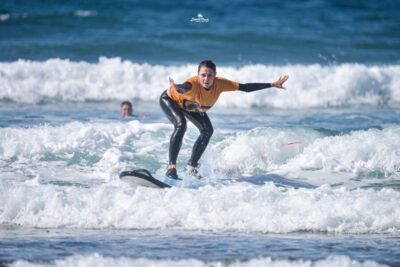
Playa de las Américas: Private or Small-Group Surf Lesson
Read our review →Browse the lists this tour appears in